
Last updated: June 18, 2026
This price guide is informational and does not recommend a specific breeder, seller, rescue, financing product, or puppy listing. Verify current prices, contracts, health records, and local rules before paying. See the affiliate disclosure and health disclaimer.
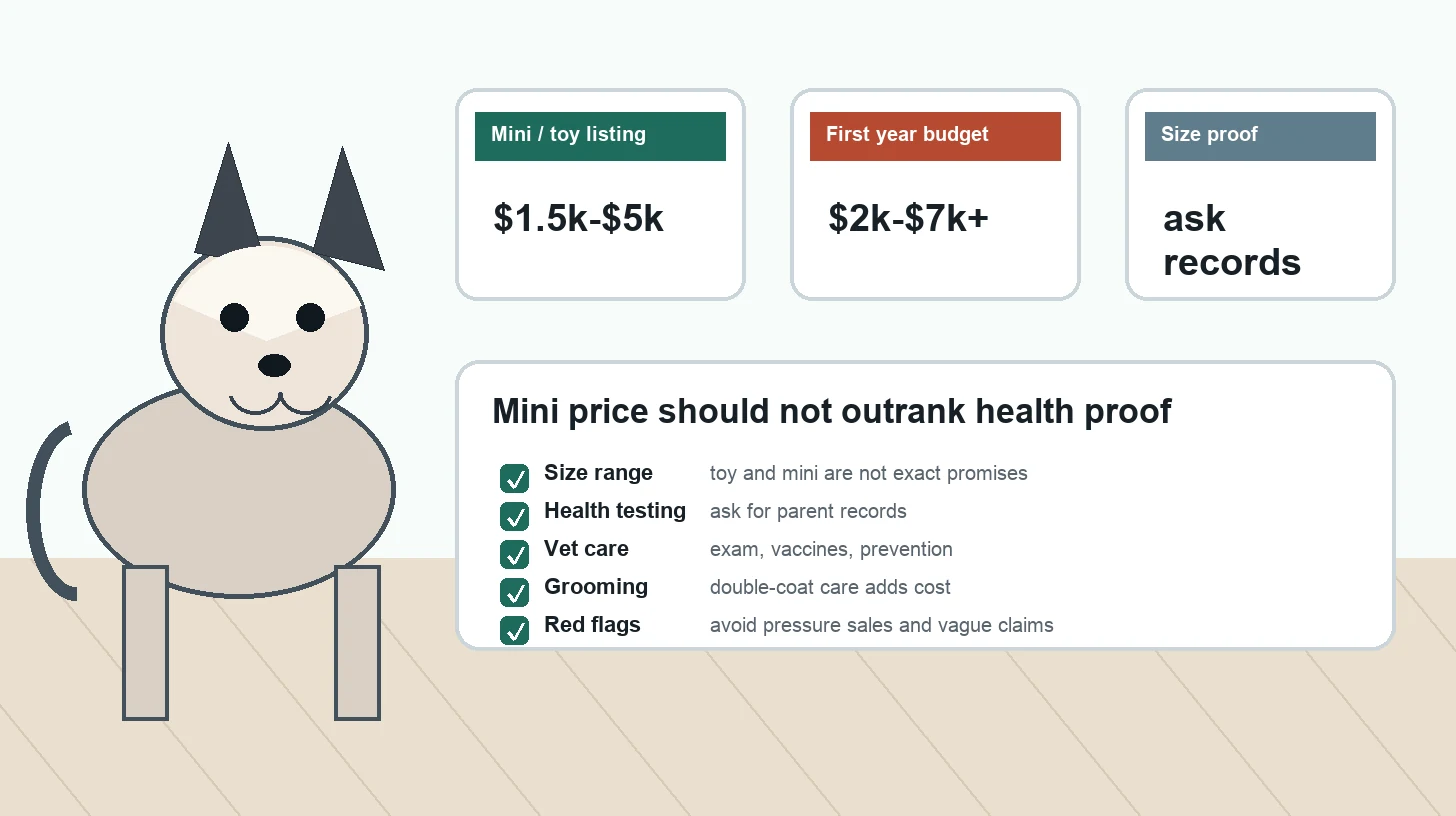
Quick answer: a mini Pomsky often costs about the same as other Pomsky puppies, commonly advertised around $1,500 to $5,000 in the United States. Small size can raise demand, but it should not be treated as a guarantee of health, adult weight, temperament, or value. Budget for the puppy, the first year, and ongoing care.
The safest way to think about mini Pomsky price is to separate three things: the advertised puppy price, the evidence behind the seller's claims, and the total cost of ownership. A smaller Pomsky can be a good companion, but "mini" or "toy" wording should make you ask more questions, not fewer.
How Much Is a Mini Pomsky?
Mini Pomskies are usually priced inside the broader Pomsky market rather than in a separate fixed category. Many listings sit in the low thousands of dollars, and a practical planning range is $1,500 to $5,000 for many breeder puppies. Adoption, older puppies, and special placements can cost less, while premium listings can be higher.
| Mini Pomsky price point | What it may mean | What to verify first |
| Under $1,000 | Adoption, older puppy, urgent placement, or possible scam hook | Seller identity, live verification, vet records, contract, and no pressure payment |
| $1,500-$3,000 | Common advertised range for many Pomsky puppies | Parent information, health screening, included care, and pickup terms |
| $3,000-$5,000 | Often tied to demand, small size, markings, location, or breeder program | Whether the price reflects documented care, not only "mini" wording |
| Over $5,000 | Premium listing or unusually high demand claim | Written contract, health testing, refund terms, and exactly what is included |
Mini Pomsky Size Facts
APKC's 2025 standard separates Pomskies by height. It lists toy Pomskies at 11 to 13 inches at the shoulder, with an average weight range around 7 to 15 pounds, and mini Pomskies at 13.01 to 16 inches, with an average weight range around 12 to 20 pounds. Standard Pomskies are larger.
| Category | Height at shoulder | Average weight range | Buyer note |
| Toy Pomsky | 11-13 inches | About 7-15 pounds | Very small size needs careful, realistic expectations |
| Mini Pomsky | 13.01-16 inches | About 12-20 pounds | Compact, but not a guaranteed exact adult weight |
| Standard Pomsky | 16.01-18 inches | About 20-35 pounds | Still smaller than many Siberian Huskies |
Price can rise when a seller advertises a puppy as tiny, toy, mini, micro, or teacup. That does not make the puppy better. Ask whether the seller is using APKC-style size categories, what size the parents and mature relatives are, and whether the adult range is an estimate rather than a promise.
What Changes a Mini Pomsky Price?
The price of a mini Pomsky usually changes with breeder practices, veterinary care, location, parent size, expected adult range, coat pattern, eye color, generation, demand, transportation, and included support. The best reason to pay more is documented care and accountability, not a vague claim that the puppy is rare.
- Health testing: responsible breeders should be able to discuss health screening and parent information.
- Veterinary care: exams, vaccines, parasite prevention, microchip, and records may be included.
- Location: prices and demand differ by region, and transport can add cost.
- Size and coat: smaller size, blue eyes, merle coats, and heavy markings can raise advertised prices.
- Contracts: spay/neuter, return, health guarantee, and breeder support terms matter more than slogans.
- Availability: waitlists and seasonal demand can move prices up or down.
Mini Pomsky Purchase Price vs First-Year Cost
The puppy price is only the entry fee. First-year dog costs can include veterinary exams, vaccines, parasite prevention, food, training, grooming, crate, harness, leash, bowls, toys, bedding, licensing, insurance, boarding, and emergency savings. Dog cost surveys from consumer pet-care sources show first-year ownership can run into several thousand dollars depending on location and choices.
| Cost category | Why it matters for a mini Pomsky | Budget note |
| Veterinary care | Puppy exams, vaccines, deworming, prevention, and illness checks | Do not skip because the puppy was expensive |
| Food | Growing puppies need complete and balanced growth nutrition | Measure portions and expect needs to change |
| Grooming | Many Pomskies have dense coats that need brushing and periodic grooming | Budget tools plus possible professional grooming |
| Training | Husky/Pomeranian traits can make early training valuable | Group classes or private help may prevent larger problems |
| Supplies | Crate, bed, harness, leash, bowls, toys, chews, cleaner | Buy safe basics before optional gear |
| Insurance or emergency fund | Unexpected vet care can cost more than routine care | Plan before an emergency happens |
Is a Mini Pomsky Cheaper Than a Standard Pomsky?
A mini Pomsky is not automatically cheaper than a standard Pomsky. In some markets, small size can increase demand and price. In other situations, an older puppy, adult dog, rescue dog, or less in-demand coat color may cost less. The label alone does not tell you whether the price is fair.
If you want a smaller Pomsky, compare the evidence behind the expected size. Parent height and weight, mature relatives, growth records, and the breeder's past outcomes are more useful than a puppy photo. No seller can honestly guarantee an exact adult weight from a young puppy.
Breeder Price vs Adoption Fee
Buying from a breeder usually costs more upfront than adoption or rescue. Adoption can be less expensive, but mini Pomsky availability is unpredictable and the dog may be older, mixed beyond a clear Pomsky label, or have unknown history. Adoption also does not remove normal care costs.
| Option | Typical advantage | Main caution |
| Responsible breeder | More information about parents, early care, and expected traits | Higher purchase price and need to verify claims |
| Rescue or adoption | Often lower upfront fee and helps a dog needing a home | Availability and background information vary |
| Online classified listing | Easy to find many puppies quickly | Higher scam and poor-breeding risk if records are vague |
What Should Be Included in the Price?
A mini Pomsky listing should clearly explain what is included. If the price is high, the documentation should be stronger, not weaker. Ask for records before paying a deposit and keep a copy of every promise in writing.
- Written contract and return policy.
- Veterinary exam record and vaccine/deworming history.
- Microchip information, if included.
- Parent information and available health screening details.
- Feeding schedule and transition food instructions.
- Expected adult size range and the evidence behind it.
- Pickup, transport, or delivery terms.
- Support after the puppy goes home.
Questions to Ask Before Paying a Deposit
Before sending money, ask for clear answers and written documentation. AKC breeder guidance emphasizes meeting the breeder, asking questions, reviewing records, and understanding the breeder's commitment to the dogs.
- Can I see the contract before paying a deposit?
- What health testing or screening was done on the parents?
- What veterinary care has the puppy already received?
- Can I see vaccine, deworming, microchip, and exam records?
- What happens if a health problem appears after purchase?
- Are you calling this puppy toy, mini, micro, or teacup, and what do those terms mean in your program?
- What adult size range do you expect and why?
- How are puppies socialized before going home?
- Do you take the dog back if the owner can no longer keep it?
- Can I meet the breeder by video or in person before final payment?
- What payment methods are accepted, and are they refundable?
Mini Pomsky Price Red Flags
A suspicious seller may advertise a beautiful tiny puppy at a bargain price, pressure you to send money quickly, avoid live calls, reuse photos, or give vague health answers. Walk away if the seller cannot provide basic records or pushes payment before you can verify the puppy and contract.
- Only accepts irreversible payment or gift cards.
- Refuses video, phone, or in-person verification.
- Uses the same photos across many listings.
- Uses "micro," "pocket," or "teacup" as the main proof of value.
- Has no written contract or return policy.
- Cannot provide veterinary records before pickup or delivery.
- Pushes immediate shipment without a safe plan.
Is a More Expensive Mini Pomsky Better?
A more expensive mini Pomsky is not automatically better. A higher price can reflect health testing, veterinary care, socialization, breeder support, and responsible placement, but it can also reflect demand for color, eyes, or size. Compare documentation, not only price.
For buyers, the strongest value is a puppy whose breeder can explain parent health, expected size, contract terms, early care, and what support remains after the sale. The cheapest puppy can become expensive if health or behavior problems were hidden.
Budget for Health, Grooming, and Training
Mini Pomskies can still inherit high energy, dense coat care needs, and a strong personality. Budgeting only for purchase price can leave no room for the care that makes ownership work. Plan for routine vet care, coat care, positive training, exercise, and safe confinement from the start.
A practical mini Pomsky budget should separate refundable deposits, final purchase payment, pickup or transport, first veterinary visit, supplies, food, grooming tools, training, and emergency savings. Keep each item visible before you commit so a low advertised puppy price does not hide a high total ownership cost.
Mini Pomsky Budget Checklist
- Decide your maximum all-in first-year budget before contacting sellers.
- Keep puppy price, transport, supplies, vet care, training, grooming, and emergency savings separate.
- Ask whether the adult size estimate is toy, mini, or a loose sales term.
- Do not pay a deposit until records, contract, and seller identity are clear.
- Choose documented health and support over the smallest or flashiest photo.
- Crate size guide for Pomskies
- Best brush for Pomskies
- Best dog food for Pomsky puppies
- Teacup and toy Pomsky size guide
- Pomsky training hub
- Pomsky health hub
Frequently Asked Questions
How much is a mini Pomsky?
Many mini Pomsky puppies are advertised around $1,500 to $5,000 in the United States, with lower adoption fees possible and premium listings sometimes higher. Always verify what the price includes before paying.
What size is a mini Pomsky?
APKC lists mini Pomskies at 13.01 to 16 inches at the shoulder, with average weight around 12 to 20 pounds. Toy Pomskies are smaller, but exact adult size still cannot be guaranteed from a young puppy.
Is a mini Pomsky cheaper than a standard Pomsky?
Not always. Mini size can increase demand, and some sellers charge more for smaller expected adult size, coat markings, or eye color. Compare health records and contract terms before comparing price alone.
Why are mini Pomskies expensive?
Mini Pomskies can be expensive because responsible breeding should include screening, veterinary care, socialization, careful placement, and owner support. Demand for smaller size can also raise advertised prices.
Is a cheap mini Pomsky a red flag?
A cheap mini Pomsky is not automatically a scam, but it deserves extra scrutiny. Ask for veterinary records, parent information, a written contract, live verification, and clear payment terms before sending money.
How much does a mini Pomsky cost per year?
Annual cost varies by location, food, grooming, training, veterinary care, insurance, boarding, and health. Budget beyond the purchase price because routine care and emergencies can cost more than expected.
Related Pomsky Cost and Care Guides
- Pomsky price hub
- Pomsky puppy cost guide
- How much do Pomskies cost?
- Pomsky prices guide
- Pomsky size and growth hub
- Health disclaimer
- Affiliate disclosure
- Editorial policy