
Last updated: June 18, 2026
This guide is informational and does not recommend a specific breeder, rescue, puppy listing, diet, medication, or medical treatment. For health symptoms or urgent concerns, contact a veterinarian. See the health disclaimer and affiliate disclosure.
Quick answer: a teacup toy Pomsky is usually a small Pomsky described with marketing language, not a guaranteed separate breed or exact adult size. APKC's current size standard uses toy, mini, and standard categories. A very small Pomsky can be a good pet, but tiny-size claims should trigger extra questions about health, feeding, breeding ethics, and realistic adult size.
This page replaces the old "smallest and cutest" framing with a safer owner guide. Small is not automatically better, healthier, or easier. For a Pomsky, the best decision is based on documented health practices, honest size ranges, stable temperament, coat care, training needs, and whether the individual dog fits your home.
What Does Teacup Toy Pomsky Mean?
"Teacup toy Pomsky" is not a single guaranteed outcome. In most listings, it means the seller expects or advertises a very small Pomsky. Some use the phrase for toy-size Pomskies, some use it for undersized puppies, and some use it as a sales hook. Treat the phrase as a question, not proof.
A better way to evaluate the dog is to ask for height, weight, age, parent sizes, mature relatives, veterinary records, and the seller's explanation of the expected adult range. A puppy photo alone is weak evidence.
Toy Pomsky Size Range
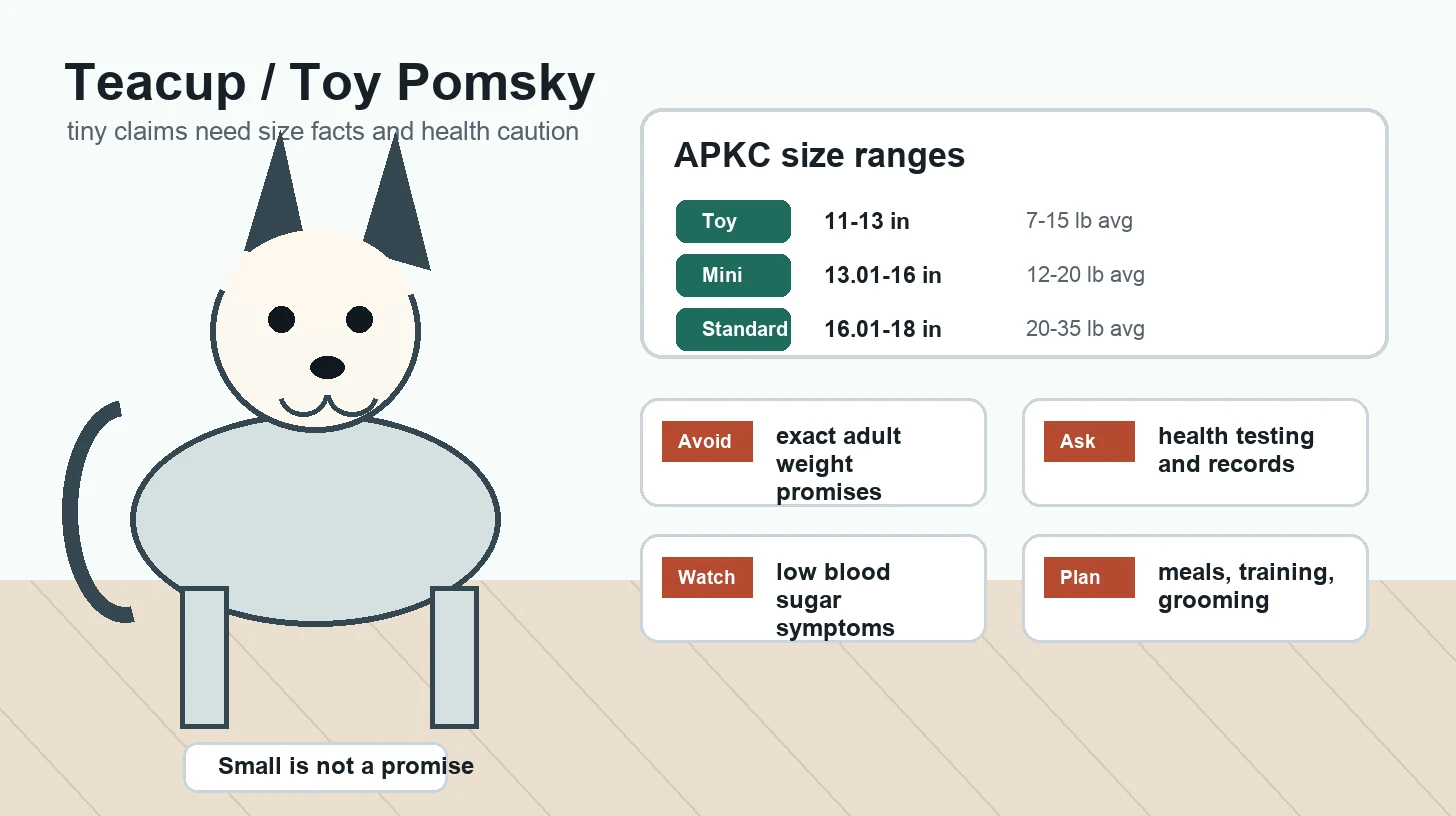
APKC lists Pomsky sizes by height at the shoulder. Its 2025 standard places toy Pomskies at 11 to 13 inches, mini Pomskies at 13.01 to 16 inches, and standard Pomskies at 16.01 to 18 inches. APKC also notes average weight ranges, while emphasizing that weight can vary.
| Category | Height at shoulder | Average weight range | Owner note |
| Toy Pomsky | 11-13 inches | About 7-15 pounds | Small, but still needs training, exercise, grooming, and vet care |
| Mini Pomsky | 13.01-16 inches | About 12-20 pounds | Often a practical middle range for many homes |
| Standard Pomsky | 16.01-18 inches | About 20-35 pounds | Still compact compared with a Siberian Husky, but not a tiny dog |
Why Teacup Size Claims Need Caution
APKC explicitly discusses smaller Pomskies and distinguishes show eligibility from ethical breeding standards. The standard says smaller dogs may occur naturally, but undersized dogs should be placed in pet homes rather than used for breeding, and it warns that breeding dogs that are too small increases health and whelping risks.
For a buyer, the practical lesson is simple: a seller who makes tiny size the main selling point should also be able to explain health testing, parent size, feeding needs, contracts, and veterinary records. If they cannot, the tiny label is not enough.
Price, Scarcity, and Real Value
Tiny-size wording is often used to make a puppy feel rare. That does not automatically make the puppy healthier, better bred, or easier to live with. A higher price should be supported by transparent care, clear records, parent information, early socialization, a written contract, and a seller who is willing to answer detailed questions before money changes hands.
When comparing listings, separate emotional appeal from proof. A cute photo, unusually small weight claim, or countdown-style deposit message should not outweigh basic facts. The more a seller emphasizes "micro" or "teacup" language, the more important it is to verify the puppy's age, current weight, feeding pattern, veterinary visits, and whether the seller will support you after pickup.
Before You Bring a Tiny Pomsky Home
A small puppy needs a calm setup before arrival. Prepare a safe sleep area, puppy food transition plan, water access, washable bedding, a vet appointment, and a way to limit rough handling. If children live in the home, plan how the puppy will be picked up, put down, and protected from falls or overexcited play.
Do not wait until the first problem to decide where emergency care is available. Save the phone number and address of your regular veterinarian and the nearest emergency clinic. Ask the breeder or rescue what the puppy currently eats, how often it eats, and what warning signs would make them call a vet immediately.
First Week Monitoring
The first week is not only about bonding. It is also the time to confirm eating, drinking, stool quality, energy, sleep, temperature comfort, and stress level. Keep changes simple: avoid switching foods abruptly, avoid crowded public places before your veterinarian clears the puppy, and do not overexercise a small puppy just because it is energetic for short bursts.
Schedule a veterinary exam soon after arrival, even if the seller says the puppy is healthy. Bring every record you received, including vaccine, deworming, microchip, diet, and contract information. A first-week exam gives you a baseline and lets a professional review any concerns before they become urgent.
Parent Breed Context
Pomskies come from a large size contrast. AKC describes the Pomeranian as a small toy breed, while the Siberian Husky is a much larger working breed. That ancestry helps explain why Pomsky size can vary, even when breeders are trying to produce a predictable companion dog.
Because the parent breeds are so different, no owner should rely on a single advertised weight. Size estimates are most credible when they are based on the parents, grandparents, mature siblings, growth curves, and the breeder's consistent historical outcomes.
Health Cautions for Very Small Puppies
Very young or very small puppies can need more careful feeding and monitoring. AKC explains that puppy or toy dog hypoglycemia can affect very young or very small puppies because limited fat and muscle mass plus immature liver function make it harder to store enough glycogen between meals.
Warning signs such as lethargy, trembling, weakness, collapse, seizures, vomiting, diarrhea, poor appetite, cold body temperature, or sudden behavior changes should be treated as veterinary concerns. Merck's neonatal management guidance also emphasizes that newborn puppies have limited glucose reserves and can become hypoglycemic with even short fasting periods.
Care Needs Are Not Smaller
A toy-size Pomsky may eat less than a larger Pomsky, but care is not automatically easier. Many Pomskies still have a dense coat, alert personality, playful energy, voice, and training needs. Hill's Pet describes Pomskies as intelligent and playful, while also noting that they can be vocal, protective, willful, and challenging for inexperienced owners.
- Feeding: young tiny puppies may need carefully timed meals under veterinary or breeder guidance.
- Training: small dogs still need crate comfort, leash manners, recall, quiet cues, and socialization.
- Grooming: a smaller coat can still shed and mat if brushing is skipped.
- Exercise: choose safe daily activity, not forced overexertion.
- Handling: teach children and guests to handle a small dog gently and safely.
Questions to Ask a Breeder or Rescue
AKC responsible-breeder guidance emphasizes meeting the breeder, asking questions, reviewing records, and expecting the breeder to care where the dog goes. For a tiny Pomsky claim, ask even more specific questions before paying a deposit.
- Is "teacup" your term, or are you using APKC toy-size categories?
- What height and weight range do you realistically expect as an adult?
- What are the sizes and ages of the parents and mature relatives?
- Do you intentionally breed for undersized dogs?
- What health testing or screening has been done on the parents?
- What veterinary care, vaccines, deworming, and records come with the puppy?
- How often is this puppy eating now, and what is the transition plan?
- What signs should trigger an immediate vet call after the puppy comes home?
- Can I read the contract before sending a deposit?
- Will you take the dog back if the placement fails?
Red Flags in Teacup Pomsky Listings
Walk away from listings that make extreme size claims without evidence, pressure you to pay quickly, or treat health questions as an annoyance. A good seller should welcome careful questions because tiny puppies need careful homes.
- Promises an exact adult weight from a very young puppy.
- Uses "micro," "pocket," or "teacup" as the main proof of value.
- Cannot show veterinary records before pickup or delivery.
- Refuses video verification or a live conversation.
- Only accepts irreversible payment.
- Does not explain feeding schedule, transition food, or health warning signs.
- Discourages a first vet visit after the puppy goes home.
Owner Fit: Is a Toy Pomsky Right for You?
| You may be a fit if... | Think twice if... |
| You want a compact companion and can handle daily coat care | You want a no-shed or no-groom dog |
| You can feed and monitor a young small puppy carefully | You are away all day and cannot manage early puppy routines |
| You are comfortable with mixed-breed size variation | You need a guaranteed adult weight |
| You will invest in training and socialization | You expect small size to replace training |
| You can afford veterinary care and emergency planning | You are stretching only to afford the purchase price |
Safer Decision Checklist
- Use APKC toy/mini/standard ranges instead of trusting vague "teacup" wording.
- Ask for documented parent information and mature-relative examples.
- Review health testing, veterinary records, contract, and return terms.
- Plan first-week feeding, sleep, potty, crate, and vet-visit routines before pickup.
- Keep emergency-vet information ready for a tiny puppy.
- Choose the individual dog's behavior and records over the smallest photo.
Frequently Asked Questions
What is a teacup toy Pomsky?
A teacup toy Pomsky is usually a very small Pomsky described with marketing language. It is not a separate guaranteed breed category. Use documented height, weight, age, parent size, and health records instead of relying on the label.
How big does a toy Pomsky get?
APKC lists toy Pomskies at 11 to 13 inches at the shoulder, with an average toy weight range around 7 to 15 pounds. Individual dogs vary, and exact adult size cannot be promised from a young puppy.
Are teacup Pomskies healthy?
Some small Pomskies can be healthy pets, but tiny size is not a health guarantee. Very small puppies may need careful feeding and monitoring, and signs such as lethargy, trembling, collapse, or seizures need veterinary attention.
Is a teacup Pomsky good for apartments?
Small size can help with space, but apartment fit also depends on barking, exercise, training, socialization, and grooming. A vocal or under-trained tiny Pomsky can still be hard in shared walls.
Should I buy the smallest Pomsky in a litter?
Not automatically. The smallest puppy may be fine, or it may need extra monitoring. Ask why the puppy is small, what the vet records show, how it eats, and whether the seller is using small size as a sales pressure tactic.
What should I feed a teacup toy Pomsky puppy?
Feed a complete and balanced puppy food appropriate for growth, following your veterinarian's and breeder's transition instructions. Tiny puppies may need a careful meal schedule; do not improvise if the puppy is weak, cold, vomiting, or not eating.
Related Pomsky Size and Care Guides
- Pomsky size and growth hub
- Pomsky health and care hub
- Best dog food for Pomsky puppies
- Pomsky crate size guide
- Best brush for Pomskies
- Pomsky puppy cost guide
- Health disclaimer
- Affiliate disclosure
- Editorial policy
Sources Reviewed
- American Pomsky Kennel Club - APKC Standards 2025
- Hill's Pet Nutrition - Pomsky dog breed information
- AKC - Pomeranian breed information
- AKC - Siberian Husky breed information
- AKC - Hypoglycemia in dogs
- Merck Veterinary Manual - Management of the neonate in dogs and cats
- AKC - Signs of a responsible breeder