
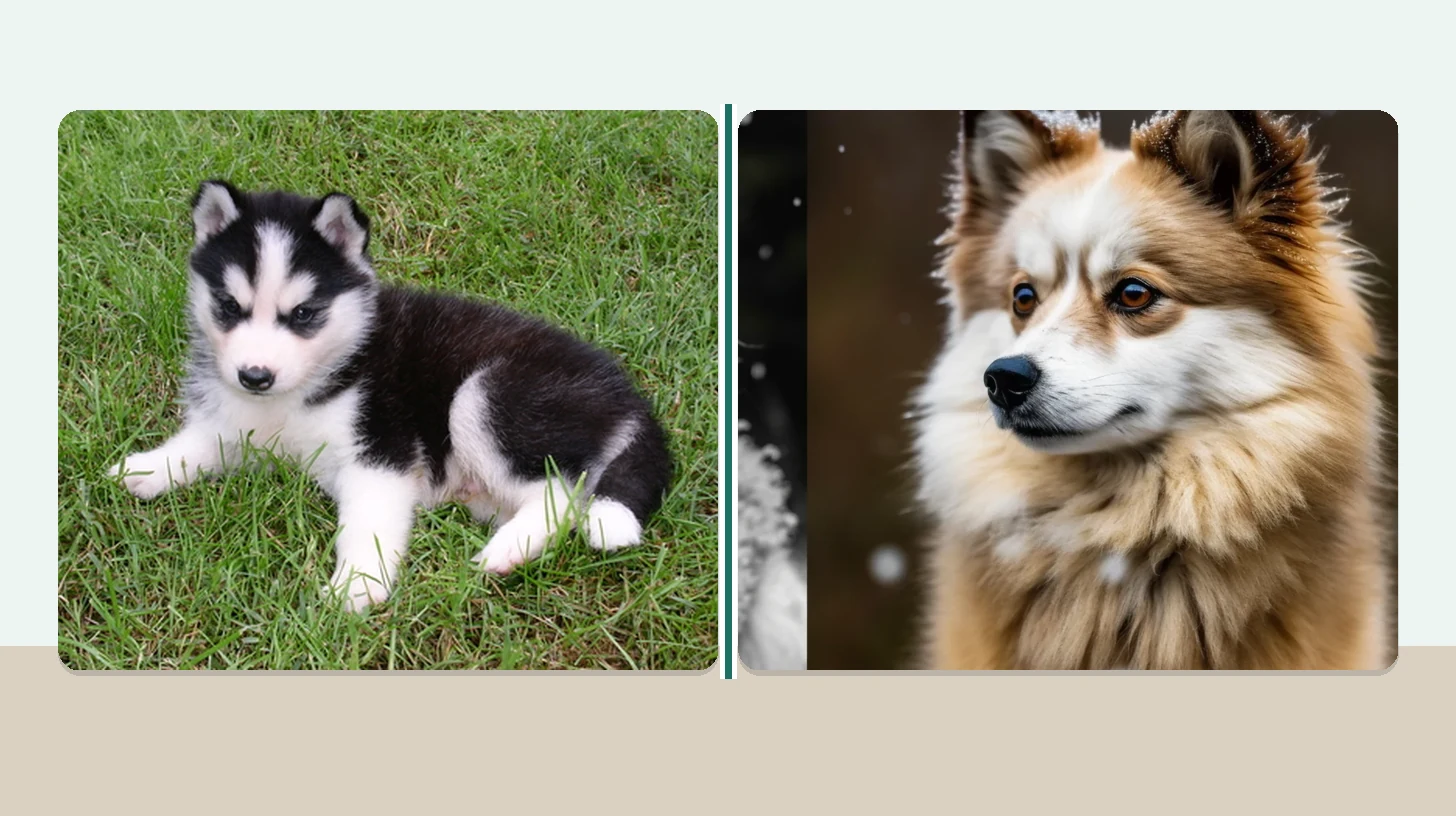
Quick answer: Miniature Husky is not an AKC-recognized breed name, while Pomsky describes a Pomeranian-Husky mix. Sellers may use small-Husky labels inconsistently, so compare documented ancestry, actual parent size, records, welfare, and the individual dog rather than the marketing term.
Written and reviewed by A Pomsky Editorial Team. Published 2026-06-19; last reviewed July 25, 2026.
This guide is informational. It does not recommend a specific breeder, rescue, listing, or medical decision. Review the editorial policy, affiliate disclosure, and health disclaimer.
Quick answer: a Pomsky is usually the better choice if you specifically want the Pomeranian-Husky companion mix and you accept variation in size, coat, voice, and temperament. A dog advertised as a Miniature Siberian Husky should be verified carefully first, because the phrase may mean a smaller Siberian Husky line, an Alaskan Klee Kai, a Pomsky, or another mix.
The comparison is confusing because all of these dogs can have a compact northern look: prick ears, plush coat, curled or carried tail, masked face, and bright expression. For a real owner decision, the label matters less than documentation, adult-size evidence, temperament, health records, grooming needs, and how the individual dog behaves.
Miniature Siberian Husky vs Pomsky: Main Difference
| Decision point | Miniature Siberian Husky label | Pomsky |
| Identity | Needs verification; may refer to smaller Husky lines, Alaskan Klee Kai, or marketing language | Pomeranian-Husky companion mix or developing Pomsky type |
| Predictability | Depends on whether the dog has clear breed and parent documentation | More variable by generation, breeder goals, and parent size |
| Size expectation | Do not rely on the word miniature alone; ask for mature relatives and records | APKC categories commonly span toy, mini, and standard Pomsky ranges |
| Energy | Northern-type energy should be expected unless proven otherwise | Often playful, intelligent, and active; boredom can become barking or mischief |
| Coat care | Expect double-coat brushing and seasonal shedding if Husky-type | Expect double-coat brushing and shedding management |
| Best fit | Owner who can verify exactly what dog they are getting | Owner who wants a Pomsky and accepts variation |
What Does Miniature Siberian Husky Mean?
Miniature Siberian Husky is a phrase you may see in ads, breeder pages, and older online articles. The safest interpretation is not to assume it is a separate standardized breed unless the seller provides clear documentation. AKC and the Siberian Husky Club of America publish information for the Siberian Husky; those references describe the standard breed, not a magic guarantee that every dog advertised as miniature will mature to a tiny size.
When someone uses this phrase, ask what they mean. They may mean a smaller Siberian Husky line. They may be talking about an Alaskan Klee Kai, which AKC describes as a separate small northern-type dog. They may be using the phrase for a Pomsky or another cross. Those are different decisions.
Do Not Confuse Mini Husky, Klee Kai, and Pomsky
This is the page's most important distinction. A Miniature Siberian Husky listing should trigger questions, not assumptions. If the dog is an Alaskan Klee Kai, evaluate it against Klee Kai expectations. If it is a Pomsky, evaluate it as a Pomsky. If it is a smaller Siberian Husky line, ask how the line is documented and whether mature relatives actually support the size claim.
The wrong label can lead to the wrong home. A family expecting a tiny quiet Pomsky may struggle with a high-drive northern-type dog. A buyer expecting a predictable purebred may be surprised by a mixed Pomsky's adult size or voice. Clarity before purchase is more useful than trying to fix mismatched expectations after the dog is home.
What Is a Pomsky?
A Pomsky is generally understood as a companion dog developed from Pomeranian and Siberian Husky ancestry. APKC describes Pomskies with size categories and a desired companion temperament, but Pomskies still vary more than a long-established purebred dog. That variation is not automatically bad; it just needs honest expectations.
If you want a Pomsky, evaluate the actual line: parent size, coat type, energy, voice, early handling, socialization, and breeder support. A Pomsky should not be selected only because a photo looks like a tiny Husky.
Size and Weight Expectations
Size is the highest-risk part of this comparison. The word miniature sounds precise, but it is not enough evidence. Ask for parent sizes, mature relatives, veterinary growth notes, and a realistic adult range. Be cautious with exact adult-weight promises from a young puppy.
| Question | What to verify |
| Is it really a Siberian Husky? | Registration, parent records, mature relatives, and whether the dog is actually from standard Siberian Husky lines |
| Is it an Alaskan Klee Kai? | Breed documentation and whether the seller is using mini husky language to describe a different breed |
| Is it a Pomsky? | Parent breeds, generation, parent sizes, Pomsky line goals, and adult relatives |
| Is size guaranteed? | Exact guarantees are a warning sign; realistic ranges are more honest |
Temperament and Family Fit
A smaller northern-looking dog is still a real dog with real needs. Siberian Husky ancestry can bring energy, independence, prey drive, shedding, and vocal behavior. Pomeranian ancestry can add alertness, confidence, and voice. A Pomsky may inherit a mix of these traits in different proportions.
For family fit, ask about the individual dog. Has the puppy met children, adults, grooming tools, crates, car rides, household sounds, and vet-style handling? Does the seller describe the dog honestly, including noise and fearfulness, or only repeat cute size and eye-color claims?
Training and Socialization
Both options need early, positive training. A compact dog is not easier just because it is smaller. The most useful skills are name response, recall, settling, leash manners, grooming handling, crate comfort, quiet routines, and calm greetings.
- Start short daily training sessions as soon as the dog comes home.
- Reward calm behavior before barking, jumping, or chasing becomes a habit.
- Use safe socialization instead of overwhelming the dog with crowded places.
- Teach grooming handling gradually, especially feet, ears, tail, and brushing.
- Get help early if fear, reactivity, guarding, or severe separation stress appears.
Exercise and Apartment Living
Either dog can live in a smaller home if the owner handles exercise, enrichment, noise, and routine. The problem is not apartment size alone. The problem is an under-exercised, under-trained, vocal, bored northern-type dog in shared walls.
A practical routine includes walks, sniffing time, short training, puzzle feeding, rest, and predictable quiet time. Do not choose either dog if the plan is a decorative lap dog with minimal daily activity.
Grooming, Shedding, and Allergies
Expect brushing and shedding management. VCA's dog coat care guidance supports regular coat care, and both Siberian Husky and Pomeranian ancestry can bring dense coat maintenance. A Pomsky can also have a plush, wooly, or longer coat that mats if ignored.
If someone markets either dog as low-shedding or hypoallergenic, slow down and ask for evidence. For allergy-sensitive homes, spend time around the actual dog and discuss allergy management with a medical professional.
Cost and Buying Risk
Do not compare only sticker price. A cheaper puppy with unclear identity, no contract, no health records, and no support can cost more over time than a better-documented dog. AKC's responsible breeder guidance is useful even when the dog is not an AKC breed: look for transparency, health care, contracts, questions from the breeder, and willingness to support the dog after placement.
Risk signs include exact adult-size guarantees, pressure to send money quickly, no parent information, refusal to show records, rare-color upsells, copied photos, no return terms, and claims that one small dog is perfect for every home.
Red Flags in Mini Husky and Pomsky Listings
Be cautious when a page relies on cute photos but gives little documentation. The most useful listing information is boring and specific: parent identity, adult relatives, vet records, socialization notes, contract terms, return policy, and what the seller will do if the placement does not work. Marketing language is not a substitute for records.
- Exact adult size promises: puppies grow unevenly, and Pomsky size can vary by generation and parent size.
- Breed-name confusion: mini husky, Klee Kai, Pomsky, and Husky mix are not interchangeable labels.
- No health records: vaccination, exam, and parent-health information should be discussed before payment.
- Pressure tactics: urgency and rare-color claims should not replace careful review.
- No support: responsible placement includes questions, documentation, and a plan if the home is not a fit.
Which Should You Choose?
| Your priority | Better direction | Why |
| You want a Pomsky specifically | Pomsky | The Pomeranian-Husky mix and its variation are the point |
| You want a documented standard breed | Verify the Miniature Siberian Husky label | The phrase alone is not enough; confirm what dog is being offered |
| You want a small northern-type breed | Also research Alaskan Klee Kai | Some people use mini husky language when they really mean a different small northern breed |
| You need low shedding | Neither is ideal | Both paths can involve double coats and seasonal shedding |
| You are a first-time owner | Only with support | Training, grooming, exercise, and behavior support matter more than the cute label |
| You need exact adult size | Neither without records | Ask for mature relatives and realistic ranges; avoid exact promises |
Decision Checklist
- Ask whether the dog is a Siberian Husky, Alaskan Klee Kai, Pomsky, or another mix.
- Ask for parent sizes, mature relative photos, health records, and veterinary paperwork.
- Read the contract, return terms, deposit terms, and health guarantee carefully.
- Ask how puppies are socialized with people, handling, grooming, crate time, and household sounds.
- Plan for brushing, shedding, training, exercise, food, equipment, and veterinary costs.
- Choose the individual dog's temperament and support system over color, eye color, or a tiny-size promise.
Frequently Asked Questions
Is a Miniature Siberian Husky the same as a Pomsky?
No. A Pomsky is a Pomeranian-Husky companion mix or developing Pomsky type. A Miniature Siberian Husky label needs verification because it may refer to a smaller Husky line, an Alaskan Klee Kai, a Pomsky, or another mix.
Is a Miniature Siberian Husky a separate AKC breed?
AKC provides Siberian Husky breed information, and SHCA publishes the Siberian Husky standard. If a seller uses the word miniature, ask for documentation explaining exactly what breed or line is being offered.
Which is more predictable?
A documented breed or line with mature relatives is easier to evaluate than a vague label. Pomskies can be wonderful companions, but they vary by parent size, generation, breeder goals, and individual temperament.
Which is better for apartments?
Either can work if the dog is exercised, trained, and not highly vocal or reactive. A bored Pomsky or a poorly socialized northern-type dog can be difficult in an apartment, even when small.
Which sheds less?
Neither should be chosen for low shedding. Siberian Husky and Pomeranian ancestry can both contribute to meaningful shedding and coat care.
What is the safest next step before choosing?
Verify the dog's identity, meet the dog or breeder by video or in person, review records, ask about adult relatives, and compare real behavior rather than relying on a cute mini-husky photo.
Related Pomsky Guides
- Klee Kai vs Pomsky
- Pomsky comparison guides
- Pomsky size and growth hub
- How much is a Mini Pomsky?
- Teacup Toy Pomsky size reality
- How to take care of a Pomsky
- Best brush for Pomskies
- Editorial policy
- Health disclaimer
- Affiliate disclosure
Sources Reviewed
- American Kennel Club - Siberian Husky
- Siberian Husky Club of America - Siberian Husky Standard
- American Kennel Club - Pomeranian
- American Pomsky Kennel Club - APKC Standards 2025
- American Pomsky Kennel Club - Is a Pomsky Right for Me?
- American Kennel Club - Alaskan Klee Kai
- VCA - Grooming and Coat Care for Your Dog
- American Kennel Club - Signs of a Responsible Breeder
Evidence and related Pomsky guides
These sources support only their stated claim scopes; they do not guarantee an individual Pomsky outcome.
Sources reviewed for this page
- American Kennel Club: Siberian Husky Dog Breed Information
- American Kennel Club: Pomeranian Dog Breed Information