Written and reviewed by A Pomsky Editorial Team. Originally published 2023-08-20; substantively reviewed July 26, 2026.
Training boundary: Use humane, reward-based methods and protect safety with management. Pain, panic, aggression, a bite history, or serious handling risk requires a veterinarian or qualified behavior professional. Read the editorial policy.
Direct answer: A Pomsky puppy may howl for contact, sound response, frustration, discomfort, or separation-related distress. Check safety and physical needs, record the exact trigger and body language, reward calm behavior, and increase alone time only while the puppy remains comfortable.
A Pomsky puppy may howl because it is seeking contact, responding to a sound, frustrated by confinement, uncomfortable, or distressed when left alone. Do not assume the sound is an adorable breed trait or deliberate defiance. Check immediate needs first, observe the context, reward calm behavior, and involve a veterinarian when the change is sudden, intense, or accompanied by physical signs.
The training goal is not absolute silence. It is a puppy that can communicate normally, settle safely, and spend developmentally appropriate periods alone without panic.
Check immediate needs before training
When a puppy howls, confirm that it is safe. Check for a bathroom need, thirst, hunger within the feeding plan, heat or cold, tangled equipment, injury, vomiting, diarrhea, abdominal swelling, breathing difficulty, or another animal causing fear.
Very young puppies need frequent bathroom opportunities and cannot be expected to match an adult schedule. A puppy that has just arrived also lost familiar littermates, smells, and routines. Support and gradual teaching are more appropriate than leaving it to "cry it out."
Contact a veterinarian promptly for sudden persistent vocalization, apparent pain, weakness, collapse, repeated vomiting or diarrhea, breathing trouble, inability to urinate, marked abdominal discomfort, or behavior that is dramatically different from baseline. Do not give human pain medicine, sedatives, supplements, or calming products without veterinary direction.
If the puppy is physically well, note exactly when the howling occurs. Useful context includes the location, time, caregiver movement, sounds outside, confinement, distance from people, duration, and what makes it stop. A pattern is more actionable than a label.
Identify the howling pattern
Howling at a siren differs from vocalization that begins when keys are picked up. A puppy may respond socially to sounds, protest a closed barrier, become frustrated when a reward is visible, or show genuine separation distress. The same noise can have different functions on different days.
Use a camera for brief, privacy-conscious observation when the puppy is alone. The Merck Veterinary Manual behavior overview notes that video is valuable for distinguishing separation distress from other triggers and observing pacing, scanning, salivation, destruction, and inability to settle.
Record:
- how soon the sound begins after departure;
- whether the puppy eats a safe food toy;
- whether it can lie down;
- pacing, panting, drooling, scratching, escape attempts, or elimination;
- outside sounds or household events;
- whether another familiar person changes the response;
- recovery time after the caregiver returns.
Howling alone does not diagnose separation anxiety. The Cornell canine anxiety guidance lists vocalization among several possible distress signs and recommends gradual desensitization and positive-reinforcement help.
Build a calm safe area
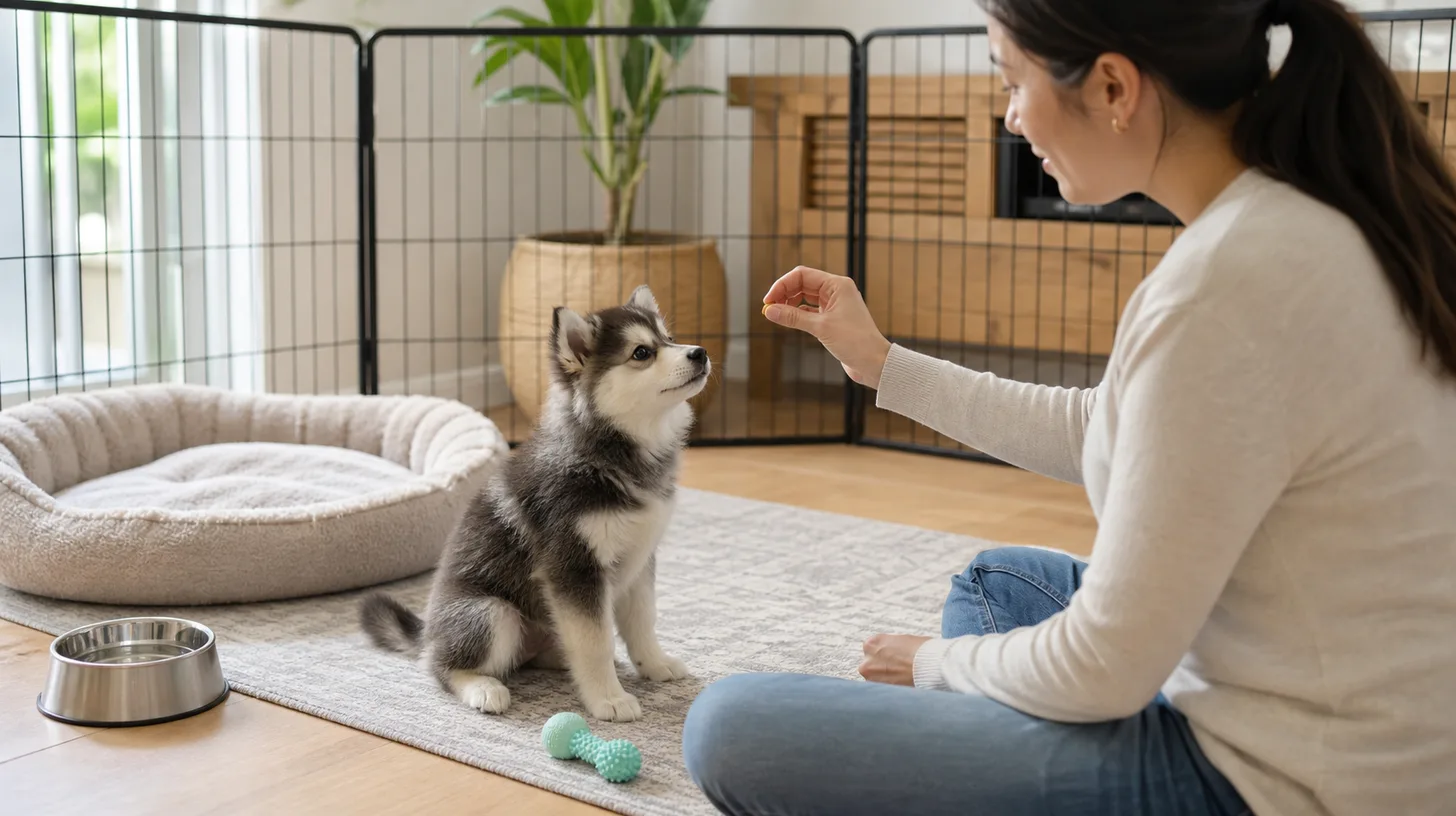
Choose a puppy-proofed pen, room, or appropriately introduced crate based on the puppy's response. Provide a comfortable resting surface, water when appropriate, and only toys or chews known to be safe under the planned level of supervision.
Introduce the area while you remain nearby. Scatter part of a meal, reward voluntary entry, sit beside the barrier, and release before distress. Repeat until the puppy can explore, chew, and rest there. Confinement should not begin only when everyone disappears.
If the puppy panics in a crate, do not force longer confinement to "teach independence." Use a safer larger area and seek professional guidance. The site's Pomsky crate-training guide covers gradual introduction, but a crate is not the right answer for every dog or every separation problem.
Control predictable triggers where possible. Close curtains if passing dogs cause vocalization, use steady background sound for abrupt hallway noise, and schedule a bathroom break before practice. Environmental changes reduce rehearsal while training addresses the underlying response.
Teach quiet and settling while you are present
Reward calm behavior before howling begins. When the puppy lies down, looks away from a mild distraction, or plays independently, quietly place a reward near its paws. This teaches that low-arousal choices matter.
Practice a mat settle in the safe area. Cue the mat, reward one or two seconds of relaxed posture, release, and repeat. Increase duration slowly. A puppy that repeatedly stands up is giving information that the step is too difficult.
To teach a quiet cue, first capture a naturally quiet moment. Say a marker such as "yes," reward, and continue the calm activity. Add the word "quiet" only after the puppy reliably pauses in that context. Repeating "quiet" over active howling often turns the cue into background noise.
Do not shout, shake the enclosure, spray water, or use a bark collar. The AVSAB humane training statement recommends reward-based methods and warns about aversive-method welfare risks. Suppressing sound does not resolve fear, pain, or panic.
Practice absence below the distress threshold
Begin with a movement the puppy can handle: stand up, sit down, step behind a barrier for one second, and return. The puppy should remain able to eat, explore, or rest. Increase time in tiny increments and vary easy and slightly harder repetitions.
Do not wait for a full howl before returning in early desensitization. The aim is to come back before distress begins, so the puppy learns that short absences are safe. If vocalization starts, make the next repetition shorter or reduce another difficulty.
Practice departure cues separately. Pick up keys and put them down, put on shoes and read a book, or open and close the door without leaving. These exercises are useful only when the puppy remains relaxed; flooding the puppy with repeated triggers can worsen concern.
Real absences must stay within the puppy's current ability. Arrange a caregiver, sitter, or schedule adjustment rather than repeatedly exceeding the threshold. Graduated work can take time, especially when true separation distress is present.
Respond to nighttime howling
Place a new puppy's safe sleeping area close enough to hear bathroom needs and signs of distress. A predictable bedtime routine can include a calm bathroom trip, low-key settling, and lights-out without exciting play.
If the puppy wakes, take it directly to the bathroom area with minimal stimulation, reward elimination, and return to bed. Do not turn every wake-up into a play session, but do not ignore possible illness or panic.
Move the sleeping area gradually if the long-term location is elsewhere. Abruptly isolating a puppy in a distant room may exceed its coping ability. Change distance only after several calm nights.
Persistent nighttime restlessness, frequent urination, diarrhea, coughing, pain, itching, or inability to settle needs veterinary review. A schedule problem and a medical problem can look similar from another room.
Avoid accidental reinforcement and punishment
Attention can reinforce demand vocalization, but that does not mean every howl should be ignored. First classify the likely cause. Meet legitimate needs and prevent panic; for mild attention-seeking in a safe, well-prepared context, reinforce the first pause or alternative behavior.
Avoid rushing in with food only after a long howl. Instead, return to an easier duration and deliver reinforcement for calm behavior before escalation. Do not punish the puppy when you return, even if bedding was damaged or the floor is soiled.
Meet age-appropriate needs for sleep, social contact, safe exploration, play, training, and bathroom breaks. Overtired puppies can become more vocal and less able to settle. The Pomsky puppy schedule can help organize a routine without forcing every puppy into identical timings.
If barking and howling occur in many contexts, see how to manage Pomsky barking for trigger-specific training. Keep the separation plan separate so one broad "quiet" cue does not replace careful assessment.
Know when professional help is needed
Seek help when the puppy injures itself trying to escape, cannot eat during absences, shows intense salivation or elimination, vocalizes continuously, deteriorates despite smaller steps, or cannot be left for essential daily activities.
Start with the veterinarian to exclude pain, illness, gastrointestinal or urinary problems, and medication effects. Ask for referral to a veterinary behaviorist or qualified reward-based professional when anxiety is likely. The guide to choosing a Pomsky trainer lists useful credential and method questions.
Do not copy medication suggestions from another dog's plan. When medication is appropriate, it is prescribed for the individual and combined with behavior modification.
Progress means the puppy can remain comfortable for gradually longer periods, not merely that the house is quieter. Track body language, eating, resting, and recovery alongside the sound.
Sources reviewed
Each source is used only for the claim scopes listed below. None establishes a guaranteed Pomsky outcome or replaces individual professional assessment.
- Cornell University College of Veterinary Medicine: Anxious Behavior: How to Help Your Dog Cope With Unsettling Situations - Supports: anxiety signs; separation-related vocalization; gradual desensitization; reward-based professional help. Limit: Howling alone does not diagnose separation anxiety; sudden or severe distress needs veterinary assessment.
- Merck Veterinary Manual: Behavior Problems of Dogs - Supports: separation-distress signs; video observation; differential causes; graduated departure work. Limit: Diagnosis, medication, and individualized treatment belong to a veterinarian or veterinary behaviorist.
- American Veterinary Society of Animal Behavior: Humane Dog Training Position Statement - Supports: reward-based training; aversive-method risk; behavior change principles. Limit: Does not guarantee outcomes for an individual dog.