Written and reviewed by A Pomsky Editorial Team. Originally published 2023-08-03; substantively reviewed July 26, 2026.
Training boundary: Use humane, reward-based methods and protect safety with management. Pain, panic, aggression, a bite history, or serious handling risk requires a veterinarian or qualified behavior professional. Read the editorial policy.
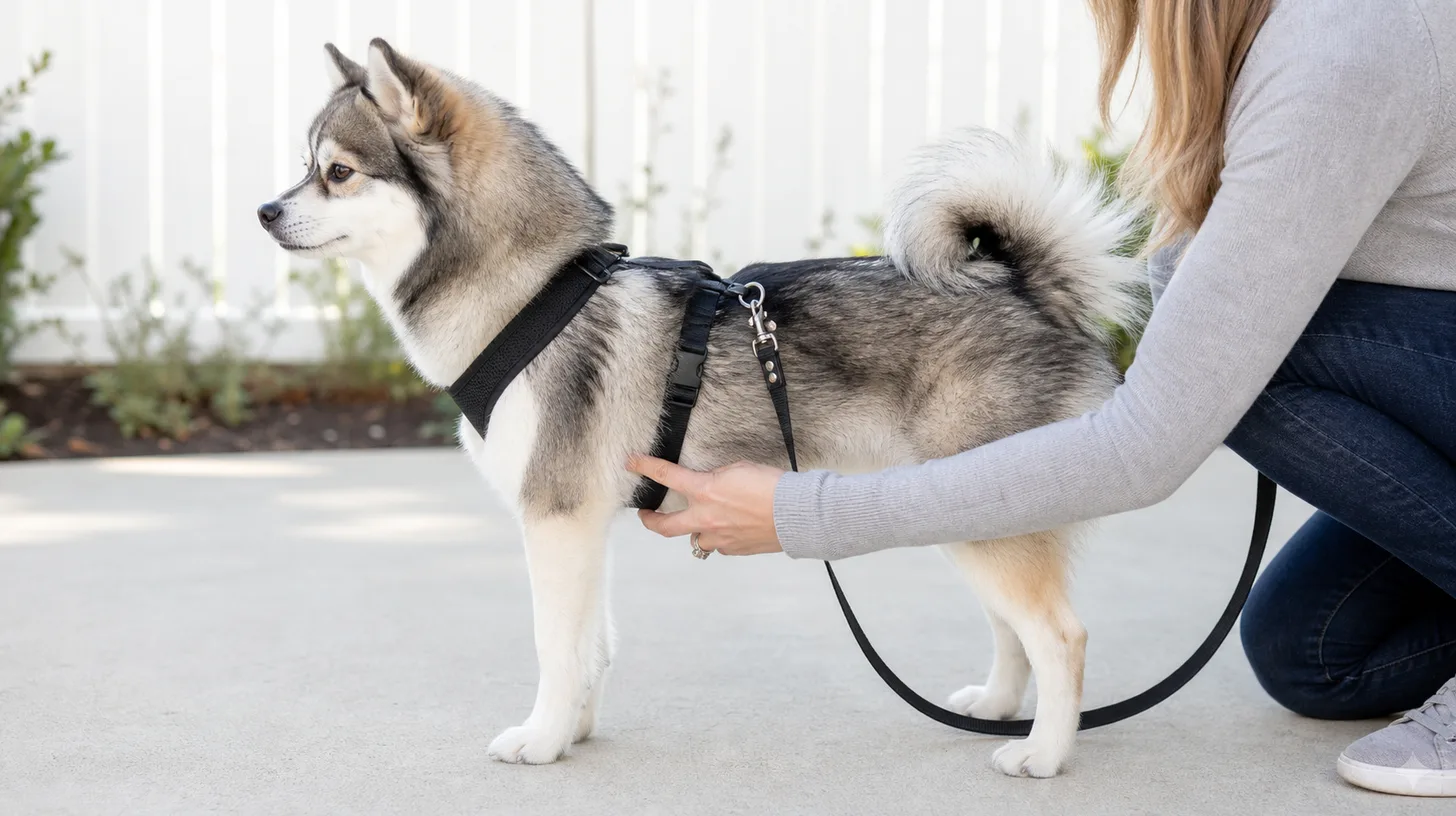
Direct answer: A Pomsky harness should sit away from the throat, allow full shoulder movement, avoid rubbing behind the front legs, remain centered, and resist backing out during a gentle secure-area test. Measure the individual dog and recheck after grooming, growth, or weight change.
A safe Pomsky walking harness fits the individual dog's chest and girth, sits away from the throat, permits full shoulder movement, does not rub behind the front legs, and cannot be backed out of during a controlled fit test. A Y-front design is often a useful starting shape, but no style fits every dog.
Measure the dog, follow the exact product instructions, observe movement, and recheck after grooming, growth, or weight change. A harness improves load distribution and control; it does not train loose-leash walking by itself.
Choose the harness job first
Walking, running, vehicle restraint, mobility assistance, and pulling sports use different designs. Do not assume one harness is approved for every job. This guide covers ordinary supervised leash walking.
For a Pomsky that pulls or reacts, equipment is only one part of the plan. Use distance, reward-based training, and routes the dog can handle. The AAHA reactive-walk guidance discusses secure equipment alongside environmental management and professional support.
A back attachment may reduce leash tangling and keep pressure away from the throat. A front attachment can provide directional influence, but a strap that crosses the shoulder or a leash pulled sideways can alter movement. Dual attachments need correct handling and should not twist the harness.
Avoid labels such as "no pull" as a guarantee. A tool may make handling easier, but pulling changes through training and reinforcement, not marketing language.
Measure chest and girth
Use a flexible tape while the dog stands naturally. Measure the girth at the location specified by the manufacturer, often around the widest part of the rib cage behind the front legs. Some designs also require lower-neck or chest measurements.
Keep the tape snug without compressing coat or body. Measure twice and record the values. Do not choose only from body weight or a breed chart; Pomskies of similar weight can have different chest depth, neck width, and coat volume.
The AKC harness-selection guidance recommends measuring the dog, checking strap clearance, observing free leg movement, testing for slipping, and rechecking after grooming or body change.
If the dog falls between sizes, compare adjustment ranges and ask the manufacturer. Choosing the larger size is not automatically safer if the neck opening or body straps cannot be secured.
Check a Y-front fit point by point
Place the harness on without forcing the dog's legs or head. A Y-front should generally meet at the chest and run around, not across, the front of the shoulders. The upper straps should not press the throat.
Check:
- the center of the Y rests on the breastbone area rather than soft throat tissue;
- front legs can extend forward and sideways without strap interference;
- the girth strap sits on the rib cage, not in the armpit or behind the ribs;
- buckles do not press the spine, elbow, or sensitive skin;
- fingers can slide under straps without large gaps;
- the harness remains centered when the leash is gently moved;
- the dog can sit, stand, turn, sniff, and lie down normally.
The AKC well-fitting harness article specifically emphasizes shoulder extension, strap clearance, and avoiding pressure at the throat or behind the front legs.
Finger checks vary with hand size and coat. Use them as one indicator alongside movement, escape resistance, and skin inspection.
Test escape resistance safely
Clip a leash in a secure indoor room or fenced area. With the dog standing, apply gentle leash tension in the directions likely during a walk. Observe whether the neck opening can pass over the head or a leg can slip through a gap.
Have the dog take several steps forward, turn, and move slightly backward toward you while the leash remains controlled. Stop if the dog becomes worried. Never drag the dog backward or conduct the test near traffic.
Dogs with narrow heads, deep chests, thick coats, or a history of backing out may need a three-strap escape-resistant design or a safety connector between harness and collar. Ask a qualified professional to fit it.
No escape test proves the harness cannot fail. Inspect buckles and leash clips before each outing, hold the leash securely, and use escape-prevention management around doors and gates.
Introduce the harness with rewards
If the dog avoids the harness, break the process into small steps. Show the equipment and reward looking at it. Reward a voluntary nose target near the opening, then brief contact, one strap, and eventual fastening.
Do not chase the dog, force the head through, or hold it down. A step-in design may suit a dog that dislikes head openings, while another dog may dislike paw handling. Select the design around the individual response.
Keep the first wearing period short and indoors. Feed rewards, remove the harness, and repeat. Add movement before adding a leash, then practice in a quiet secure area.
The AVSAB humane training statement supports reward-based methods. Equipment conditioning should reduce fear rather than overpower it.
Watch movement skin and coat
Observe the dog from the side and front at a walk. Shortened stride, elbows pushed outward, hopping, freezing, or persistent scratching can indicate poor fit, discomfort, or an unrelated health issue.
After each early walk, remove the harness in a secure place and part the coat. Check the chest, armpits, sternum, neck, spine, and buckle areas for redness, broken hair, matting, or moisture.
Dense Pomsky fur changes with grooming and seasonal shedding. A harness that fit over a full coat may become loose after a groom, while matting can make the same setting painfully tight. Recheck every strap.
Wash and dry the harness according to instructions. Dirt, salt, and wet material can increase friction. Replace frayed webbing, cracked buckles, bent rings, loose stitching, or adjustment hardware that slips.
Seek veterinary care for pain, swelling, open skin, breathing changes, coughing, weakness, or a gait change that persists after the harness is removed.
Train the walk rather than relying on gear
Begin where the dog can notice you and take food or another reward. Reinforce a slack leash, check-ins, and movement beside you. Change direction before the leash stays tight for long periods.
Use sufficient distance from dogs, wildlife, traffic, or people that trigger lunging. A harness can provide control, but it cannot make an overwhelmed dog feel safe. The site's Pomsky leash-training guide provides a structured reward plan.
Do not jerk the leash, lift the dog's front end, or use the harness handle to suspend the dog. A handle may support brief emergency control only when the design and dog's health allow it.
For running or hiking, increase distance gradually and review temperature, paw condition, hydration, and terrain. A walking harness is not evidence that a dog is conditioned for strenuous exercise.
Separate walking and vehicle restraint
A walking harness may not be crash-tested or designed for a seat-belt system. Use only a vehicle restraint in the way its manufacturer specifies, and never connect a seat belt to a neck collar.
Do not leave a harnessed dog unattended where straps can snag. Remove walking equipment in a secure environment when its job is finished, unless an individualized safety plan requires otherwise.
Identification still matters. Many caregivers use a flat collar with current tags while attaching the leash to the harness. Review the Pomsky collar guide for a separate identification fit check.
The best harness is therefore not a universal product winner. It is the design that matches the intended activity, fits the individual Pomsky without restricting movement, stays secure under gentle multidirectional testing, and works alongside humane leash training.
Sources reviewed
Each source is used only for the claim scopes listed below. None establishes a guaranteed Pomsky outcome or replaces individual professional assessment.
- American Kennel Club: The Importance of a Well-Fitting Harness - Supports: harness measurement; strap clearance; shoulder movement; escape and chafing checks. Limit: No harness corrects pulling by itself or fits every body shape; pain, rubbing, or gait change needs reassessment.
- American Animal Hospital Association: How Can I Safely Walk My Reactive Dog? - Supports: distance and route management; well-fitted walking equipment; reward-based handling; professional behavior referral. Limit: Equipment and general management cannot guarantee safety during an uncontrolled loose-dog encounter.
- American Animal Hospital Association: Lifestyle and Safety Assessment - Supports: appropriate confinement; leash, collar and harness planning; lifestyle-specific safety review. Limit: Equipment selection must account for the individual dog's anatomy, behavior, health, and environment.
- American Veterinary Society of Animal Behavior: Humane Dog Training Position Statement - Supports: reward-based training; aversive-method risk; behavior change principles. Limit: Does not guarantee outcomes for an individual dog.