Written and reviewed by A Pomsky Editorial Team. Originally published 2023-04-20; substantively reviewed July 26, 2026.
Training boundary: Use humane, reward-based methods and protect safety with management. Pain, panic, aggression, a bite history, or serious handling risk requires a veterinarian or qualified behavior professional. Read the editorial policy.
Direct answer: Stop a Pomsky from running away by preventing access first and training recall second. Use a leash or long line outside unsecured areas, inspect fences and gates, manage doors with a second barrier, reward every return, and keep collar identification and microchip details current. A trained recall is valuable, but it is not a substitute for secure containment around traffic, wildlife, fear triggers, or unfamiliar places.
A dog who runs through a door, slips a harness, climbs a fence, or bolts after a sudden sound is facing a safety problem, not demonstrating a moral failure. The most reliable plan uses several layers: prevent access to escape routes, teach useful skills under controlled conditions, meet daily needs safely, and keep identification current in case management fails.
Do not test a Pomsky's recall near traffic, wildlife, or an open boundary to find out whether training is "finished." Training improves choices; secure equipment and environments reduce the consequence of a mistake.
Start with management, not a recall test
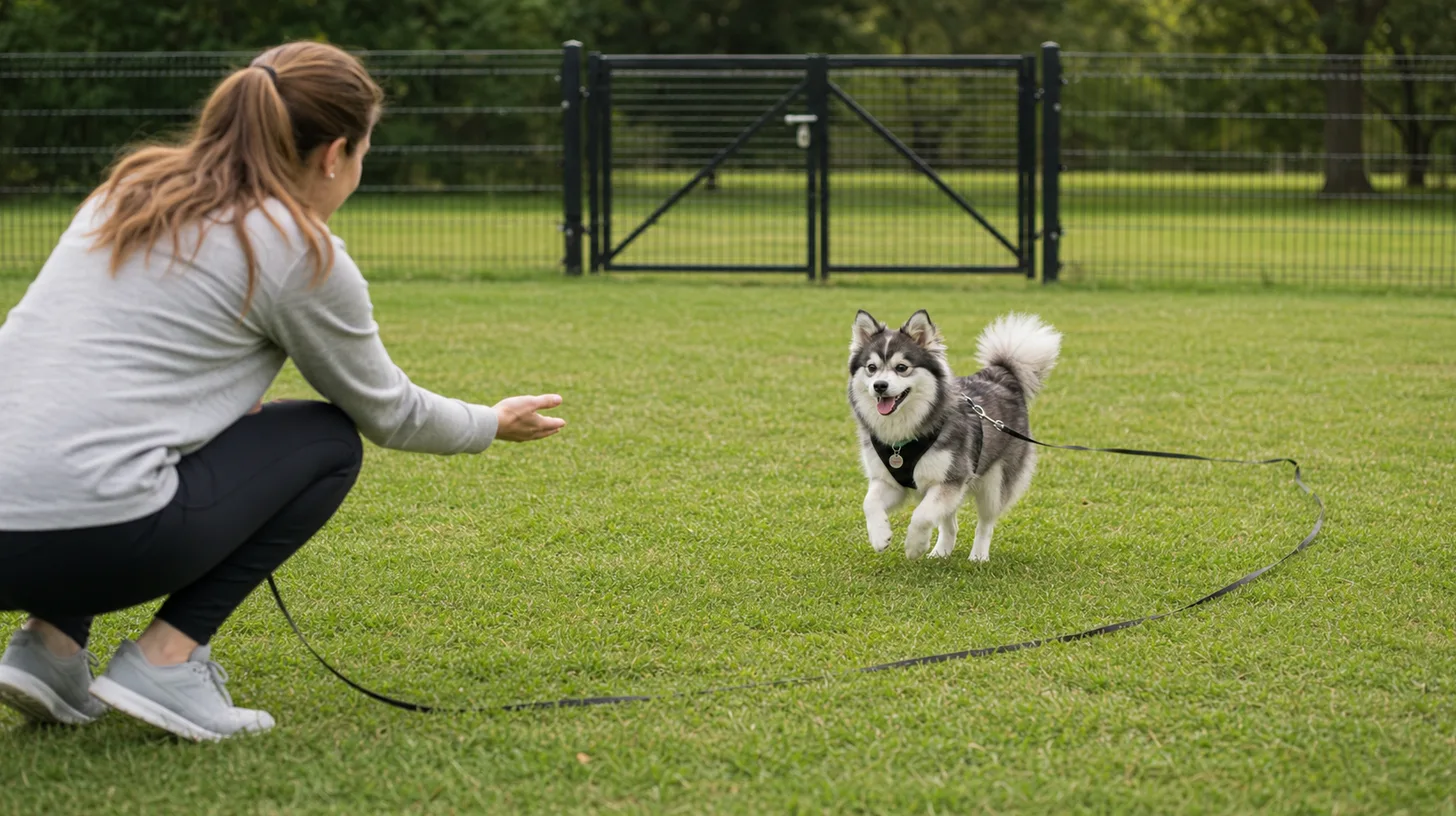
For now, assume an unsecured outdoor area is not safe. Use a standard leash for ordinary walks and a well-fitted long line for distance practice in an appropriate open space. Attach the line to equipment designed for safe walking and verify that the dog cannot back out. A long line is not a retractable leash and should be handled so it does not wrap around people, dogs, or obstacles.
Supervise outdoor time even in a fenced area until you know how the escape occurred and have repaired it. Do not rely on an electronic boundary as the only barrier. The AAHA runaway-prevention guidance notes that a motivated or frightened dog may cross such a boundary, and it does not prevent other animals or people from entering.
Inside the home, create an "airlock" at high-risk exits. A closed interior door, baby gate, exercise pen, or secured room can separate the dog from the exterior door when deliveries arrive, guests enter, children go outside, or luggage is carried through. Put the leash on before opening the last barrier.
Management is not giving up on training. It prevents the dog from practicing a dangerous behavior while training is still developing.
Find and close the escape route
Walk the property line and inspect it from the dog's height. Check:
- gaps under or beside gates;
- loose boards, bent wire, and weak latches;
- objects that create a step near the fence;
- soil disturbed by digging;
- snow, debris, or landscaping that reduces effective fence height;
- doors that do not latch fully;
- screens that can be pushed out;
- harnesses, collars, clips, and leash hardware that are worn or incorrectly sized.
Watch how people use the space. Many escapes happen because a gate is left open, two doors open at once, or someone assumes another person is holding the dog. Use one clear household rule: no exterior door or gate opens until the dog's location and restraint are confirmed.
If the dog bolts during thunderstorms, fireworks, construction, visitors, or another predictable event, prepare before it begins. Bring the dog inside, close access to exits, provide a secure resting area, and use identification. Severe panic or a sudden new fear response warrants veterinary guidance; simply increasing exercise or tightening equipment may not address it.
Build a recall on a long line
The site's recall training guide covers the cue in detail. For escape prevention, focus on a few essential rules.
Choose one recall word that the household can use consistently. Begin in a quiet room or secure yard at a distance where the dog is likely to succeed. Say the cue once, move away invitingly, and reward the dog when it reaches you. Deliver the reward close enough that you can gently take the harness or collar before releasing the dog again.
Use rewards that matter in that setting. Food may work indoors but lose value around wildlife or play. Short access to a favorite toy, another safe sniff, or release back to an activity can also reinforce returning. Reward every response while the skill is being built, especially when the dog leaves something interesting.
Increase one variable at a time:
- distance from the handler;
- duration before the cue;
- environmental distraction.
Do not add all three together. A dog who succeeds from 20 feet in a quiet field may not be ready for five feet near a squirrel. The long line prevents departure while showing you which level is actually trained.
If the dog does not respond, avoid repeating the cue until it becomes background noise. Use the line to prevent further movement, reduce the distraction or distance, and set up an easier repetition. Do not reel the dog in harshly or punish it after it arrives. Punishment can make returning to the handler less valuable.
The AVSAB humane training position supports reward-based methods and advises against aversive training. Shock, prong, or intimidation-based approaches can add fear or conflict without making the environment secure.
Prevent door dashing and gate mistakes
Teach a station several feet from the door, such as a mat. Reward the dog for moving to the station while the door remains closed. Then practice touching the handle, opening the door a crack, and closing it again. If the dog leaves the station, reset at an easier step; the open door is not the reward for rushing.
Use a leash or second barrier during practice. A training setup should not allow one mistake to become a real escape. Gradually add household movement, a knock, a familiar visitor, or a delivered package only after the simpler version is reliable.
Everyone who uses the door needs the same routine. A sign on the inside of the door can remind visitors to wait, but the physical barrier is more important than a reminder. Children should not be responsible for holding the dog during arrivals.
At gates, train a pause while the handler moves through first, closes or controls the gate, and then releases the dog if the destination is secure. Continue to use restraint; a pause cue is not a lock.
Meet activity and enrichment needs safely
Some dogs seek opportunities because their day provides too little movement, exploration, social contact, or problem solving. Others bolt because they are frightened, frustrated, or highly practiced at chasing. Do not reduce every escape to "too much energy."
Build a predictable routine that includes age-appropriate walks, sniffing, short training, food-search games, play, rest, and calm time. The Pomsky exercise guide explains why the amount should follow the individual dog's age, health, recovery, and behavior rather than a fixed breed quota. Indoor enrichment provides safe outlets when weather or location limits outdoor activity.
More exercise is not always the answer. Repeated high-arousal chasing can improve stamina without improving recall or calm behavior. Balance active outlets with decompression, sleep, and training at a level where the dog can think.
Improve identification and recovery readiness
Use a secure collar with a readable ID tag in addition to walking equipment when appropriate for the dog. Keep the phone number current. Identification should be visible even if a dog is found by someone without a microchip scanner.
Microchip the dog through a veterinary or authorized service and register the chip. Update the registry whenever your phone number, email, address, or alternate contact changes. The AAHA animal-identification guidance recommends current registry information, collar tags, and periodic scanning to confirm the chip can be detected. A microchip is identification, not live location tracking.
Keep current photographs from both sides and the front, the microchip number, license information, medication details, and veterinary contact in an accessible record. Add a trusted alternate contact. The ASPCA lost-pet guidance emphasizes acting quickly and spreading accurate information if a pet disappears.
A GPS device can be an additional recovery aid if it is suitable and maintained, but battery, coverage, attachment, and subscription failures are possible. It does not replace a leash, fence, tag, or registered chip.
What to do if your Pomsky gets loose
Protect people first. Do not run into traffic or create another emergency. If the dog is still nearby and the setting is safe, use the trained recall in a cheerful voice, move away rather than charging toward the dog, and make the return valuable. Avoid angry pursuit or punishment when the dog reaches you.
If the dog is moving out of sight, start the recovery plan immediately:
- notify local animal control and nearby shelters;
- contact the microchip registry and mark the dog missing;
- call veterinary clinics in the area;
- give neighbors a current photograph and a phone number;
- check the immediate area carefully, including quiet hiding places;
- post a factual location, time, description, and safe contact method;
- keep one person available to answer calls and verify sightings.
Do not publish sensitive ownership documents or home-access details publicly. Be alert to lost-pet scams that demand payment or verification codes. Ask for a description or photograph that only a genuine finder is likely to have before traveling or sending information.
After recovery, check for injury, overheating, toxin exposure, or unusual behavior and contact a veterinarian as appropriate. Then identify the failed layer before restoring normal freedom.
When to involve a veterinarian or behavior professional
Seek veterinary help when escape behavior starts suddenly, occurs with pain, disorientation, sleep change, increased vocalization, altered appetite, or panic. Medical and sensory changes can affect behavior.
Use a qualified reward-based trainer or veterinary behavior professional when the dog is dangerously difficult to contain, shows severe fear, redirects aggression, cannot recover around triggers, or has repeated escapes despite careful management. The site's trainer-selection guide explains credentials and red flags.
Bring a factual record: escape route, trigger, time of day, equipment, body language, what happened immediately before and after, and video from a safe fixed camera if available. Do not stage another escape to obtain footage.
The goal is layered reliability, not proof that the dog can be trusted everywhere without restraint. Secure access, practiced recall, fulfilled daily needs, current identification, and a ready recovery plan work together. If any one layer fails, the others still protect the dog.
Sources reviewed
Each source is used only for the claim scopes listed below. None establishes a guaranteed Pomsky outcome or replaces individual professional assessment.
- American Animal Hospital Association: How Can I Discourage My Dog From Running Away? - Supports: secure fencing; leash use; recall foundations; escape-route checks; appropriate activity. Limit: No recall cue or fence design guarantees that an individual dog cannot escape.
- American Animal Hospital Association: Animal Identification and Microchipping - Supports: current microchip registration; visible ID tags; annual chip scan; lost-pet search limits. Limit: Microchips are not GPS devices and do not replace secure containment, a leash, visible ID, or active search.
- ASPCA: Finding a Lost Pet - Supports: visible identification; current microchip registration; rapid neighborhood search and notification. Limit: Supports recovery planning after a loss; it does not make any prevention method fail-safe.
- American Veterinary Society of Animal Behavior: Humane Dog Training Position Statement - Supports: reward-based training; aversive-method risk; behavior change principles. Limit: Does not guarantee outcomes for an individual dog.