Written and reviewed by A Pomsky Editorial Team. Originally published 2023-07-24; substantively reviewed July 26, 2026.
Training boundary: Use humane, reward-based methods and protect safety with management. Pain, panic, aggression, a bite history, or serious handling risk requires a veterinarian or qualified behavior professional. Read the editorial policy.
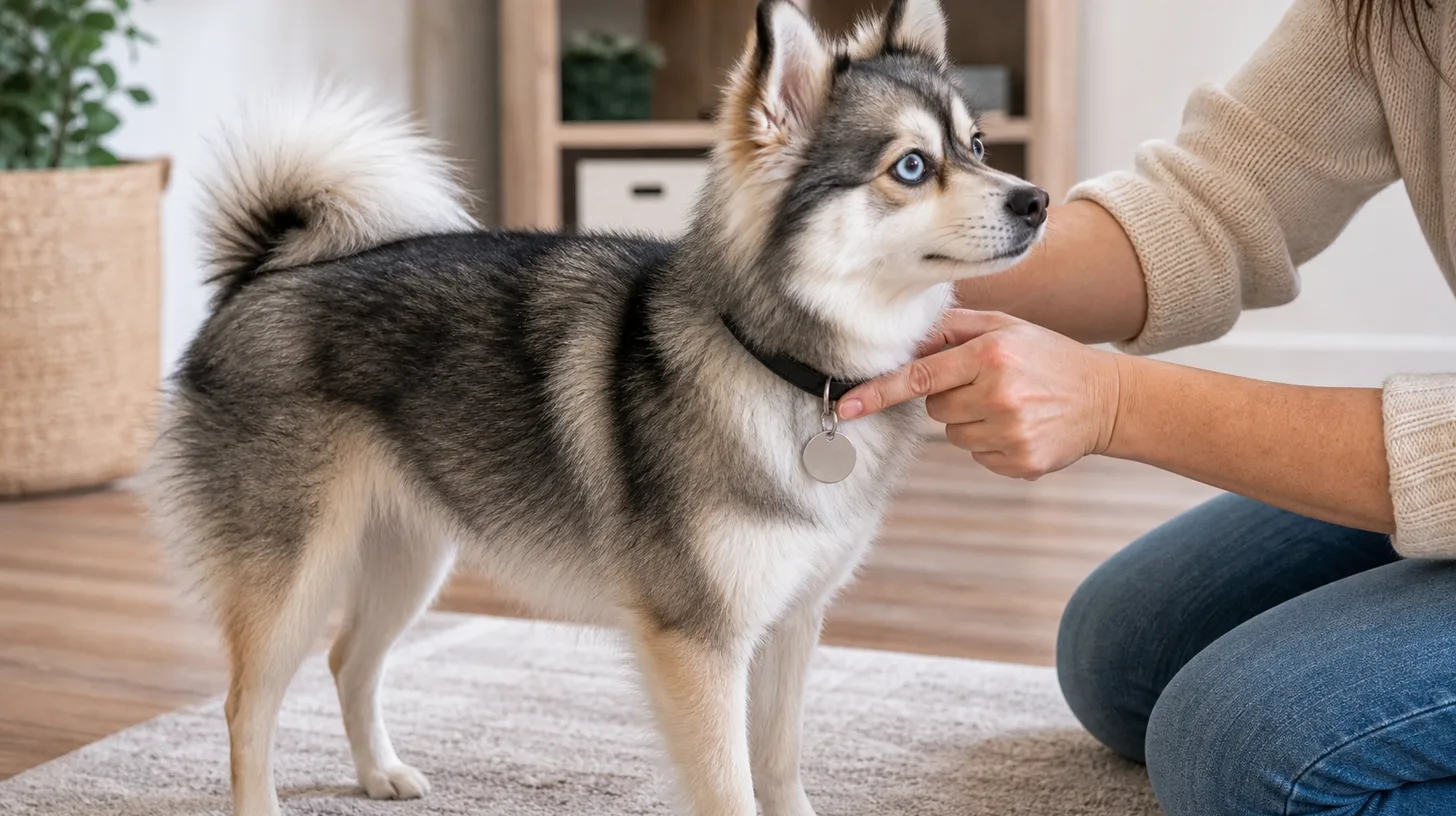
Direct answer: Measure the Pomsky's actual neck, choose a secure adjustable flat collar, and check that it permits normal breathing without sliding over the head. Part the dense coat, inspect the skin and hardware, and recheck after grooming, growth, or body-size change.
For most Pomskies, a plain adjustable flat collar is appropriate for identification, while a well-fitted harness is usually the better leash attachment for routine walks. Measure the actual neck, check that the collar cannot slide over the head, leave comfortable finger clearance, and recheck under the dense coat after grooming or body-size changes.
No collar is escape-proof, and corrective collars are not a substitute for training. Choose by function and fit rather than a breed label or product ranking.
Decide what the collar needs to do
Start with the job. A daily identification collar carries current contact information and local license or rabies tags where required. A walking collar connects to a leash. A training tool changes pressure or sensation. Combining these jobs without thought can create avoidable risk.
A lightweight flat collar with a secure buckle is a practical identification layer for many dogs. Keep the tag readable and update the phone number after a move. A microchip adds another recovery layer, but it is not GPS and does not replace visible identification.
If a Pomsky pulls, lunges, coughs on leash, or can back out of a collar, use an appropriately fitted harness and a training plan rather than tightening the collar excessively. The AAHA lifestyle and safety assessment includes collars and harnesses within a broader confinement and control review.
Remove or modify collars when a veterinarian, boarding facility, crate policy, playgroup, or sport requires it for safety. Tags and collars can catch on crates, fencing, branches, furniture, or another dog's jaw. The safest choice depends on the supervised activity and environment.
Measure a Pomsky's neck correctly
Use a flexible cloth tape around the part of the neck where the collar will sit. Keep the tape flat against the coat without crushing the airway. If a tape is unavailable, use non-stretch string and measure it against a ruler.
Record the neck circumference and the widest part of the head if escape is a concern. Compare those measurements with the manufacturer's actual adjustment range, not only a small, medium, or large label.
The AKC collar-fit guidance recommends measuring the individual dog and using a finger-clearance check. A common starting point is enough room to slide two fingers under the collar, but hand size and coat thickness vary. The functional checks matter more than repeating a slogan.
With the dog standing calmly:
- confirm normal breathing and swallowing;
- slide fingers under the collar without forcing them;
- check that the buckle and adjustment hardware do not press the throat;
- gently test whether the collar can pass over the ears or head;
- part the coat and inspect the skin;
- rotate the collar to confirm it is not trapped in matted fur.
Do not perform a forceful escape test or lift the dog by the collar.
Account for coat and growth
A Pomsky's coat can hide a collar that is too tight and can also make a loose collar appear snug. Part the fur to feel the actual strap position. Check the neck after brushing, coat blowout, professional grooming, bathing, and seasonal shedding.
Puppies need frequent adjustment. Set a recurring reminder to inspect fit and hardware, and never assume a collar purchased a month ago still fits. Replace a collar when the dog reaches the end of the safe adjustment range.
Weight gain, weight loss, medication-related swelling, skin disease, and aging can also change fit. Unexplained change in neck size, pain, cough, gagging, or sensitivity requires veterinary assessment rather than a different collar alone.
Long coat can mat beneath rough edges or bulky hardware. Remove the collar during supervised grooming, inspect friction areas, and follow the site's Pomsky grooming guide to keep coat and skin observable.
Choose materials and hardware
Select smooth, durable material with finished edges and hardware sized for the dog's strength. The buckle should close fully and resist accidental release, while still allowing an adult caregiver to remove it promptly.
Inspect:
- stitching around the buckle and D-ring;
- cracks, corrosion, bent rings, and sharp edges;
- stretched holes or slipping adjustment hardware;
- tag rings that can catch or open;
- wet material, odor, and embedded debris;
- skin redness, hair loss, or matting underneath.
Wash according to the manufacturer instructions and dry completely. Salt water, mud, sunscreen, and household cleaners can affect material and skin. Replace hardware that shows damage rather than relying on a cosmetic repair.
Reflective material can improve visibility but does not make nighttime walking safe by itself. Use a leash, lit route, caregiver visibility, and traffic awareness. Electronic trackers can support recovery but require charging and coverage and should not be described as fail-safe.
Avoid aversive and high-risk use
Do not use choke chains, prong collars, or electronic shock collars as a shortcut for loose-leash training or behavior treatment. The AVSAB humane training position statement recommends reward-based methods and details welfare concerns associated with aversive approaches.
Never attach a leash and leave the dog tied by the collar unattended. Sudden pressure can injure the neck or trap the dog. Do not use the collar to lift, drag, or physically correct a Pomsky.
A martingale collar can reduce backing out for some head-to-neck shapes when correctly fitted, but it still needs professional fitting and supervision. It should limit closure rather than choke, and it is not an unattended wear item.
Head collars require gradual conditioning and careful leash handling. They are not ordinary neck collars, and abrupt leash force can create injury. Ask a qualified professional whether the tool fits the dog's health and behavior.
Pair identification with walking equipment
For routine walks, many Pomskies benefit from wearing both an identification collar and a harness, with the leash attached as directed by the harness design. This separates identification from load-bearing control.
The Pomsky harness guide explains chest, shoulder, girth, and escape checks. No harness automatically stops pulling; teach loose-leash walking with reinforcement and suitable distance from distractions.
Before each outing, check buckle closure, strap placement, leash clip engagement, and current identification. After the walk, inspect skin and coat for rubbing. A dog that repeatedly scratches at equipment, freezes when it appears, or changes gait needs reassessment and gradual conditioning.
For car travel, a walking harness and a vehicle-restraint system are not necessarily interchangeable. Follow the vehicle product instructions and the site's Pomsky car travel safety checklist.
Monitor comfort and skin
Remove the collar regularly in a secure area to inspect the entire contact zone. Look for redness, odor, moisture, broken hair, sores, swelling, or matting. Clean and dry the collar before reuse.
Seek veterinary care for persistent coughing, breathing changes, neck pain, swelling, open skin, discharge, sudden sensitivity, or a collar injury. Do not apply human creams or essential oils under the collar without professional guidance.
If the dog guards its collar, snaps during handling, or panics when equipment approaches, do not force removal except in an immediate emergency. Use safe management and contact a veterinarian or qualified reward-based behavior professional for cooperative-care training.
The correct fit should allow normal breathing and movement, stay secure during ordinary activity, and leave healthy skin beneath it. Comfort is assessed on the dog, not from the package description.
Recheck the complete safety system
A collar is one layer. Secure doors, fences, leash habits, recall training, current identification, and a registered microchip all reduce different risks. Review the Pomsky escape-prevention guide rather than expecting one buckle to prevent every loss.
Check the collar weekly and before unusual outings. Replace it after material damage, unexplained buckle opening, significant growth, or a fit that cannot be adjusted safely.
The best Pomsky collar is not a branded "top pick." It is a simple, well-maintained item selected for a defined job, measured on the individual dog, and supported by humane training and redundant safety layers.
Sources reviewed
Each source is used only for the claim scopes listed below. None establishes a guaranteed Pomsky outcome or replaces individual professional assessment.
- American Kennel Club: Finding and Choosing the Right Dog Collar for Your Dog - Supports: neck measurement; flat-collar fit; routine cleaning and rechecking. Limit: A two-finger check is a starting fit check, not a guarantee against escape, injury, or coat compression.
- American Animal Hospital Association: Lifestyle and Safety Assessment - Supports: appropriate confinement; leash, collar and harness planning; lifestyle-specific safety review. Limit: Equipment selection must account for the individual dog's anatomy, behavior, health, and environment.
- American Veterinary Society of Animal Behavior: Humane Dog Training Position Statement - Supports: reward-based training; aversive-method risk; behavior change principles. Limit: Does not guarantee outcomes for an individual dog.