
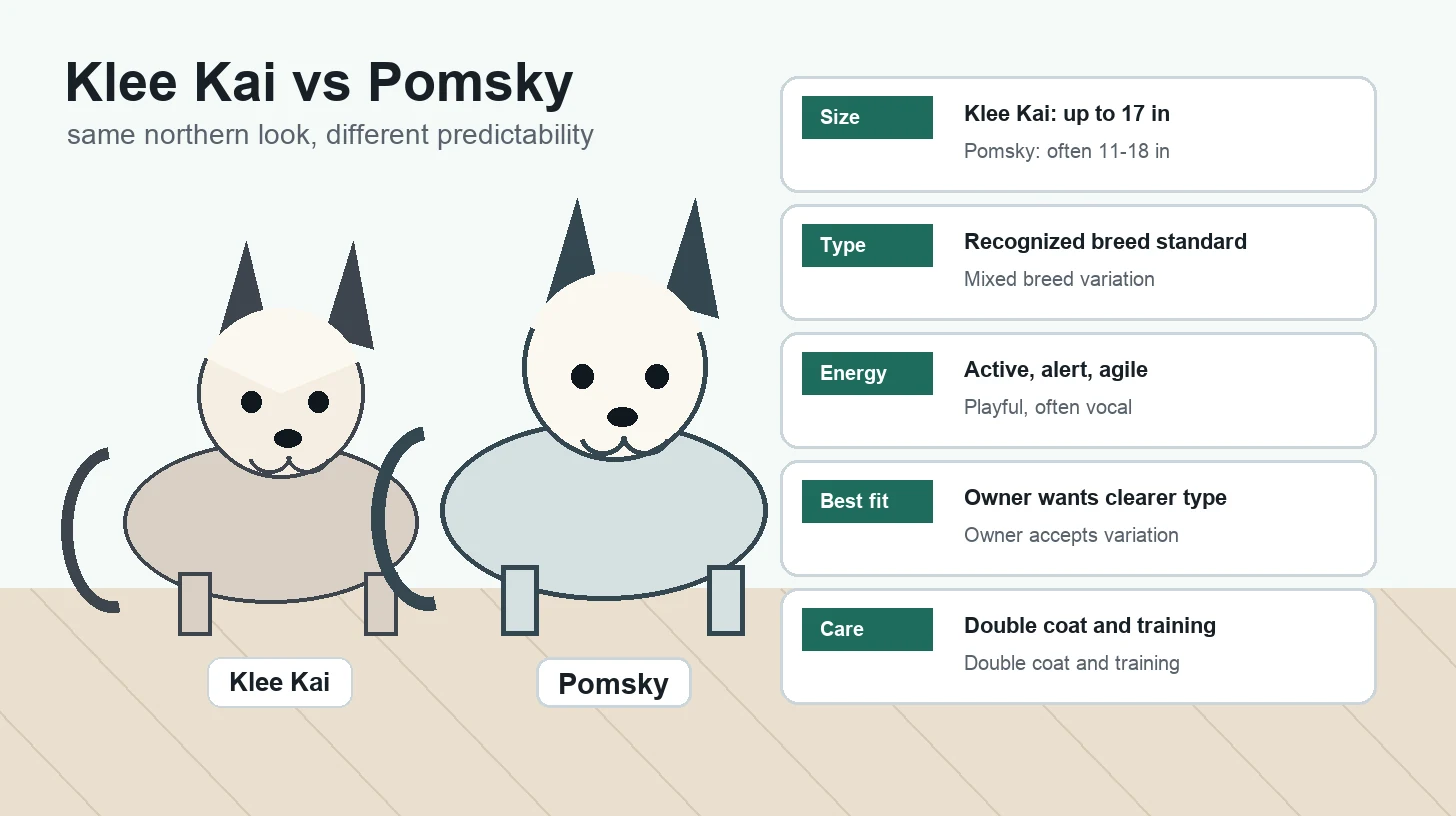
Quick answer: An Alaskan Klee Kai is a recognized breed with a defined standard, while a Pomsky is a variable Pomeranian-Husky mix. They can look similar, but predictability, size ranges, coat, temperament, sourcing, and owner fit should be compared separately.
Written and reviewed by A Pomsky Editorial Team. Published 2026-06-18; last reviewed July 25, 2026.
This comparison is informational and does not recommend a specific breeder, rescue, puppy listing, or medical decision. Verify current standards, health records, contracts, and local rules before buying or adopting. See the affiliate disclosure and health disclaimer.
Quick answer: choose an Alaskan Klee Kai if you want a small northern-type companion with a clearer breed identity and a more formal standard. Choose a Pomsky if you specifically want the Pomeranian-Husky companion mix and you are comfortable with more variation in adult size, coat, voice, and personality. In both cases, meet the individual dog, verify the breeder or rescue, and budget for training, grooming, and veterinary care.
Klee Kai and Pomsky searches overlap because both dogs can look like compact Huskies. That surface similarity hides important differences. The Alaskan Klee Kai is a recognized breed with defined varieties in the United Kennel Club standard. The Pomsky is a newer companion dog type with Pomeranian, Siberian Husky, and in some club standards additional development history. That makes Pomsky outcomes less uniform from litter to litter.
Klee Kai vs Pomsky Overview
| Question | Alaskan Klee Kai | Pomsky |
| Identity | Recognized small northern-type breed with UKC standard | Developing Pom/Husky companion type with more line variation |
| Size range | UKC varieties up to 17 inches at the withers | APKC categories commonly span 11-18 inches with varied weights |
| Temperament pattern | Alert, active, loyal, often reserved with strangers | Affectionate, playful, intelligent, sometimes vocal or stubborn |
| Grooming | Double coat; regular brushing and seasonal shedding management | Double coat; shedding and brushing needs can be heavy |
| Training need | Early socialization and calm structure are important | Early training, socialization, and boredom prevention are important |
| Best for | Owners who value a clearer breed standard and compact northern dog | Owners who accept mix variation and want a Pomsky-specific look and personality |
What Is an Alaskan Klee Kai?
The Alaskan Klee Kai was developed as a companion-sized northern spitz-type dog. UKC describes the breed as a smaller version of northern ancestors, with a masked face, prick ears, curled tail, double coat, and alert expression. The standard also emphasizes health, welfare, soundness, and avoiding exaggerations.
For owner fit, the important part is not only appearance. UKC describes Alaskan Klee Kai as curious, intelligent, active, quick, agile, loyal, and alert. They can be devoted companions, but may be aloof with strangers. AKC's breed page similarly describes the Alaskan Klee Kai as alert, energetic, curious, and reserved with unfamiliar people and situations.
What Is a Pomsky?
A Pomsky is usually discussed as a Pomeranian and Siberian Husky companion dog type. The American Pomsky Kennel Club describes the goal as a smaller Husky-like companion rather than simply a Husky-marked Pomeranian. Hill's Pet notes that Pomskies often inherit intelligence, playfulness, confidence, affection, and vocal tendencies from the parent breeds.
Because Pomskies are newer and still variable, the label alone is not enough. One Pomsky may be compact, plush, and easygoing; another may be louder, more athletic, more independent, or more difficult for a first-time owner. This page treats Pomsky as a range, not a guaranteed template.
Size and Weight Differences
Size is one of the biggest reasons people compare Klee Kai and Pomsky. They overlap, so a buyer should not assume one is always tiny and the other is always medium-sized.
| Size point | Alaskan Klee Kai | Pomsky |
| Small end | UKC toy variety is up to and including 13 inches | APKC toy category starts around 11-13 inches with average 7-15 lb range |
| Middle range | UKC miniature variety is over 13 inches to 15 inches | APKC mini category is 13.01-16 inches with average 12-20 lb range |
| Larger end | UKC standard variety is over 15 inches to 17 inches | APKC standard category is 16.01-18 inches with average 20-35 lb range |
| Main caution | Weight should be proportionate to height and bone | Weight can vary significantly; height and body condition matter |
If your decision depends on adult size, ask for mature relatives, parent sizes, growth records, and realistic ranges. Avoid sellers who promise an exact adult weight from a young puppy, especially with Pomskies where line variation is part of the decision.
Temperament and Personality
Klee Kai temperament is often described around alertness, loyalty, curiosity, and reserve. That can be excellent for an owner who likes an observant companion, but it also means socialization matters. A Klee Kai that is under-socialized may be too wary or reactive in busy homes.
Pomskies are usually marketed as affectionate and playful, but the best public sources also warn about voice, willfulness, and training demands. APKC describes the desired Pomsky temperament as affectionate, intelligent, biddable, playful, adaptable, confident, and curious. Hill's Pet adds that Pomskies can be vocal, protective, willful, and challenging for inexperienced owners.
Trainability and Socialization
Both dogs are smart enough to learn quickly and smart enough to form unwanted habits quickly. The safer assumption is that either breed needs early socialization, short positive training sessions, predictable household rules, and mental enrichment.
- Klee Kai: prioritize people, handling, noise, vet visit, leash, crate, and guest exposure early.
- Pomsky: prioritize recall, calm greetings, boredom prevention, leash manners, crate comfort, and quiet cues.
- Both: avoid punishment-heavy methods that increase fear, conflict, or defensive behavior.
Energy, Exercise, and Apartment Fit
Neither dog should be chosen as a couch decoration. Klee Kai are active and agile. Pomskies can have high energy and may need about an hour of daily activity, according to Hill's Pet, plus puzzle toys and indoor outlets to prevent boredom.
Apartment fit depends less on square footage and more on noise, schedule, training, neighbors, and owner consistency. A quiet, trained, well-exercised Pomsky may do better in an apartment than a poorly socialized Klee Kai. A calm Klee Kai may do better than a highly vocal Pomsky in a building with thin walls.
Grooming, Shedding, and Coat Care
Both dogs generally bring northern double-coat maintenance. Expect brushing, seasonal shedding, and fur around the home. Pomsky coat length and density can vary from shorter standard coats to plush or woolier coats, while Klee Kai also have a double coat tied to their northern heritage.
Before choosing either dog, decide whether you can handle regular brushing, nail care, ear checks, dental care, and occasional professional grooming. If shedding is a deal-breaker, neither comparison point is ideal.
Health and Lifespan Caveats
This guide is not veterinary advice, and no breed label proves a puppy will be healthy. Klee Kai standards include attention to soundness and breed-specific faults. Pomsky sources discuss the need for health testing, responsible breeding, and awareness of possible issues from parent breeds.
Ask for parent health information, veterinary records, age-appropriate screening, contracts, and return terms. For any symptoms, behavior changes, lameness, breathing issues, dental problems, seizures, skin problems, or sudden appetite changes, talk to a veterinarian rather than relying on breed averages.
Cost and Buying Risk
Purchase price varies by region, breeder, age, demand, testing, and included care. Pomsky listings often reach the low thousands of dollars, and rare appearance traits can raise prices. Klee Kai pricing can also be high because responsible breeders, small litters, and limited availability affect supply.
The better comparison is not which dog is cheaper. The better comparison is which seller can document health practices, parent information, contract terms, early care, and support after placement. A low-price puppy can become expensive if health, behavior, or seller problems were hidden.
Owner Fit: Which Dog Should You Choose?
| Your priority | Likely better fit | Why |
| Clearer breed standard | Alaskan Klee Kai | More formal identity and defined size varieties |
| Pom/Husky companion mix | Pomsky | The Pomsky look and personality range is the point |
| Very low shedding | Neither | Both can have double coats and meaningful shedding |
| Quiet apartment dog | Individual dog | Pomskies may be vocal; Klee Kai may be alert and reserved |
| First-time owner | Only with support | Both can be workable with training, but neither is hands-off |
| Predictable adult outcome | Klee Kai | Breed standard gives a clearer frame than most Pomsky litters |
Decision Checklist Before You Commit
- Meet the dog or breeder by video or in person before final payment.
- Ask for parent size, adult relatives, and realistic adult size ranges.
- Review health testing, veterinary records, and vaccination information.
- Read the contract before sending a deposit.
- Ask how puppies are socialized and how noise/reactivity are managed.
- Budget for grooming tools, training, veterinary care, food, crate, and emergency savings.
- Avoid sellers who guarantee exact adult size, rare traits, or perfect behavior.
- Choose the individual dog, not only the prettier photo.
Frequently Asked Questions
Are Klee Kai and Pomsky the same dog?
No. The Alaskan Klee Kai is a recognized small northern-type breed with a breed standard. The Pomsky is a developing companion dog type based on Pomeranian and Siberian Husky ancestry, with more variation between breeders and lines.
Which is bigger, a Klee Kai or a Pomsky?
They overlap. UKC Alaskan Klee Kai varieties run up to 17 inches at the withers. APKC Pomsky size categories commonly span 11 to 18 inches, with average weight ranges that vary by category and individual body condition.
Which sheds more?
Either can shed heavily. Both are northern-looking dogs with double-coat maintenance. The individual coat, season, grooming routine, diet, health, and home environment all affect how much fur you manage.
Which is easier to train?
Neither is automatically easier. Klee Kai can be alert and reserved, while Pomskies can be vocal, stubborn, and energetic. Consistent positive training and early socialization matter more than the label.
Which is better for apartments?
Either can work in the right apartment if exercise, noise, and training are handled. A very vocal Pomsky or highly reactive Klee Kai can be difficult in shared walls. Meet the dog and ask about real behavior, not only breed traits.
Which costs more?
Both can be expensive depending on breeder quality, health testing, region, demand, age, and included care. Compare documentation and support, not only purchase price.
Can a first-time owner get either dog?
Yes, but only with realistic expectations. A first-time owner should plan for puppy class, daily exercise, grooming, socialization, and professional help early if fear, barking, reactivity, or training trouble appears.
Related Pomsky Guides
- Pomsky comparison guides
- Pomsky size and growth hub
- Pomsky price hub
- How much is a Pomsky puppy?
- Pomsky crate size guide
- Best brush for Pomskies
- Editorial policy
- Health disclaimer
- Affiliate disclosure
Sources Reviewed
- United Kennel Club - Alaskan Klee Kai breed standard
- American Kennel Club - Alaskan Klee Kai breed information
- American Pomsky Kennel Club - APKC Standards 2025
- American Pomsky Kennel Club - Is a Pomsky right for me?
- Hill's Pet Nutrition - Pomsky dog breed information
- American Kennel Club - Signs of a responsible breeder
Evidence and related Pomsky guides
These sources support only their stated claim scopes; they do not guarantee an individual Pomsky outcome.
Sources reviewed for this page
- American Kennel Club: Alaskan Klee Kai Dog Breed Information
- American Kennel Club: Pomeranian Dog Breed Information
- American Kennel Club: Siberian Husky Dog Breed Information