Written and reviewed by A Pomsky Editorial Team. Originally published 2023-04-19; substantively reviewed July 26, 2026.
Training boundary: Use humane, reward-based methods and protect safety with management. Pain, panic, aggression, a bite history, or serious handling risk requires a veterinarian or qualified behavior professional. Read the editorial policy.
Direct answer: Teach a Pomsky a visible replacement behavior such as resting on a mat or waiting behind a threshold. Reward the location, add duration and distractions gradually, and keep gates, doors, or a leash as backup where crossing the boundary could be unsafe.
A household boundary is a behavior the dog can perform, not an invisible rule the dog should somehow understand. Teach a Pomsky where to wait, settle, or turn away; reward that choice; and use gates, doors, leashes, or distance so mistakes cannot become dangerous rehearsals.
The fastest reliable approach is to make the correct location obvious and valuable. Punishment after the dog crosses a line may interrupt behavior, but it does not explain where to go or what to do next.
Define one observable boundary behavior
Replace a vague goal such as "stay out of the kitchen" with an action you can see and reward. Examples include four paws on a mat, waiting behind a threshold, remaining outside a marked work area, or returning to a bed when asked.
Start with one location and one cue. If several family members use different words or allow different exceptions, the dog receives an inconsistent pattern. Write down the boundary, the permitted release cue, and who is responsible for practice.
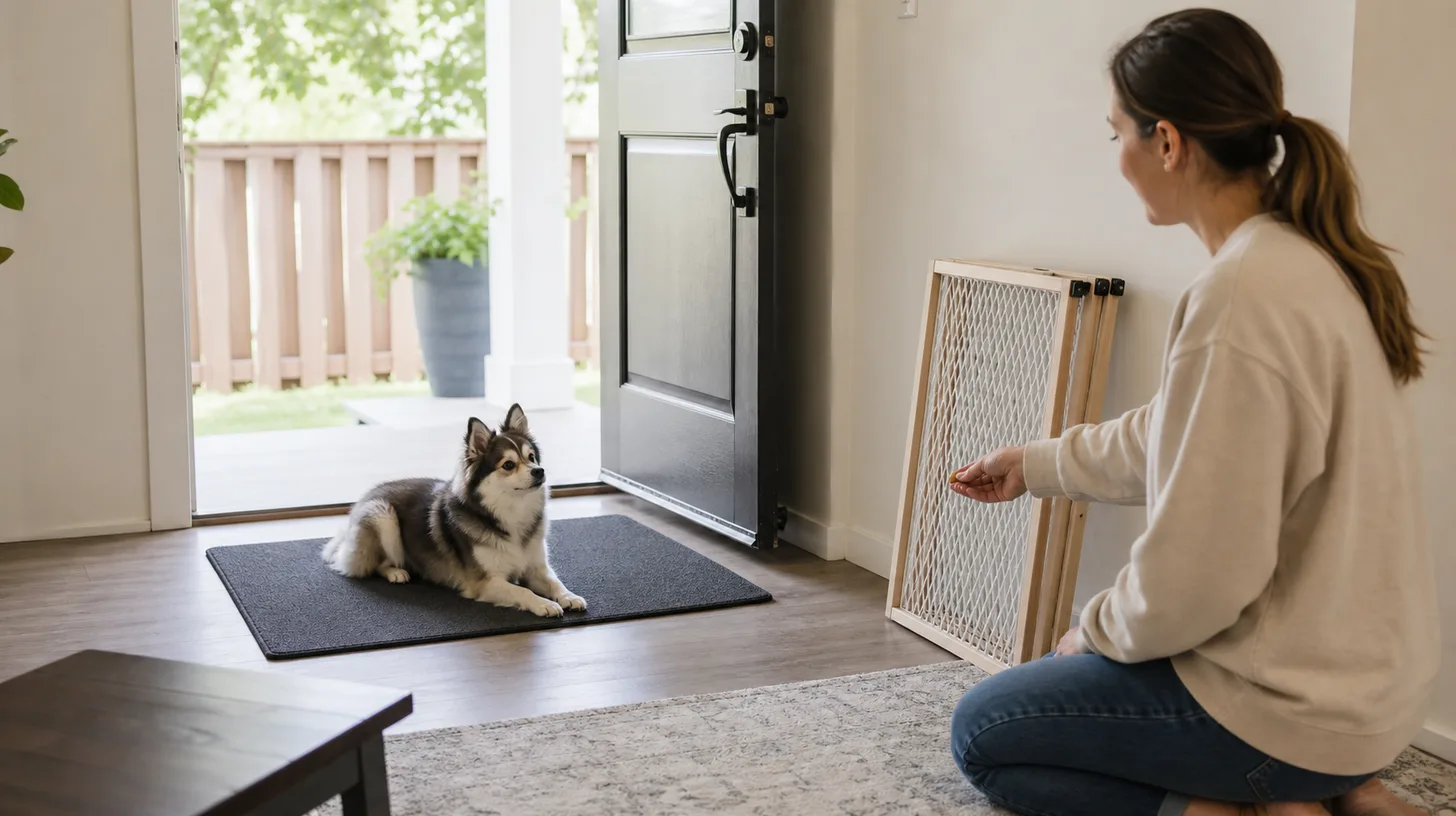
Choose a target position that works in real life. A mat should be large enough for the dog to lie comfortably and placed far enough from traffic that people do not step over the dog. A doorway wait must not leave the dog in the swing path. Near an exterior door, use a physical backup barrier because a training cue is not escape-proof.
The AVSAB humane training position statement recommends reward-based methods for training and behavior modification. That principle fits boundary work: reinforce the response you want and manage the environment while the skill is developing.
Teach the mat before adding the boundary
Place the mat in a quiet room. Mark and reward any voluntary interest: looking at it, stepping toward it, placing a paw on it, and eventually standing or lying on it. Deliver rewards on the mat so the location gains value.
Once the dog repeatedly moves onto the mat, add a cue such as "mat" just before the movement. Release with a separate word and toss a treat away so the distinction between staying and being released is clear. Keep early sessions short.
Build duration one small step at a time. Reward after one second, then two, then vary the interval. If the dog leaves repeatedly, the increase was too large. Reduce duration or distractions instead of repeating the cue more loudly.
Add your own movement gradually. Take one step away, return, and reward. Then practice sitting down, turning your back briefly, opening a cabinet, or carrying an object. Change only one difficulty at a time: duration, distance, or distraction.
Do not trap the dog on the mat. The goal is a fluent, reinforced choice, not stillness caused by fear. If the dog avoids the area, freezes, pants when the room is cool, refuses food, or repeatedly tries to leave, stop and reassess the setup.
Transfer the skill to a doorway
Begin at an interior doorway with little consequence. Approach on leash if necessary, stop before the threshold, cue the mat or wait behavior, and reward behind the line. Open the door only a small amount. If the dog moves forward, close it calmly and make the next repetition easier.
The opening door becomes a consequence: staying back makes access possible; rushing makes the door pause. Release the dog only when the route is safe. This teaches a functional pattern without intimidation.
For exterior doors, add a baby gate, exercise pen panel, closed secondary door, or secured leash. The AAHA lifestyle and safety assessment highlights confinement and control across the home, yard, car, and travel. Training reduces risk, but management protects the dog when a visitor, delivery, loud noise, or human error exceeds the training level.
Practice with realistic movements only after calm repetitions succeed: picking up keys, putting on shoes, touching the handle, opening the door, stepping through, and returning. A family member should not test the dog by suddenly sprinting outside or calling from the other side.
Add household distractions gradually
List distractions from easiest to hardest. A quiet person walking past may be easy; dropped food, children running, a doorbell, another pet, or an arriving guest may be difficult. Work below the level that causes the dog to abandon the trained response.
Use distance to reduce difficulty. If the Pomsky cannot settle three feet from the kitchen, move the mat farther away. If the dog leaves when food is carried, practice first with an empty plate, then a low-value item, then a normal meal.
Reward the dog often enough to make the rule worthwhile. Early training may require frequent food rewards. Over time, real-life rewards can join the plan: being released to greet a guest, going into the yard, receiving a chew, or resting near the family. Do not remove reinforcement abruptly after the first successful day.
A sample progression is:
- ten calm mat repetitions in an empty room;
- ten repetitions while the handler takes one or two steps;
- brief stays while a household member walks past;
- practice near the target area at a generous distance;
- short real-life uses with a gate as backup;
- gradual increases in duration and normal household activity.
Advance based on relaxed success, not a calendar.
Prevent common boundary-training mistakes
Do not create a rule that changes by mood. If the kitchen is off-limits only when cooking, pair the boundary with a clear environmental cue or mat setup rather than expecting the dog to infer human intent.
Avoid repeatedly pushing, blocking with a knee, yelling, spraying water, or using shock, prong, or boundary collars. These methods can add fear or conflict around people and locations. They may suppress movement without teaching the desired station.
Do not use the cue when you cannot reinforce or manage it. Saying "stay" while the dog runs through an open front door rehearses cue failure. Secure the dog first, then train at a level where the response is possible.
Do not punish a return. If the dog crosses the line and then comes back, reward or calmly reset. Punishing the return can make both recall and boundary behavior weaker.
Finally, do not assume a thick coat or compact size makes equipment fit obvious. If you use a house line during supervised practice, keep it lightweight, prevent tangling, and remove it when supervision ends.
Troubleshoot by changing one variable
When progress stalls, record what happened immediately before the boundary failed. Was the session longer, the reward weaker, the mat moved, the person farther away, or the distraction new? Change one factor and test again.
If the dog succeeds alone but not with another family member, have that person repeat easy foundation steps. If the dog understands the mat but cannot stay during meals, teach the separate settle behavior for begging instead of stretching one cue across every context.
Sudden inability to settle, reluctance to lie down, sensitivity to handling, new pacing, or a marked behavior change can reflect pain or illness. Arrange veterinary assessment rather than treating every failure as disobedience.
Fear, guarding, lunging, or panic around a doorway needs qualified help. The site's guide to choosing a Pomsky trainer explains how to look for transparent, reward-based methods. Severe anxiety or aggression may require a veterinarian or veterinary behaviorist as part of the team.
Maintain the boundary in daily life
Use the skill outside formal sessions. Ask for the mat while groceries enter, before a guest comes through, during food preparation, or when children need clear space. Keep the first real uses short and retain the gate or leash backup.
Reinforce strong responses unpredictably rather than stopping rewards completely. Sometimes deliver food, sometimes release access, and sometimes offer calm praise followed by rest. Refresh the easy version after travel, moving furniture, a new pet, or a long break.
Link boundary behavior with related safety skills. A reliable recall foundation helps recover from a mistake, while escape-prevention layers protect exterior doors and yards. Neither skill makes an open door safe by itself.
A well-taught boundary is clear, observable, and supported by the environment. When the Pomsky knows exactly where to go and receives a worthwhile consequence for going there, the rule becomes easier for both dog and household to maintain.
Sources reviewed
Each source is used only for the claim scopes listed below. None establishes a guaranteed Pomsky outcome or replaces individual professional assessment.
- American Veterinary Society of Animal Behavior: Humane Dog Training Position Statement - Supports: reward-based training; aversive-method risk; behavior change principles. Limit: Does not guarantee outcomes for an individual dog.
- American Animal Hospital Association: Lifestyle and Safety Assessment - Supports: appropriate confinement; leash, collar and harness planning; lifestyle-specific safety review. Limit: Equipment selection must account for the individual dog's anatomy, behavior, health, and environment.