
Quick answer: Routine shaving is usually not appropriate for a healthy Pomsky double coat. It does not stop shedding and may change regrowth or reduce protection; clipping may still be medically necessary or needed for severe matting under professional direction.
Written and reviewed by A Pomsky Editorial Team. Published 2026-06-18; last reviewed July 25, 2026.
This coat-care guide is informational and is not a substitute for veterinary or professional grooming advice. If your Pomsky has severe mats, skin redness, odor, wounds, pain, or sudden hair loss, contact a veterinarian or qualified groomer. See the health disclaimer.
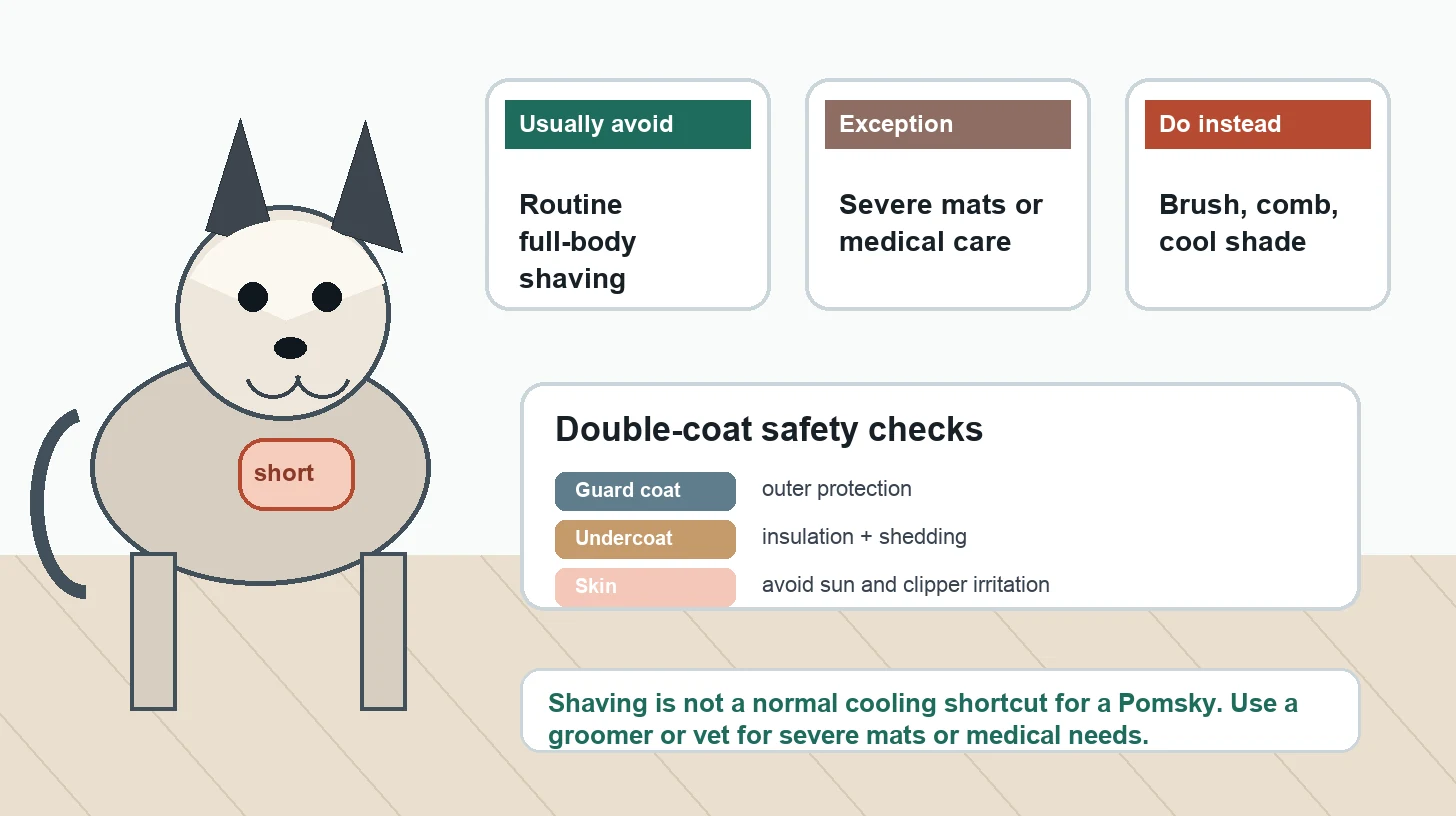
Quick answer: shaving a Pomsky is usually not recommended as a routine grooming or summer cooling shortcut. A Pomsky often has a dense double coat, and shaving can expose skin, change coat regrowth, reduce natural weather protection, and still fail to solve shedding. Severe mats or medical needs are the main exceptions.
This guide is for owners asking whether a Pomsky should be shaved, what can happen after clipping, and what to do instead. It is not a substitute for a veterinarian or qualified groomer, especially when mats are tight, skin is irritated, or the dog is already uncomfortable.
What Happens If You Shave a Pomsky?
When you shave a Pomsky, you remove both the outer guard coat and much of the insulating undercoat. That can leave the skin more exposed and can change how the coat returns. Some dogs grow back evenly, but others look patchy, coarse, wooly, or uneven for months.
| Possible result | Why it matters | What to do instead |
| Patchy regrowth | Undercoat and guard hairs may not return at the same speed | Brush and comb regularly; trim only what needs trimming |
| Skin exposure | Short coat can expose pale or sensitive skin to sun and irritation | Use shade, indoor rest, and avoid peak heat |
| Less coat protection | The coat helps buffer weather, dirt, and minor outdoor contact | Remove loose coat without clipping to skin |
| More grooming stress | A forced shave can make handling harder later | Use short, calm grooming sessions and professional help |
| Unsolved shedding | Shaving shortens hair; it does not stop the hair cycle | Use slicker brush, comb, and light undercoat tools |
Why a Pomsky Coat Is Different
Many Pomskies inherit coat traits from both Pomeranian and Siberian Husky lines. That often means a fluffy outer coat plus a dense undercoat. The undercoat sheds, while the guard coat helps protect the skin and gives the coat structure.
Self-contained answer: a Pomsky coat should usually be managed by brushing, combing, bathing when needed, drying well, and removing loose undercoat. Shaving is a last-resort or professional-care tool, not a standard way to reduce heat or shedding.
Should You Shave a Pomsky in Summer?
Most Pomskies should not be shaved just because the weather is hot. A shorter coat may look cooler to humans, but it can remove insulation and expose the skin. Heat safety should focus on environment, timing, hydration, shade, and removing dead undercoat.
Safer summer steps
- Brush and comb several times per week to remove trapped loose hair.
- Use a light undercoat rake only where it moves without scraping or pulling.
- Walk during cooler parts of the day.
- Provide shade, fresh water, and indoor rest during peak heat.
- Keep coat clean and dry so air can reach the skin more easily.
- Ask a groomer about trimming paw pads, sanitary areas, or feathering instead of shaving the body.
When Shaving or Clipping May Be Necessary
There are real exceptions. Clipping can be appropriate when the coat is severely matted, a veterinarian needs skin access, surgery is planned, parasites or wounds require treatment, or a professional groomer decides clipping is the least painful way to remove tight mats.
| Situation | Who should handle it | Why |
| Severe mats close to skin | Professional groomer or veterinarian | Skin can be pulled into mats and cut accidentally |
| Skin infection, wounds, or hot spots | Veterinarian | The skin problem needs diagnosis and treatment |
| Surgery or medical imaging | Veterinary team | Clipping is done for medical access and cleanliness |
| Fleas, ticks, or parasite complications | Veterinarian or groomer depending on severity | Clipping may support treatment, but prevention and medicine matter |
| Paw-pad or sanitary trimming | Owner with skill or groomer | Small targeted trimming is different from shaving the body |
Do Not Cut Tight Mats With Scissors
Tight mats can pull skin upward. If you slide household scissors under a mat, you may not see where the skin begins. VCA grooming guidance recommends professional care for severe tangles and using clippers rather than scissors when mats must be removed.
For mild tangles, work slowly with a slicker brush and comb. If the comb cannot pass through after gentle brushing, stop. Forcing the tool through a mat can hurt the dog and make future grooming more difficult.
Will a Shaved Pomsky Coat Grow Back?
A Pomsky coat often grows back, but not always in the same texture or timing. The undercoat can come back faster than the guard coat, making the coat feel fuzzy, uneven, or thicker in some places. Color and pattern may also look different during regrowth.
If your Pomsky has already been shaved, focus on skin protection and calm regrowth care. Avoid repeat shaving unless a veterinarian or groomer has a clear reason. Keep the skin out of harsh sun, brush gently as hair returns, and watch for redness, itching, scabs, or odor.
What to Do If Your Pomsky Was Already Shaved
- Protect the skin: avoid long direct sun exposure and harsh weather while the coat is very short.
- Skip harsh products: use only dog-safe shampoo and rinse thoroughly when bathing is needed.
- Brush gently as it grows: do not rake hard through short or irritated coat.
- Watch for symptoms: redness, repeated scratching, odor, dandruff, scabs, or hot spots need attention.
- Ask for help early: a groomer can plan regrowth grooming, and a veterinarian should check skin changes.
How to Keep a Pomsky Cool Without Shaving
Cooling a Pomsky safely is mostly about reducing heat exposure and keeping the coat functional. Brushing removes dead coat that can trap warmth, but clipping the entire body is not the same as improving coat health.
- Use morning or evening walks instead of midday heat.
- Offer water before, during, and after outdoor activity.
- Use shade, fans, air conditioning, and cool indoor flooring.
- Keep exercise shorter during hot or humid weather.
- Brush out loose undercoat before baths.
- Dry the coat well after bathing or swimming.
- Use a cooling mat or damp towel only if your dog tolerates it and stays supervised.
Safe Grooming Routine for a Pomsky Coat
A steady routine prevents the situation where shaving feels like the only option. The routine does not need to be complicated, but it must reach hidden areas where mats form.
- Brush small sections with a gentle slicker brush.
- Comb each section afterward to check for hidden tangles.
- Pay attention behind ears, under the collar, armpits, back legs, belly, and tail base.
- Use a dog-safe shampoo only when the coat is dirty or smells.
- Dry dense coat thoroughly after baths.
- Trim nails and check paws during grooming sessions.
- Stop before the dog becomes stressed or defensive.
Shaving Myths to Avoid
| Myth | Reality |
| Shaving stops Pomsky shedding | It only shortens the hair being shed; the coat cycle continues |
| Shorter always means cooler | A double coat also provides insulation and skin protection |
| Mats can be cut out quickly at home | Tight mats can hide skin and should be handled professionally |
| A shaved coat always grows back the same | Regrowth can be uneven, wooly, patchy, or slower in some areas |
| All groomers will shave a Pomsky | Many will recommend brushing, deshedding, sanitary trimming, or targeted clipping instead |
When to Call a Groomer or Veterinarian
Call a professional when the coat problem is painful, close to the skin, widespread, or linked to skin changes. A groomer can remove coat safely, and a veterinarian can diagnose irritation, infection, parasites, allergies, wounds, or pain.
- Your Pomsky cries, flinches, growls, or snaps when a mat is touched.
- The mat is tight, damp, smelly, or close to the skin.
- The skin looks red, hot, crusted, bleeding, or scabby.
- Your dog scratches one area repeatedly or loses hair in patches.
- You see fleas, ticks, discharge, or an unusual odor.
- You cannot brush through the coat without pulling.
Frequently Asked Questions
What happens if you shave a Pomsky?
Shaving a Pomsky can expose the skin, change coat texture, make regrowth uneven, and remove part of the coat's natural weather protection. It also does not stop shedding. The better routine is brushing, comb checking, safe bathing, drying, and professional help for mats.
Should you shave a Pomsky in summer?
Most Pomskies should not be shaved in summer as a normal cooling method. Use shade, fresh water, indoor rest, cooler walk times, and regular brushing to remove dead undercoat. Ask a groomer about targeted trimming if the coat is hard to maintain.
When is shaving a Pomsky necessary?
Shaving or clipping may be necessary for severe mats, veterinary treatment, surgery, wounds, parasite complications, or cases where a professional decides clipping is the least painful option. That is different from shaving a healthy coat for convenience.
Will a Pomsky coat grow back after shaving?
A Pomsky coat often grows back, but it may not look or feel exactly the same at first. Guard hairs and undercoat may grow at different speeds, which can create a patchy, wooly, or uneven appearance during regrowth.
How do I keep a Pomsky cool without shaving?
Keep a Pomsky cool with regular brushing, undercoat removal during shedding, shade, water, shorter activity in heat, cool indoor rest, and safe drying after baths. These steps protect the coat while reducing heat stress.
Can I cut Pomsky mats with scissors?
Do not cut tight mats with household scissors. Mats can pull skin into the hair, making cuts easy even when you cannot see the skin. Use gentle brushing for mild tangles and ask a groomer or veterinarian for tight mats.
Related Pomsky Grooming Guides
- Pomsky grooming hub
- Pomsky grooming tools: what to buy and skip
- Best brush for Pomskies
- Best shampoo for Pomskies
- Health disclaimer
- Affiliate disclosure
- Editorial policy
Sources Reviewed
- American Kennel Club - Should you shave your dog in the summer?
- American Kennel Club - How to groom a double-coated dog
- VCA Animal Hospitals - Grooming and coat care for your dog
- ASPCA - Dog grooming tips
- ASPCA - Preventing your pet's coat from matting
- Merck Veterinary Manual - Preventative health care and husbandry in small animals
Evidence and related Pomsky guides
These sources support only their stated claim scopes; they do not guarantee an individual Pomsky outcome.
Sources reviewed for this page
- American Kennel Club: Pomeranian Dog Breed Information
- American Kennel Club: Siberian Husky Dog Breed Information
- American Animal Hospital Association: AAHA-AVMA Canine Preventive Healthcare Guidelines