Written and reviewed by A Pomsky Editorial Team. Originally published 2026-07-26; substantively reviewed July 26, 2026.
Training boundary: Use humane, reward-based methods and protect safety with management. Pain, panic, aggression, a bite history, or serious handling risk requires a veterinarian or qualified behavior professional. Read the editorial policy.
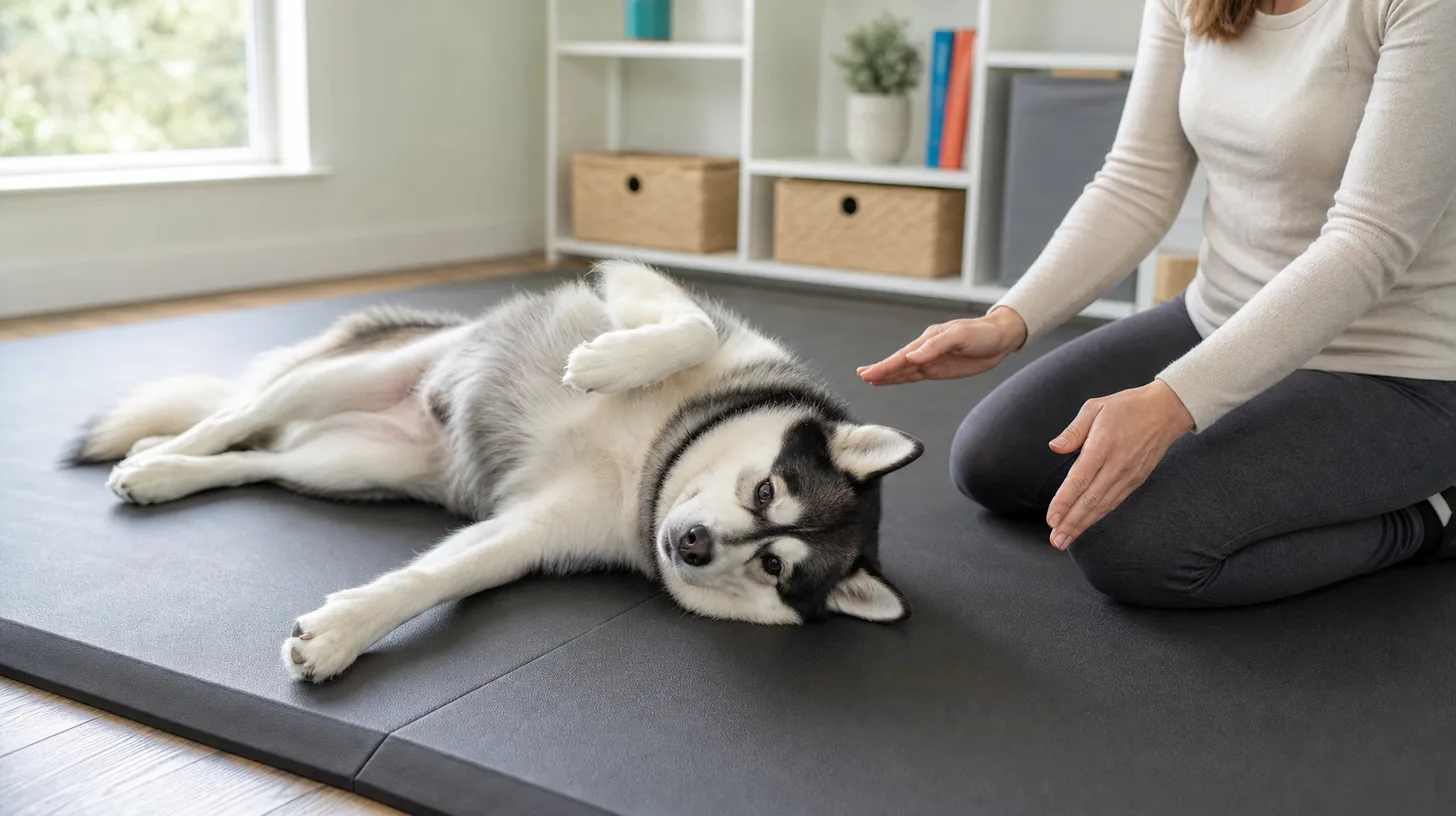
Direct answer: Use a wide padded nonslip mat and begin only if the Pomsky already offers a comfortable down and can lie on one side without hesitation. Reward the side-lying posture first. Next mark a small shoulder and hip weight shift toward the back, then place the reward where the head can follow in a broad neutral arc without twisting the neck. Shape the movement in separate pieces until one relaxed full roll occurs. Add the verbal cue only after the same sequence is predictable. Balance repetitions between sides only when both are comfortable. Never push the body, pull the paws or repeat through fatigue. Stop for stiffness, pain, fear, imbalance or reluctance.
This page shapes a full voluntary body roll from side lying; down ends in a prone posture, bow keeps the rear standing, and lateral side-step is an upright sideways movement. Use a wide padded nonslip mat and begin only if the Pomsky already offers a comfortable down and can lie on one side without hesitation. Reward the side-lying posture first. Next mark a small shoulder and hip weight shift toward the back, then place the reward where the head can follow in a broad neutral arc without twisting the neck. Shape the movement in separate pieces until one relaxed full roll occurs. Add the verbal cue only after the same sequence is predictable. Balance repetitions between sides only when both are comfortable. Never push the body, pull the paws or repeat through fatigue. Stop for stiffness, pain, fear, imbalance or reluctance. This guide is limited to reward-based skill building in a controlled setup. It does not make a medical, temperament or guaranteed-behavior claim.
Direct answer
Use a wide padded nonslip mat and begin only if the Pomsky already offers a comfortable down and can lie on one side without hesitation. Reward the side-lying posture first. Next mark a small shoulder and hip weight shift toward the back, then place the reward where the head can follow in a broad neutral arc without twisting the neck. Shape the movement in separate pieces until one relaxed full roll occurs. Add the verbal cue only after the same sequence is predictable. Balance repetitions between sides only when both are comfortable. Never push the body, pull the paws or repeat through fatigue. Stop for stiffness, pain, fear, imbalance or reluctance.
The reader task is specific: Begin only from a comfortable voluntary down and side-lying posture on a padded nonslip surface, reward a small shoulder and hip weight shift, shape one unhurried complete roll without pushing the body or pulling a lure over the neck, add the cue later, and stop for stiffness, pain, fear, repeated imbalance or reluctance. Keep the nearest owner pages separate when the real problem is equipment selection, household management, a complete routine, medical care or another already-defined training behavior.
Confirm Comfortable Down and Side Lying
Use only a posture the Pomsky offers freely without bracing, repeated repositioning or hesitation.
For how to teach a pomsky to roll over safely, this checkpoint passes only when the Pomsky completes the described step voluntarily and returns to ordinary posture without crowding, restraint or repeated prompting. Define the pass condition before beginning and record the first observable response that earns reinforcement. Do not add the next confirm comfortable down and side lying variable until that observable criterion is repeatable.
Prepare a Wide Padded Surface
Choose enough nonslip space for the complete body and remove furniture, edges, toys and other animals.
For how to teach a pomsky to roll over safely, this checkpoint passes only when the Pomsky completes the described step voluntarily and returns to ordinary posture without crowding, restraint or repeated prompting. Keep footing, equipment and the exit route easier than the final use case so one error does not create another forced attempt. Do not add the next prepare a wide padded surface variable until that observable criterion is repeatable.
Reward the Side-Lying Starting Point
Reinforce relaxed hip and shoulder contact before asking for any movement toward the back.
For how to teach a pomsky to roll over safely, this checkpoint passes only when the Pomsky completes the described step voluntarily and returns to ordinary posture without crowding, restraint or repeated prompting. Change only one variable after three calm successes; duration, distance, body position and distraction should not rise together. Do not add the next reward the side-lying starting point variable until that observable criterion is repeatable.
Capture a Small Weight Shift
Mark the first voluntary shoulder and hip rotation without touching the legs, spine or head.
For how to teach a pomsky to roll over safely, this checkpoint passes only when the Pomsky completes the described step voluntarily and returns to ordinary posture without crowding, restraint or repeated prompting. Treat a reset as information by restoring the starting picture, waiting for ordinary movement and making the next repetition easier. Do not add the next capture a small weight shift variable until that observable criterion is repeatable.
Guide a Broad Neutral Head Arc
Place reinforcement where the nose can follow slowly without lifting sharply or twisting the neck.
For how to teach a pomsky to roll over safely, this checkpoint passes only when the Pomsky completes the described step voluntarily and returns to ordinary posture without crowding, restraint or repeated prompting. Place reinforcement where it prepares the next safe setup instead of creating crowding, twisting, rushing or fixation. Do not add the next guide a broad neutral head arc variable until that observable criterion is repeatable.
Shape the Back-to-Other-Side Transition
Reward partial movement across the back before expecting the feet and body to complete the roll.
For how to teach a pomsky to roll over safely, this checkpoint passes only when the Pomsky completes the described step voluntarily and returns to ordinary posture without crowding, restraint or repeated prompting. End while the Pomsky can still choose and recover; repetition after fatigue or avoidance changes the behavior being taught. Do not add the next shape the back-to-other-side transition variable until that observable criterion is repeatable.
Mark One Unhurried Full Roll
Reinforce after the Pomsky reaches a stable posture on the opposite side and recovers ordinary breathing.
For how to teach a pomsky to roll over safely, this checkpoint passes only when the Pomsky completes the described step voluntarily and returns to ordinary posture without crowding, restraint or repeated prompting. Use physical management for real-world risk while the skill is incomplete because a cue never replaces barriers or fitted equipment. Do not add the next mark one unhurried full roll variable until that observable criterion is repeatable.
Add the Cue After Predictability
Say roll over before the known sequence and keep hand help smaller across successful repetitions.
For how to teach a pomsky to roll over safely, this checkpoint passes only when the Pomsky completes the described step voluntarily and returns to ordinary posture without crowding, restraint or repeated prompting. Describe feet, head position, distance, latency and recovery rather than assigning motives such as stubbornness or dominance. Do not add the next add the cue after predictability variable until that observable criterion is repeatable.
Balance Sides Only if Comfortable
Treat each direction separately and omit a side that produces stiffness, fear or repeated difficulty.
For how to teach a pomsky to roll over safely, this checkpoint passes only when the Pomsky completes the described step voluntarily and returns to ordinary posture without crowding, restraint or repeated prompting. Generalize as a new lesson, returning to an easier criterion whenever the room, surface, caregiver or equipment changes. Do not add the next balance sides only if comfortable variable until that observable criterion is repeatable.
Stop for Pain or Loss of Balance
End for yelping, guarding, stiffness, slipping, frantic rolling, neck discomfort, fatigue or refusal to lie on one side.
For how to teach a pomsky to roll over safely, this checkpoint passes only when the Pomsky completes the described step voluntarily and returns to ordinary posture without crowding, restraint or repeated prompting. Protect the stop rule: pain, startle, guarding, panic, equipment failure or repeated avoidance requires a different plan. Do not add the next stop for pain or loss of balance variable until that observable criterion is repeatable.
Training record
Record the date, location, setup and reward used for how to teach a pomsky to roll over safely. Track the first three checkpoints (Confirm Comfortable Down and Side Lying, Prepare a Wide Padded Surface, Reward the Side-Lying Starting Point), the middle progression (Capture a Small Weight Shift, Guide a Broad Neutral Head Arc, Shape the Back-to-Other-Side Transition, Mark One Unhurried Full Roll) and the final safety checks (Add the Cue After Predictability, Balance Sides Only if Comfortable, Stop for Pain or Loss of Balance). Note latency, repetitions, release quality and recovery in direct language. A useful record also states why a session ended early.
When to pause or get help
The risk boundary for this page is spinal neck joint comfort surface traction and no physical manipulation. Stop for pain, lameness, breathing change, guarding, fear, a bite or snap, equipment failure, loss of physical control or a sudden change from the Pomsky's ordinary behavior. Use a veterinarian for health questions and a qualified reward-based professional when the setup cannot be completed without conflict or distress.
Keep the skill distinct
This page shapes a full voluntary body roll from side lying; down ends in a prone posture, bow keeps the rear standing, and lateral side-step is an upright sideways movement. Preserve that boundary when updating this page or linking related owners. The useful outcome is one observable voluntary behavior with a reliable transition and safe management, not a staged demonstration or proof that the cue works everywhere.
Sources reviewed
Each source is used only for the claim scopes listed below. None establishes a guaranteed Pomsky outcome or replaces individual professional assessment.
- American Veterinary Society of Animal Behavior: Humane Dog Training Position Statement - Supports: reward-based training; aversive-method risk; behavior change principles. Limit: Does not guarantee outcomes for an individual dog.
- American Animal Hospital Association: Humane Restraint of Animals - Supports: least-stress handling; basket muzzle preparation; positive behavior modification. Limit: Does not authorize forceful restraint or replace veterinary handling decisions.
- American Animal Hospital Association: AAHA-AVMA Canine Preventive Healthcare Guidelines - Supports: preventive exams; individual risk assessment; parasite and vaccination planning. Limit: The veterinarian sets the schedule for the individual dog and location.