Written and reviewed by A Pomsky Editorial Team. Originally published 2026-07-26; substantively reviewed July 26, 2026.
Training boundary: Use humane, reward-based methods and protect safety with management. Pain, panic, aggression, a bite history, or serious handling risk requires a veterinarian or qualified behavior professional. Read the editorial policy.
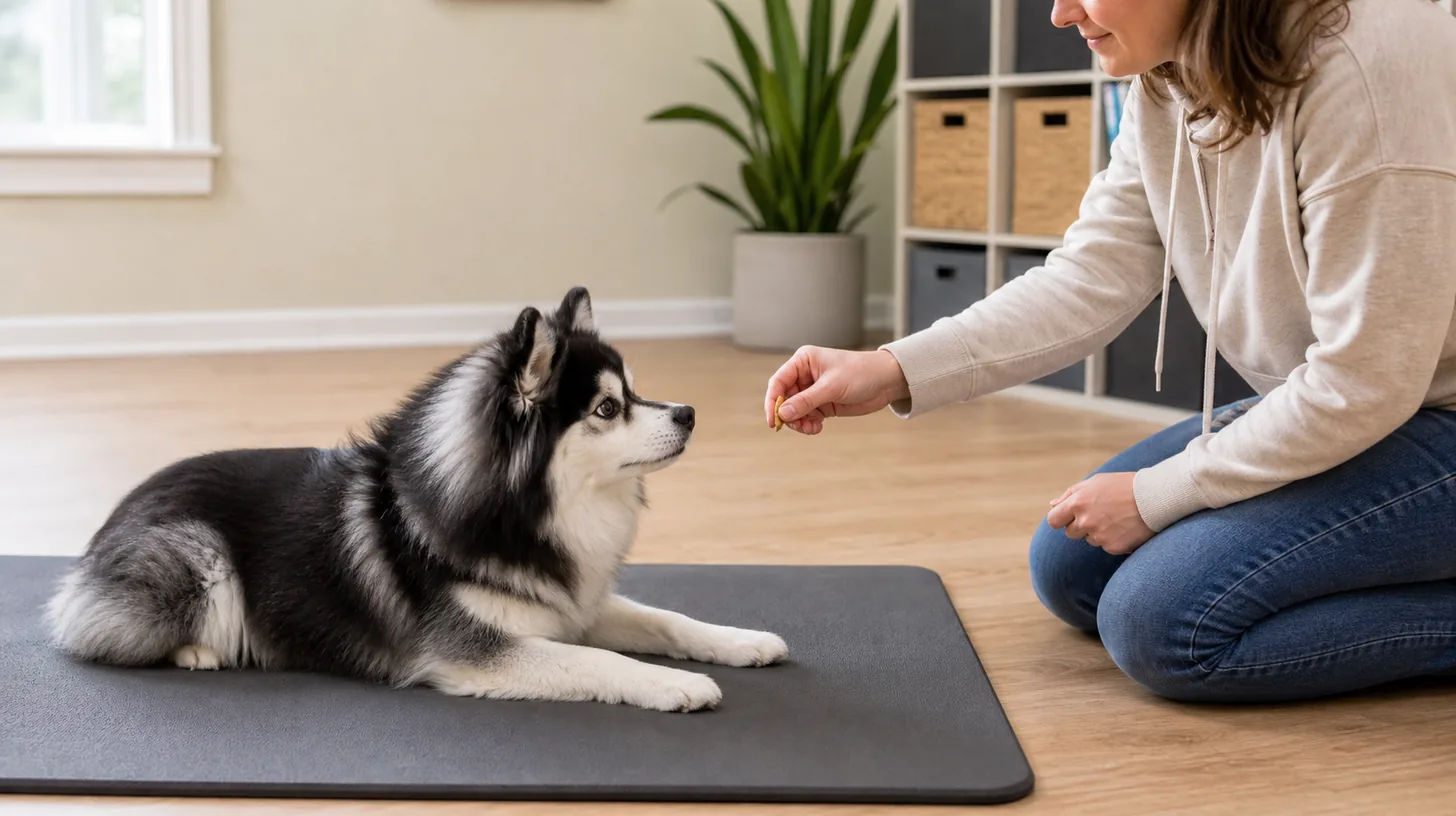
Direct answer: Start on a warm, comfortable nonslip surface where the Pomsky already lies down freely. Capture a naturally offered down or guide a small lure from nose level toward the floor and slightly forward, leaving room for the elbows and body to lower. Mark only the completed comfortable posture, reward low, and release promptly. Fade the lure before adding the verbal cue, never pull the legs or press the shoulders, and stop for stiffness, pain, slipping, fear, or reluctance.
This page teaches one down posture on cue; relax-on-mat adds a location and calm duration, the exam mat supports cooperative handling, and the bow keeps the rear standing rather than lowering the whole body. Watch ordinary rest transitions and defer training when elbow, shoulder, back, hip or breathing comfort appears changed. Choose a broad mat or floor area that supports the whole body without sliding, cold contact or furniture confinement. The sequence keeps one observable criterion, one release point and one safety layer visible throughout practice.
Confirm the Pomsky Lies Down Comfortably
Watch ordinary rest transitions and defer training when elbow, shoulder, back, hip or breathing comfort appears changed.
A second capable adult can verify the boundary during early practice or higher-risk situations. That person should follow the same sequence and avoid adding prompts, handling, or access that changes the task. The shared standard remains Teach a Pomsky to lower the elbows and body voluntarily on a comfortable nonslip surface, mark and reward the complete down, fade any food lure, add the cue only after the movement is predictable, release promptly, and stop for pressure, slipping, pain, stiffness, fear, or reluctance.. In this routine, step 1 is the confirm the pomsky lies down comfortably decision.
The absence of an incident is not proof that the arrangement is sound. Recheck for skipping capture or guide the lowering motion, losing precision during leave space for elbows and hips, continuing after fade the lure in small steps fails, repeating cues, forcing the dog, or treating the unfinished behavior as containment. Document For Teach a Pomsky to Lie Down on Cue, record Confirm the Pomsky Lies Down Comfortably, Prepare a Warm Nonslip Surface, Begin From an Easy Posture, Capture or Guide the Lowering Motion; then reconcile Leave Space for Elbows and Hips, Mark the Complete Down, Reward Low and Release; and close with Fade the Lure in Small Steps, Attach the Cue to the Predictable Motion, Monitor Posture Across Settings. Keep the note factual, brief, private and based on observable responses. so a later caregiver can distinguish a passed step from one that was skipped. Record the result of confirm the pomsky lies down comfortably before continuing.
Prepare a Warm Nonslip Surface
Choose a broad mat or floor area that supports the whole body without sliding, cold contact or furniture confinement.
Perform this check before adding the next variable. The target remains Teach a Pomsky to lower the elbows and body voluntarily on a comfortable nonslip surface, mark and reward the complete down, fade any food lure, add the cue only after the movement is predictable, release promptly, and stop for pressure, slipping, pain, stiffness, fear, or reluctance.. Work in the controlled training setting needed to confirm the pomsky lies down comfortably, prepare a warm nonslip surface, and begin from an easy posture, with measured rewards, nonslip footing, an open retreat and physical safety management available. If the setup cannot preserve that condition, simplify it or stop rather than relying on speed or physical control. In this routine, step 2 is the prepare a warm nonslip surface decision.
If the Pomsky cannot remain comfortable or the equipment and environment cannot remain controlled, end the attempt. Do not proceed through skipping capture or guide the lowering motion, losing precision during leave space for elbows and hips, continuing after fade the lure in small steps fails, repeating cues, forcing the dog, or treating the unfinished behavior as containment. Capture For Teach a Pomsky to Lie Down on Cue, record Confirm the Pomsky Lies Down Comfortably, Prepare a Warm Nonslip Surface, Begin From an Easy Posture, Capture or Guide the Lowering Motion; then reconcile Leave Space for Elbows and Hips, Mark the Complete Down, Reward Low and Release; and close with Fade the Lure in Small Steps, Attach the Cue to the Predictable Motion, Monitor Posture Across Settings. Keep the note factual, brief, private and based on observable responses. before deciding what changes next. Record the result of prepare a warm nonslip surface before continuing.
Begin From an Easy Posture
Use a relaxed stand or sit the individual dog can leave freely and avoid requiring a sit first when that transition is uncomfortable.
Use an observable pass condition: the relevant item is checked, the boundary is closed, and the Pomsky can remain safe without being used as a test. This protects the main objective, Teach a Pomsky to lower the elbows and body voluntarily on a comfortable nonslip surface, mark and reward the complete down, fade any food lure, add the cue only after the movement is predictable, release promptly, and stop for pressure, slipping, pain, stiffness, fear, or reluctance., while leaving a clear point at which the caregiver can step back. In this routine, step 3 is the begin from an easy posture decision.
Do not convert this step into a stress test. The principal avoidable risks are skipping capture or guide the lowering motion, losing precision during leave space for elbows and hips, continuing after fade the lure in small steps fails, repeating cues, forcing the dog, or treating the unfinished behavior as containment. Write down For Teach a Pomsky to Lie Down on Cue, record Confirm the Pomsky Lies Down Comfortably, Prepare a Warm Nonslip Surface, Begin From an Easy Posture, Capture or Guide the Lowering Motion; then reconcile Leave Space for Elbows and Hips, Mark the Complete Down, Reward Low and Release; and close with Fade the Lure in Small Steps, Attach the Cue to the Predictable Motion, Monitor Posture Across Settings. Keep the note factual, brief, private and based on observable responses.; a short factual note is more useful than a reassuring guess. Record the result of begin from an easy posture before continuing.
Capture or Guide the Lowering Motion
Mark a naturally offered down or move one small lure slowly toward the floor and forward without trapping the muzzle.
Keep the sequence repeatable across caregivers. Say what is being checked, complete it, and return equipment and people to neutral before continuing. In this page's context, success means Teach a Pomsky to lower the elbows and body voluntarily on a comfortable nonslip surface, mark and reward the complete down, fade any food lure, add the cue only after the movement is predictable, release promptly, and stop for pressure, slipping, pain, stiffness, fear, or reluctance.; it does not mean proving that a known risk can be tolerated. In this routine, step 4 is the capture or guide the lowering motion decision.
Stop when the expected condition is absent or the situation begins to depend on force, luck, or an open boundary. Specifically avoid skipping capture or guide the lowering motion, losing precision during leave space for elbows and hips, continuing after fade the lure in small steps fails, repeating cues, forcing the dog, or treating the unfinished behavior as containment. The follow-up record should cover For Teach a Pomsky to Lie Down on Cue, record Confirm the Pomsky Lies Down Comfortably, Prepare a Warm Nonslip Surface, Begin From an Easy Posture, Capture or Guide the Lowering Motion; then reconcile Leave Space for Elbows and Hips, Mark the Complete Down, Reward Low and Release; and close with Fade the Lure in Small Steps, Attach the Cue to the Predictable Motion, Monitor Posture Across Settings. Keep the note factual, brief, private and based on observable responses.. Record the result of capture or guide the lowering motion before continuing.
Leave Space for Elbows and Hips
Position yourself to the side or front with an open exit so the dog can lower naturally instead of folding against an obstacle.
Treat this as one part of the complete routine, not an isolated trick. The surrounding setup is the controlled training setting needed to confirm the pomsky lies down comfortably, prepare a warm nonslip surface, and begin from an easy posture, with measured rewards, nonslip footing, an open retreat and physical safety management available. A clean transition reduces ambiguity and makes it easier to notice when the dog, equipment, environment, or records differ from the previous attempt. In this routine, step 5 is the leave space for elbows and hips decision.
The absence of an incident is not proof that the arrangement is sound. Recheck for skipping capture or guide the lowering motion, losing precision during leave space for elbows and hips, continuing after fade the lure in small steps fails, repeating cues, forcing the dog, or treating the unfinished behavior as containment. Document For Teach a Pomsky to Lie Down on Cue, record Confirm the Pomsky Lies Down Comfortably, Prepare a Warm Nonslip Surface, Begin From an Easy Posture, Capture or Guide the Lowering Motion; then reconcile Leave Space for Elbows and Hips, Mark the Complete Down, Reward Low and Release; and close with Fade the Lure in Small Steps, Attach the Cue to the Predictable Motion, Monitor Posture Across Settings. Keep the note factual, brief, private and based on observable responses. so a later caregiver can distinguish a passed step from one that was skipped. Record the result of leave space for elbows and hips before continuing.
Mark the Complete Down
Wait for both elbows and the body to settle comfortably before marking, rather than rewarding repeated crouching or pawing.
Pause long enough to inspect the result rather than assuming the action worked. Look at the dog, the physical boundary, and the next movement available to the caregiver. Continue only when the arrangement still supports Teach a Pomsky to lower the elbows and body voluntarily on a comfortable nonslip surface, mark and reward the complete down, fade any food lure, add the cue only after the movement is predictable, release promptly, and stop for pressure, slipping, pain, stiffness, fear, or reluctance.. In this routine, step 6 is the mark the complete down decision.
If the Pomsky cannot remain comfortable or the equipment and environment cannot remain controlled, end the attempt. Do not proceed through skipping capture or guide the lowering motion, losing precision during leave space for elbows and hips, continuing after fade the lure in small steps fails, repeating cues, forcing the dog, or treating the unfinished behavior as containment. Capture For Teach a Pomsky to Lie Down on Cue, record Confirm the Pomsky Lies Down Comfortably, Prepare a Warm Nonslip Surface, Begin From an Easy Posture, Capture or Guide the Lowering Motion; then reconcile Leave Space for Elbows and Hips, Mark the Complete Down, Reward Low and Release; and close with Fade the Lure in Small Steps, Attach the Cue to the Predictable Motion, Monitor Posture Across Settings. Keep the note factual, brief, private and based on observable responses. before deciding what changes next. Record the result of mark the complete down before continuing.
Reward Low and Release
Deliver a measured reward between the paws or at floor level, then use the release cue before the dog becomes restless.
A second capable adult can verify the boundary during early practice or higher-risk situations. That person should follow the same sequence and avoid adding prompts, handling, or access that changes the task. The shared standard remains Teach a Pomsky to lower the elbows and body voluntarily on a comfortable nonslip surface, mark and reward the complete down, fade any food lure, add the cue only after the movement is predictable, release promptly, and stop for pressure, slipping, pain, stiffness, fear, or reluctance.. In this routine, step 7 is the reward low and release decision.
Do not convert this step into a stress test. The principal avoidable risks are skipping capture or guide the lowering motion, losing precision during leave space for elbows and hips, continuing after fade the lure in small steps fails, repeating cues, forcing the dog, or treating the unfinished behavior as containment. Write down For Teach a Pomsky to Lie Down on Cue, record Confirm the Pomsky Lies Down Comfortably, Prepare a Warm Nonslip Surface, Begin From an Easy Posture, Capture or Guide the Lowering Motion; then reconcile Leave Space for Elbows and Hips, Mark the Complete Down, Reward Low and Release; and close with Fade the Lure in Small Steps, Attach the Cue to the Predictable Motion, Monitor Posture Across Settings. Keep the note factual, brief, private and based on observable responses.; a short factual note is more useful than a reassuring guess. Record the result of reward low and release before continuing.
Fade the Lure in Small Steps
Use an empty hand path, shorten it gradually and reward from the other hand so food is not required at the nose.
Perform this check before adding the next variable. The target remains Teach a Pomsky to lower the elbows and body voluntarily on a comfortable nonslip surface, mark and reward the complete down, fade any food lure, add the cue only after the movement is predictable, release promptly, and stop for pressure, slipping, pain, stiffness, fear, or reluctance.. Work in the controlled training setting needed to confirm the pomsky lies down comfortably, prepare a warm nonslip surface, and begin from an easy posture, with measured rewards, nonslip footing, an open retreat and physical safety management available. If the setup cannot preserve that condition, simplify it or stop rather than relying on speed or physical control. In this routine, step 8 is the fade the lure in small steps decision.
Stop when the expected condition is absent or the situation begins to depend on force, luck, or an open boundary. Specifically avoid skipping capture or guide the lowering motion, losing precision during leave space for elbows and hips, continuing after fade the lure in small steps fails, repeating cues, forcing the dog, or treating the unfinished behavior as containment. The follow-up record should cover For Teach a Pomsky to Lie Down on Cue, record Confirm the Pomsky Lies Down Comfortably, Prepare a Warm Nonslip Surface, Begin From an Easy Posture, Capture or Guide the Lowering Motion; then reconcile Leave Space for Elbows and Hips, Mark the Complete Down, Reward Low and Release; and close with Fade the Lure in Small Steps, Attach the Cue to the Predictable Motion, Monitor Posture Across Settings. Keep the note factual, brief, private and based on observable responses.. Record the result of fade the lure in small steps before continuing.
Attach the Cue to the Predictable Motion
Say the spoken cue once before the reduced signal only after the Pomsky is confidently completing the posture.
Use an observable pass condition: the relevant item is checked, the boundary is closed, and the Pomsky can remain safe without being used as a test. This protects the main objective, Teach a Pomsky to lower the elbows and body voluntarily on a comfortable nonslip surface, mark and reward the complete down, fade any food lure, add the cue only after the movement is predictable, release promptly, and stop for pressure, slipping, pain, stiffness, fear, or reluctance., while leaving a clear point at which the caregiver can step back. In this routine, step 9 is the attach the cue to the predictable motion decision.
The absence of an incident is not proof that the arrangement is sound. Recheck for skipping capture or guide the lowering motion, losing precision during leave space for elbows and hips, continuing after fade the lure in small steps fails, repeating cues, forcing the dog, or treating the unfinished behavior as containment. Document For Teach a Pomsky to Lie Down on Cue, record Confirm the Pomsky Lies Down Comfortably, Prepare a Warm Nonslip Surface, Begin From an Easy Posture, Capture or Guide the Lowering Motion; then reconcile Leave Space for Elbows and Hips, Mark the Complete Down, Reward Low and Release; and close with Fade the Lure in Small Steps, Attach the Cue to the Predictable Motion, Monitor Posture Across Settings. Keep the note factual, brief, private and based on observable responses. so a later caregiver can distinguish a passed step from one that was skipped. Record the result of attach the cue to the predictable motion before continuing.
Monitor Posture Across Settings
Generalize one surface or room at a time and stop for asymmetry, delayed rising, pain, fear or repeated avoidance.
Keep the sequence repeatable across caregivers. Say what is being checked, complete it, and return equipment and people to neutral before continuing. In this page's context, success means Teach a Pomsky to lower the elbows and body voluntarily on a comfortable nonslip surface, mark and reward the complete down, fade any food lure, add the cue only after the movement is predictable, release promptly, and stop for pressure, slipping, pain, stiffness, fear, or reluctance.; it does not mean proving that a known risk can be tolerated. In this routine, step 10 is the monitor posture across settings decision.
If the Pomsky cannot remain comfortable or the equipment and environment cannot remain controlled, end the attempt. Do not proceed through skipping capture or guide the lowering motion, losing precision during leave space for elbows and hips, continuing after fade the lure in small steps fails, repeating cues, forcing the dog, or treating the unfinished behavior as containment. Capture For Teach a Pomsky to Lie Down on Cue, record Confirm the Pomsky Lies Down Comfortably, Prepare a Warm Nonslip Surface, Begin From an Easy Posture, Capture or Guide the Lowering Motion; then reconcile Leave Space for Elbows and Hips, Mark the Complete Down, Reward Low and Release; and close with Fade the Lure in Small Steps, Attach the Cue to the Predictable Motion, Monitor Posture Across Settings. Keep the note factual, brief, private and based on observable responses. before deciding what changes next. Record the result of monitor posture across settings before continuing.
When to Stop and Escalate
Stop when the Pomsky, caregiver, equipment, records, or environment no longer supports Teach a Pomsky to lower the elbows and body voluntarily on a comfortable nonslip surface, mark and reward the complete down, fade any food lure, add the cue only after the movement is predictable, release promptly, and stop for pressure, slipping, pain, stiffness, fear, or reluctance.. Do not improvise through skipping capture or guide the lowering motion, losing precision during leave space for elbows and hips, continuing after fade the lure in small steps fails, repeating cues, forcing the dog, or treating the unfinished behavior as containment. Seek the veterinarian, veterinary behaviorist or qualified reward-based behavior professional for exceptions found during reward low and release, attach the cue to the predictable motion or monitor posture across settings. Bring the factual observations already collected rather than recreating the event.
Before another attempt, review For Teach a Pomsky to Lie Down on Cue, record Confirm the Pomsky Lies Down Comfortably, Prepare a Warm Nonslip Surface, Begin From an Easy Posture, Capture or Guide the Lowering Motion; then reconcile Leave Space for Elbows and Hips, Mark the Complete Down, Reward Low and Release; and close with Fade the Lure in Small Steps, Attach the Cue to the Predictable Motion, Monitor Posture Across Settings. Keep the note factual, brief, private and based on observable responses.. Resume only after the responsible person, physical setup, and controlling instructions are clear. A stop is part of the protocol: it preserves useful evidence and prevents uncertainty from becoming exposure.
Keep the Routine Current
Recheck the complete setup whenever the dog, household, product, instructions, environment, or purpose changes. The intended outcome remains Teach a Pomsky to lower the elbows and body voluntarily on a comfortable nonslip surface, mark and reward the complete down, fade any food lure, add the cue only after the movement is predictable, release promptly, and stop for pressure, slipping, pain, stiffness, fear, or reluctance., not a perfect-looking performance. Use the newest primary instruction, retain dated records, and retire superseded assumptions so every caregiver begins from the same current plan.
Sources reviewed
Each source is used only for the claim scopes listed below. None establishes a guaranteed Pomsky outcome or replaces individual professional assessment.
- American Veterinary Society of Animal Behavior: Humane Dog Training Position Statement - Supports: reward-based training; aversive-method risk; behavior change principles. Limit: Does not guarantee outcomes for an individual dog.
- American Animal Hospital Association: AAHA-AVMA Canine Preventive Healthcare Guidelines - Supports: preventive exams; individual risk assessment; parasite and vaccination planning. Limit: The veterinarian sets the schedule for the individual dog and location.