Written and reviewed by A Pomsky Editorial Team. Originally published 2023-07-19; substantively reviewed July 26, 2026.
Training boundary: Use humane, reward-based methods and protect safety with management. Pain, panic, aggression, a bite history, or serious handling risk requires a veterinarian or qualified behavior professional. Read the editorial policy.
Direct answer: Measure your Pomsky in its longest natural sleeping position and choose a bed with enough usable inner area to stretch and turn. Match the shape, support, entry height, temperature, and washability to the individual dog instead of relying on a generic breed or weight label.
Choose a Pomsky bed by measuring the dog in its longest natural sleeping position, then selecting a usable inner sleeping area that allows the dog to stretch without hanging over an edge. Shape, support, temperature, entry height, cover material, and washability should follow the individual dog's habits and health, not a generic "Pomsky size" label.
A thick coat can make a dog look larger while compressed bolsters make a listed bed size feel smaller. Measure the space the dog can actually use.
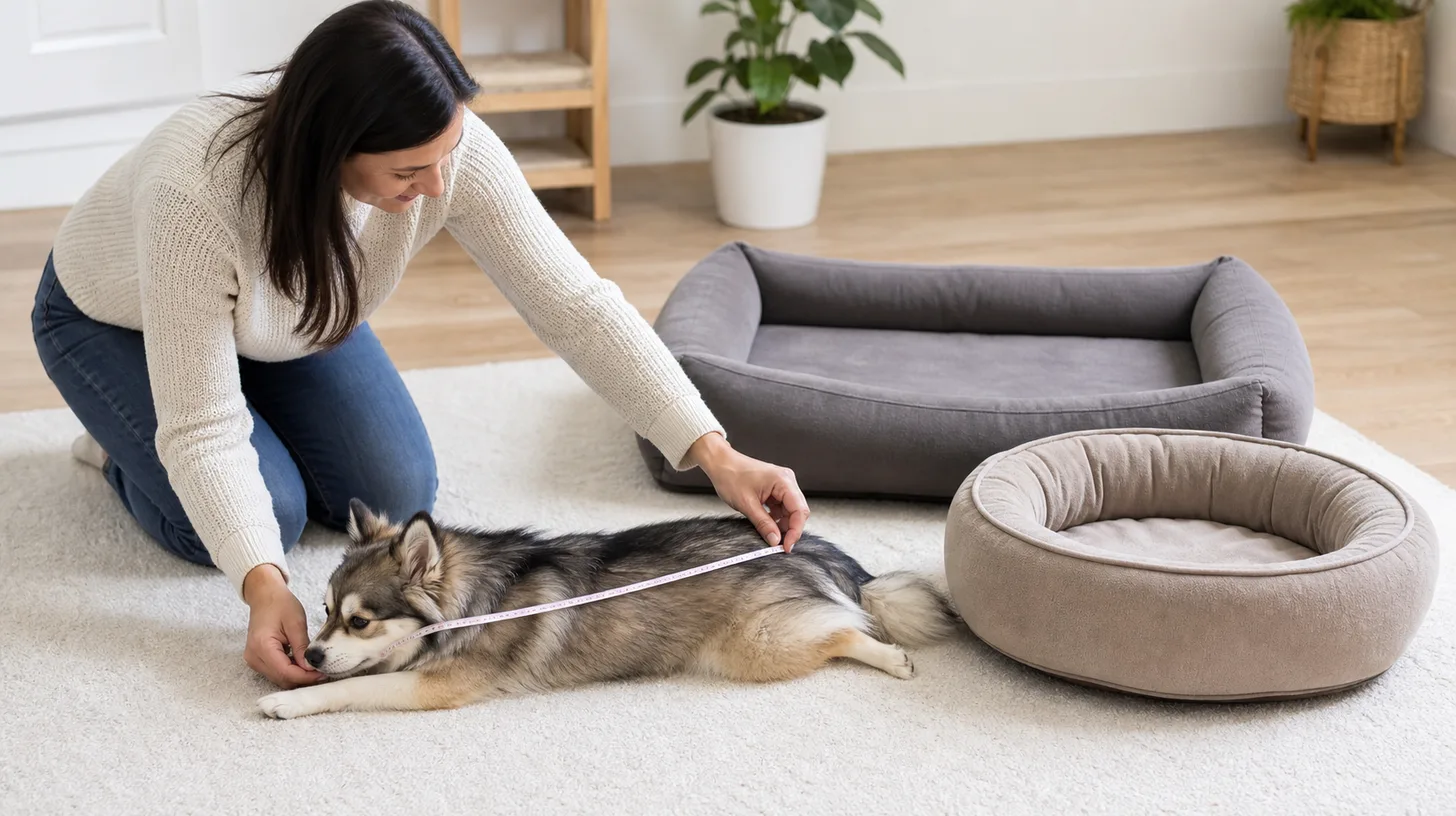
Measure the dog while fully stretched
Watch the Pomsky sleep over several days. Some dogs curl tightly, while others extend the front legs, lie on one side, or sprawl on the back. Measure nose to rump or feet in the longest comfortable posture, then measure the width occupied by the body and legs.
Do not measure only the standing back length or rely on weight. Two dogs at the same weight can have different proportions. Add practical room for changing position, but remember that a bed's outer dimensions include bolsters, seams, and frames.
The RSPCA dog-bed guidance recommends enough room for natural positions, including stretching out. It also notes that different shapes support different preferences.
When comparing a product, find the inner sleeping dimensions. If only the outside dimensions are listed, the usable area is uncertain. A rectangular mattress often offers more stretch space than a thick round bolster with the same advertised width.
Mark the proposed dimensions on the floor with painter's tape and observe whether the dog can lie inside the outline. This inexpensive test is more informative than guessing from a product photo.
Match the bed shape to sleeping posture
A flat rectangular mattress suits dogs that sleep on their side or fully extended. A bolstered bed can provide a headrest and a sense of enclosure for dogs that curl or lean, but the bolsters reduce usable space.
Some Pomskies alternate between a cool floor and a softer bed. Offering two resting options can be more useful than searching for one universal design. Place one option near the family and another in a quiet area if the dog likes both social contact and uninterrupted sleep.
Avoid assuming that a cave or covered bed will suit a nervous dog. Some dogs enjoy enclosure; others become hot or uncomfortable when the exit is narrow. The dog should be able to enter and leave freely.
For a puppy, choose a washable, appropriately sized surface without loose filling or parts that can be chewed and swallowed. Plan to replace or resize the bed as the puppy grows rather than buying an oversized structure that is hard to clean.
Choose support and entry height
A healthy young adult may be comfortable on a moderately padded washable mattress. An older dog, a dog recovering from surgery, or one with arthritis or weakness may need a low entry, stable footing, and support selected with veterinary guidance.
Do not market "orthopedic" as a diagnosis or guaranteed treatment. Foam density, construction, and the dog's preference matter, and the label itself is not proof. Persistent stiffness, difficulty rising, pacing at night, reluctance to jump, or a sudden change in sleeping location warrants veterinary assessment.
The bed should not bottom out immediately under the dog's hips and shoulders. Press the surface with a hand, then watch the dog rise and turn. A very soft bed can be difficult for some dogs to exit, while a thin pad may not provide enough cushioning.
Place non-slip material under the bed if it moves on hard flooring. A sliding bed can make entry frightening and can increase fall risk. Keep a clear path to water and the usual bathroom exit.
Control heat and choose a safe location
Pomskies have dense coats, but individual heat tolerance varies. A deep plush bed beside a heater may be uncomfortable even in winter. Give the dog access to a cooler alternative and watch whether it repeatedly leaves the bed to lie on tile.
Place the bed away from direct drafts, intense sunlight, cords, unstable furniture, and busy walkways. Do not block an exit or force the dog to rest where people must step over it.
Children and visitors should leave a resting dog undisturbed. A bed should function as a predictable safe resting place, not a location where the dog is hugged, climbed on, or repeatedly moved.
Heated pads require special caution. Use only a pet-appropriate product if the veterinarian agrees, follow the manufacturer instructions, prevent cord chewing, and ensure the dog can move away from the heat. Never use a human heating pad unattended.
For travel or outdoor use, keep the bed dry and inspect waterproof layers for damage. A water-resistant cover is not a reason to leave a dog outdoors in unsafe temperatures.
Prioritize washable materials
A removable machine-washable cover makes routine cleaning easier. Check whether the inner liner also resists moisture and whether replacement covers are available. Wash according to the label and dry completely before use.
Inspect seams, zippers, non-slip coatings, foam, and filling. Repair or replace a bed when stuffing becomes accessible, a zipper breaks, or the base loses stability. Dogs that shred or ingest bedding need a safer setup and veterinary or behavior advice if ingestion occurs.
Use unscented or low-fragrance cleaning products appropriate for pet bedding. Rinse thoroughly. Strong fragrance can discourage use, while retained detergent or dampness can irritate skin.
If fleas, ringworm, a contagious condition, urine leakage, or persistent skin irritation is suspected, ask the veterinarian how to clean the environment safely. Routine laundering guidance is not a substitute for a disease-control plan.
Introduce the new bed without force
Place the bed in a location the dog already chooses. Scatter a few treats or part of a meal on it, reward voluntary investigation, and allow the dog to leave. Do not hold the dog on the bed or repeatedly place it there.
Transfer a familiar washable blanket if it is safe and the dog finds the scent comforting. Keep the old bed temporarily so the dog has a choice. A new material may sound, smell, or move differently.
Teach a mat or bed cue by rewarding four paws on the surface, then a sit or down. The household boundary guide explains how to build duration and release. The cue should never mean the dog will be trapped or punished.
If the dog refuses the bed, test location, temperature, movement, entry height, and texture. Do not assume stubbornness. A dog that previously used beds and suddenly avoids them may be uncomfortable.
Avoid common buying mistakes
Do not select only by breed label, body weight, color, or a posed product image. Compare the dog's actual measurements with usable dimensions.
Avoid paying more for unverified medical claims. A bed can improve comfort and access, but it does not cure joint disease, anxiety, skin disease, or sleep disorders.
Do not choose a high bolster for a dog that struggles to step over it. Do not choose a slick base for hard flooring. Do not put a heat-retaining fabric in the only available resting area for a dog that seeks cool surfaces.
For multi-dog homes, provide at least one suitable resting place per dog and additional choice when resources create tension. Do not require dogs to share. Guarding a bed, blocking access, or conflict around resting areas needs management and qualified help.
The site's guide on whether a Pomsky should sleep in a human bed covers household sleeping arrangements. Regardless of that choice, the dog should have an accessible independent resting option.
Recheck fit as needs change
Measure puppies as they grow and adults after meaningful weight or body-condition changes. Replace compressed foam, unstable bases, and covers that can no longer be cleaned.
Observe sleep quality and movement rather than assuming a new purchase solved the problem. Can the dog stretch, turn, rise, and leave without slipping? Does it choose the bed under normal conditions? Does it rest rather than repeatedly reposition?
Discuss changes in mobility, sleep, pain signs, or continence with the veterinarian. Adaptations may include a lower edge, firmer support, a ramp to another sleeping area, more frequent cleaning, or a different location, but the medical cause still needs assessment.
The right Pomsky bed is the one that fits the individual dog's body and preferred posture, remains safe and clean, and supports comfortable independent rest. Measurement and observation are more reliable than a product category.
Sources reviewed
Each source is used only for the claim scopes listed below. None establishes a guaranteed Pomsky outcome or replaces individual professional assessment.
- Royal Society for the Prevention of Cruelty to Animals: Choosing the Perfect Dog Bed - Supports: bed sizing by sleeping posture; resting-location choice; washability; individual comfort. Limit: A bed is not a treatment for pain or mobility disease; persistent discomfort requires veterinary assessment.
- American Animal Hospital Association: Lifestyle and Safety Assessment - Supports: appropriate confinement; leash, collar and harness planning; lifestyle-specific safety review. Limit: Equipment selection must account for the individual dog's anatomy, behavior, health, and environment.