Written and reviewed by A Pomsky Editorial Team. Originally published 2023-04-17; substantively reviewed July 26, 2026.
Safety boundary: This guide is educational and cannot diagnose, treat, or replace veterinary, medical, public-health, emergency-dispatch, animal-control, or jurisdiction-specific legal guidance. Use the health disclaimer and contact the appropriate professional for the actual situation.
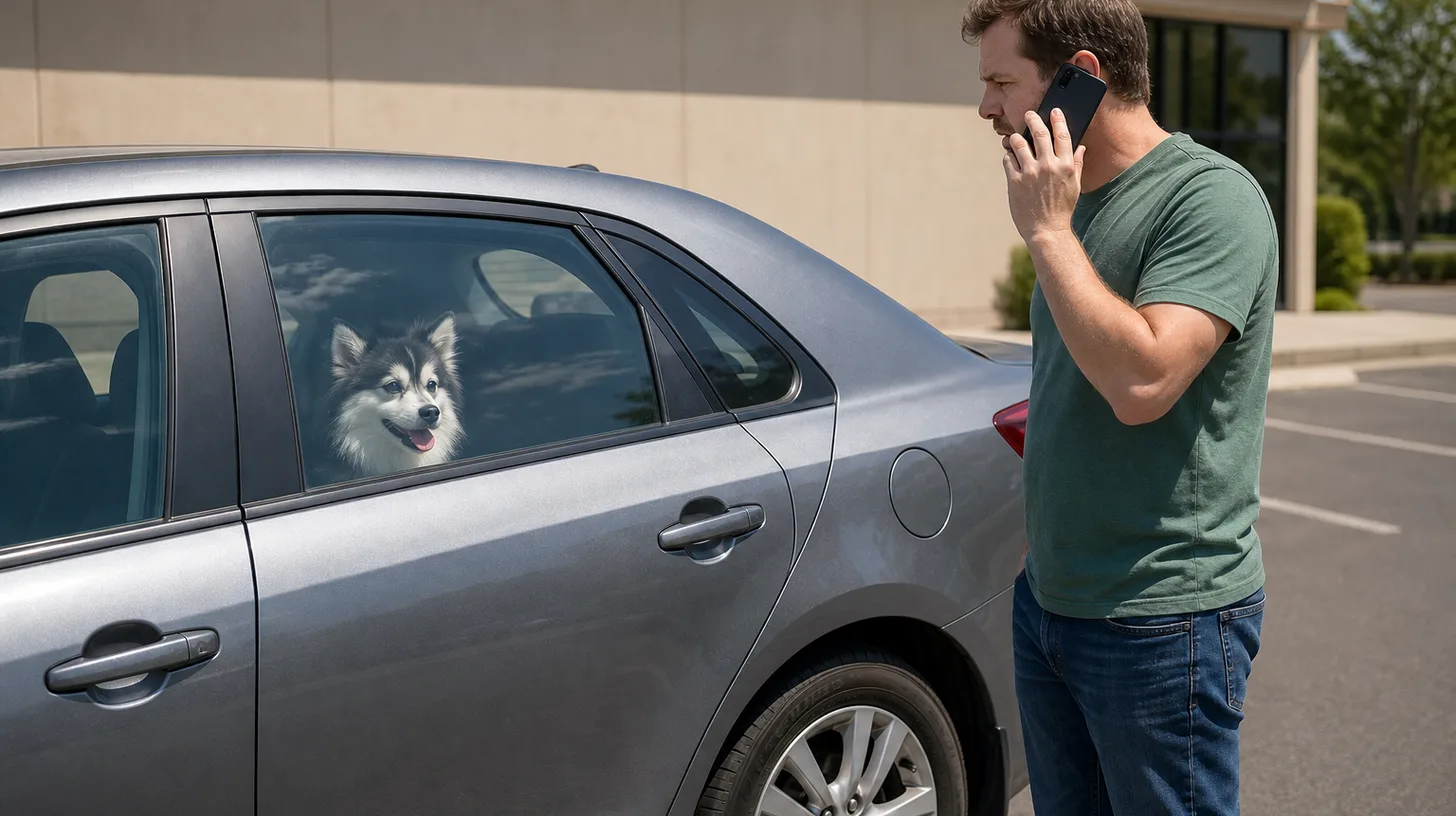
Direct answer: Treat a Pomsky left in a warm parked car as time-sensitive. Call local emergency services, law enforcement, or animal control; give the exact location, vehicle description, and the dog's observable condition; ask a nearby business to page the owner without losing sight of the car; and follow the dispatcher's instructions. Do not assume you may legally break a window, because rescue laws and required steps vary by location. Stay until help arrives and arrange emergency veterinary assessment after the dog is removed.
A parked vehicle can become dangerous quickly even when the outside air feels moderate, the windows are cracked, or the car is in partial shade. Dogs cool primarily by panting, and a confined hot environment can overwhelm that process. A thick coat or previous warm-weather tolerance does not make a Pomsky safe in a parked car.
The bystander's job is to start an effective response without creating a second emergency. Call the appropriate local service, provide observable facts, keep the vehicle under observation, and follow dispatcher and local-law instructions.
Why a parked car is a time-sensitive risk
Sunlight heats the vehicle's interior surfaces and trapped air. Opening a window slightly does not provide reliable cooling. The AVMA pet-in-car heat resource shows that vehicle temperature can rise rapidly over a short period. Exact heating depends on weather, sun, vehicle, ventilation, and time, so there is no outside temperature or "quick errand" threshold that makes an unattended dog safe.
An alert dog can deteriorate. Observable warning signs can include heavy or frantic panting, excessive drooling, agitation, weakness, vomiting, diarrhea, confusion, loss of coordination, collapse, or seizures. Do not wait for severe signs before calling. The absence of collapse does not establish that the dog is safe.
The ASPCA hot-car guidance treats leaving an animal in a parked vehicle as dangerous and notes that laws vary among jurisdictions. That variation is why the call to local responders matters.
Assess from outside without delaying the call
Approach only far enough to observe the dog and vehicle safely. Check:
- whether the dog is responsive and able to stand;
- the pattern and effort of breathing;
- drooling, vomiting, loss of coordination, or collapse;
- whether the engine appears to be running;
- whether an adult is visible nearby;
- the exact location, parking level, entrance, and landmark;
- vehicle color, make or body type, and license plate.
Do not spend several minutes taking a temperature reading, searching online, or debating whether the dog "looks hot enough." Call while you observe. If another adult is present, one person can call while the other keeps the car in sight.
Do not open a door simply because it appears unlocked unless the dispatcher or responding authority confirms what to do. An unknown vehicle may present legal and physical risks, and the dog may bolt or bite when the door opens.
Give responders the details they need
Call the emergency number, law enforcement, or animal control service appropriate to your location. If you are unsure which service handles the situation, call emergency dispatch and explain that a dog is confined in a parked vehicle and may be overheating.
State the facts in a useful order:
- exact address and where the car is parked;
- description and plate of the vehicle;
- number and location of animals inside;
- observable signs, such as heavy panting, vomiting, weakness, or collapse;
- whether the engine is running and windows are open;
- how long you have personally observed the situation;
- your phone number and location beside the vehicle.
Do not estimate how long the dog has been there unless you know. Say "I first saw the dog at 2:10 p.m." rather than "the dog has been there for an hour." Ask the dispatcher whether to remain on the line and what actions are authorized.
If the dog collapses or breathing changes while you wait, update dispatch immediately. Do not assume the first call fully communicates a changing emergency.
Find the owner while keeping the car observed
Ask a nearby store, office, venue, or parking manager to make an urgent announcement using the vehicle description and plate. Give staff your location and callback number. If possible, have another person do this so the car remains observed.
Do not leave to search a large property alone. The vehicle could move, the dog's condition could change, or responders could arrive without finding the exact location.
Avoid confronting the owner. The priority is getting the dog out safely and assessed, not arguing about intent. If the owner returns, tell dispatch and follow instructions. Record the time and observable condition. If the person drives away while the dog remains at risk, give dispatch the direction of travel rather than following in a dangerous way.
Keep bystanders back from traffic and the vehicle. Do not let a crowd surround the car, strike the windows, or excite the dog.
Follow local law before attempting entry
Laws governing animals in vehicles and bystander entry differ by state, country, and municipality. Some protections apply only after specific calls, observations, waiting periods, or attempts to locate the owner. Some authorize only law enforcement, animal control, firefighters, or other designated responders.
Do not assume a social-media summary applies where you are. Ask dispatch directly:
- Is an officer or animal-control responder on the way?
- What should I do if the dog's condition worsens?
- Am I authorized to attempt entry?
- What documentation or steps are required?
Breaking glass can injure the dog, bystanders, and rescuer; alarm the animal; allow an escape into traffic; and create legal consequences. This page does not tell a private person to break a window. Follow current local law and the instructions of emergency professionals who know the location and circumstances.
If an authorized responder directs entry, clarify which door or window, how the animal will be restrained, and where veterinary care is available. Keep people away from the projected glass area and prepare a leash or barrier only if the responder requests it.
What to do when the dog is removed
Heatstroke is a veterinary emergency. The ASPCA emergency-care guidance includes heatstroke among conditions needing emergency care. A dog that appears brighter after leaving the car may still have internal injury, so do not treat visible improvement as clearance.
Follow the responding professional's instructions. In general, move the dog to shade or air conditioning and begin transport to emergency veterinary care. Use cool rather than ice-cold water only when directed and when it can be applied safely. Avoid ice, an ice bath, alcohol on the paws, or wrapping the dog in wet towels that can trap heat.
Do not force water into the mouth. If the dog is alert and able to swallow, a professional may advise offering small amounts, but vomiting, impaired consciousness, or swallowing difficulty changes the risk. Do not delay transport while trying multiple home-cooling methods.
Handle carefully. A frightened, painful, or confused dog may bite. Use a leash or secure carrier if available and safe, but do not place a tight muzzle on a dog that needs to pant. Tell the veterinary clinic that heat exposure is suspected and give the timeline and any cooling already performed.
If the owner is present, the need for prompt veterinary evaluation remains. Responders can determine custody and transport responsibilities.
Preserve a useful incident record
Write down times:
- when you first saw the dog;
- when you called;
- changes you observed;
- when the owner or responders arrived;
- when the dog was removed;
- when transport began.
Photograph the vehicle, plate, window position, and dog only when doing so does not delay the call or care. Keep the original files and the incident or dispatch number. Record names or badge numbers when provided.
Use factual language. "Dog was standing, panting continuously, and drooling at 3:14 p.m.; dog lay down and did not rise when called at 3:19 p.m." is more useful than a diagnosis you are not qualified to make.
Share evidence with the responding authority, not as entertainment on social media. Public posting can expose private information, interfere with an investigation, or trigger harassment.
Prevent the same emergency
Never leave a Pomsky or any dog unattended in a parked vehicle as part of an errand, even with cracked windows or shade. If the destination cannot include the dog, leave the dog safely at home with appropriate care or arrange another adult to remain with the running, climate-controlled vehicle where lawful and continuously supervised.
Plan car travel around stops. The site's Pomsky car-travel safety checklist covers restraint, water, breaks, identification, and emergency clinics. The hot-weather guide covers routine outdoor exposure and recovery. Neither makes an unattended parked car acceptable.
Before travel:
- confirm every stop allows the dog or has a supervised alternative;
- carry current identification and veterinary contacts;
- know the location of emergency clinics along the route;
- use reminders so no animal is forgotten in the vehicle;
- assign one adult responsibility for the dog during transitions;
- check the rear seat and carrier every time everyone exits.
If you see a confined dog, action should be prompt, organized, and lawful: call, describe, observe, recruit help, follow instructions, and route the dog to veterinary assessment. Do not wait for certainty about heatstroke, and do not improvise a dangerous rescue when trained responders are directing the scene.
Sources reviewed
Each source is used only for the claim scopes listed below. None establishes a guaranteed Pomsky outcome or replaces individual professional assessment.
- ASPCA: The Dangers of Leaving an Animal in a Hot Car and Other Heat-Related Hazards - Supports: parked-car heat risk; heat-distress warning signs; need for prompt emergency response; jurisdictional law variation. Limit: Local law and emergency-dispatch instructions control whether and how a private person may enter a vehicle.
- American Veterinary Medical Association: Pets in Vehicles: Heat Safety - Supports: rapid vehicle temperature rise; parked-car prevention; heat-risk awareness. Limit: Vehicle heating varies with conditions; the resource does not replace emergency dispatch, animal control, law enforcement, or veterinary care.
- ASPCA: Emergency Care for Your Pet - Supports: heatstroke as a veterinary emergency; emergency clinic planning; professional escalation. Limit: A general article cannot assess stability or replace emergency veterinary examination and treatment.