Written and reviewed by A Pomsky Editorial Team. Originally published 2023-04-19; substantively reviewed July 26, 2026.
Safety boundary: This guide is educational and cannot diagnose, treat, or replace veterinary, medical, public-health, emergency-dispatch, animal-control, or jurisdiction-specific legal guidance. Use the health disclaimer and contact the appropriate professional for the actual situation.
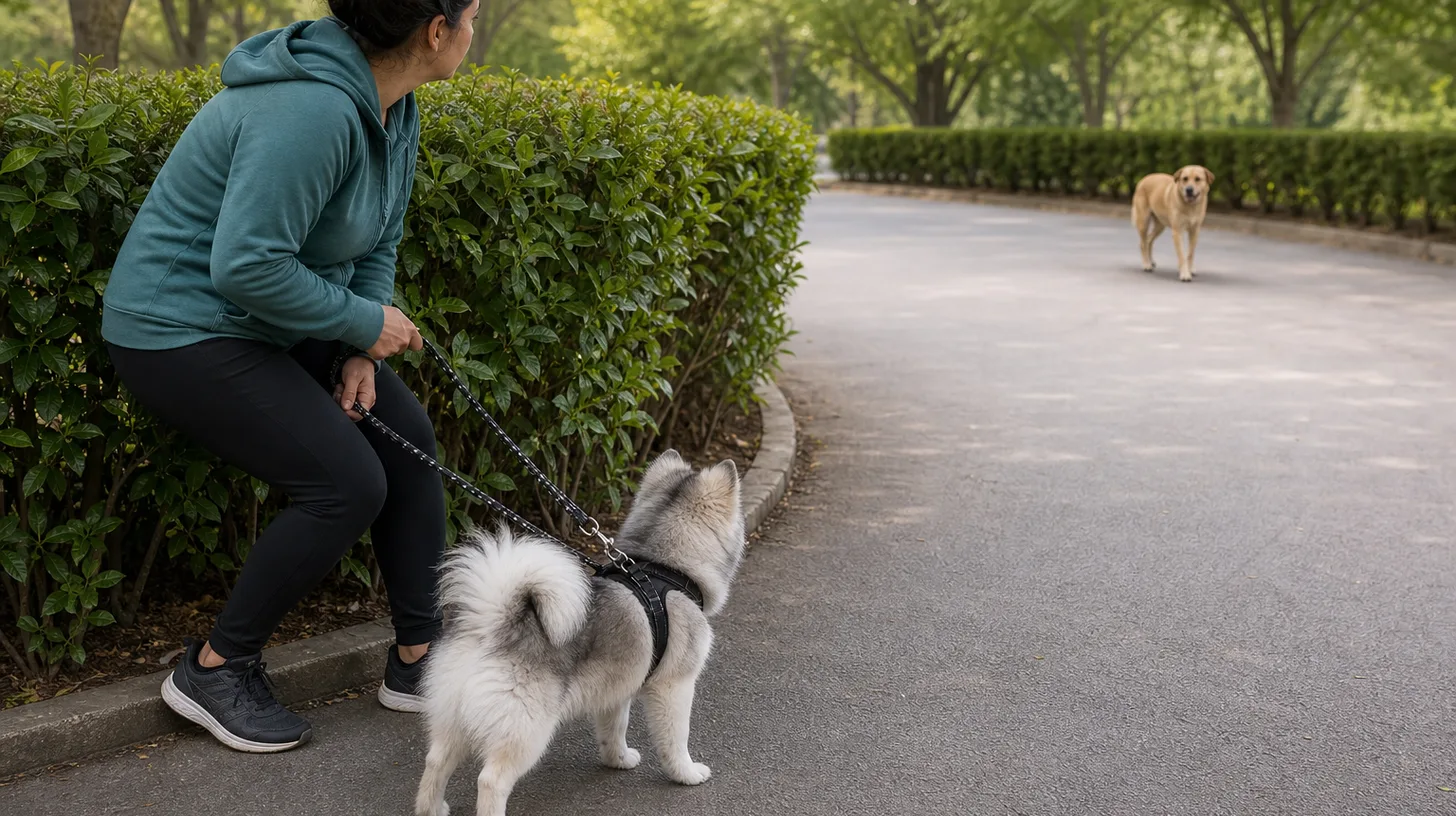
Direct answer: If an unfamiliar off-leash dog approaches while you are walking your Pomsky, stay calm, avoid running or shouting, create distance, and place a car, hedge, gate, or other solid barrier between the dogs when you can do so safely. Keep your Pomsky's leash controlled without forcing a face-to-face greeting. Use a firm voice to tell the loose dog to stop or go home, and call animal control or emergency services when the dog remains a danger. Do not put your hands between fighting dogs.
An unfamiliar loose dog creates an uncontrolled situation. You do not know the dog's health, training, social history, or response to restraint. Even a dog that appears friendly can become frustrated or frightened when it reaches a leashed dog.
The goal is not to decide whether the other dog is "good." It is to increase distance, avoid escalation, keep people out of the bite zone, and contact the appropriate authority when the hazard continues.
Prepare before a loose-dog encounter
Use a well-fitted walking harness or other equipment appropriate for your Pomsky, a standard leash in good condition, current identification, and a charged phone. Check clips and stitching before leaving. A retractable leash can make rapid, close control difficult, particularly when line is extended.
Choose routes with visibility and safe exit options. Notice gates, parked cars, solid fences, wide driveways, and businesses that could provide a barrier or help. Avoid narrow paths where two dogs cannot pass with space if your dog is fearful or reactive.
Practice simple movements away from emergencies: a cheerful turn, moving behind the handler, following a food lure for a few steps, and returning attention to the handler. These skills can help you leave early, but they do not control the loose dog.
Carry rewards in an accessible pocket rather than buried in a bag. Their first purpose is to move and reinforce your own dog. Throwing food toward an unfamiliar dog sometimes changes its path, but it can also fail or create competition, so it should never be treated as a guaranteed defense.
If your Pomsky has a bite history or severe reactivity, ask a qualified professional about a broader walking plan. The AAHA reactive-dog walking guidance discusses distance, secure equipment, reward-based handling, and professional support. A properly conditioned basket muzzle may be one additional layer for the leashed dog, but it does not make an approaching dog safe.
Act early when you first see the dog
Distance is easiest to create before the loose dog reaches you. Turn around, cross a street only when traffic conditions are safe, step into a gated area with permission, or move behind a solid barrier. Do not wait for the dogs to exchange greetings before deciding.
Scan for the owner without taking your eyes off the loose dog for long. In a clear, calm voice, ask the person to call and leash the dog. Avoid debating whether the dog is friendly. "Please leash your dog" communicates the needed action.
Keep your own breathing and movement as steady as possible. Do not run, scream, wave your arms, or stare directly at the unfamiliar dog. The CDC dog-safety guidance advises remaining calm, avoiding direct eye contact, using a firm voice, and slowly backing away when an unfamiliar dog approaches.
Do not tighten the leash so much that your Pomsky is lifted, choked, or forced face-first toward the other dog. Shorten it enough to prevent a rush while preserving stable footing and room to turn.
What to do as the dog closes distance
Turn your body partly sideways rather than squaring up. Place your Pomsky on the side farthest from the approaching dog and move away in an arc when space allows. Use a firm, low voice such as "No," "Stop," or "Go home." Do not rely on the unfamiliar dog understanding a specific cue.
Avoid reaching toward the loose dog's face, grabbing its collar, or trying to pet it. Do not allow a tight-leash nose-to-nose greeting just because the dog is wagging. A wag does not by itself establish relaxed intent, and constrained greetings can change quickly.
Keep children and bystanders back. Do not ask another person to step between the dogs. If someone can safely open a nearby gate or call animal control from a distance, give one clear task.
Picking up a small dog can sometimes move it out of reach, but it can also bring an approaching dog toward the person's torso and hands or cause jumping. There is no universal rule. If you cannot lift and move to secure space before the dog arrives, do not bend into the bite zone. Prioritize stable movement and a solid barrier.
Use barriers and positioning without trapping your Pomsky
A parked car, closed gate, solid fence, large tree, hedge, bench, trash enclosure, or building corner can interrupt a straight approach. Move around the barrier while continuing toward a safe exit. A visual barrier is more useful than an object that leaves both dogs trapped in a small space.
Do not wrap your Pomsky's leash around a post or your hand. Keep enough control to move. Check that the leash is not crossing legs or tightening around the dog's neck.
If you carry an umbrella, bag, or jacket as part of normal walking equipment, it may provide visual space when held between you and the dog, but do not strike the animal or sacrifice balance. No object guarantees that an approaching dog will stop.
Avoid escalating tools you have not been trained or legally permitted to use. Laws, wind, distance, the presence of people, and the dogs' positions can make sprays or other devices unsafe. This page does not provide jurisdiction-specific legal advice.
Continue backing toward safety rather than trying to hold ground. Once a secure door, gate, or vehicle separates the dogs, close it and call for help.
If contact or a fight begins
Human safety comes first. Do not place hands near either dog's mouth, grab collars, or reach between fighting dogs. The CDC specifically advises people not to try to break up dog fights because of bite risk.
Shout for the owner or another adult to call emergency services or animal control. If a solid object can be placed as a barrier without entering the bite zone, it may help create separation, but active fights are unpredictable. There is no risk-free universal technique for an untrained bystander.
Do not pull your dog upward by the neck. If you can move away after separation, go behind a closed barrier immediately. Secure both exits before examining injuries.
If a person is in immediate danger, bleeding cannot be controlled, or the attack is continuing, call emergency services. Give the location and describe the active hazard. Follow dispatcher instructions.
Do not pursue the loose dog after the immediate danger ends. Note its direction, appearance, and any owner or vehicle information from a safe place.
Check people and dogs after the incident
Move to safety before checking for injury. Thick Pomsky fur can conceal punctures, bruising, and bleeding. Use calm handling and avoid pressing a painful area. A dog that has just been attacked may bite defensively, including a familiar caregiver.
Contact a veterinarian after contact, a bite, a fall, or a concerning behavior change. Small punctures can be deeper than they appear. Breathing difficulty, collapse, uncontrolled bleeding, pale gums, severe pain, abdominal swelling, inability to walk, or rapid deterioration requires emergency veterinary care.
For a human bite or scratch, wash the area with soap and running water. Seek prompt medical advice for deep wounds, uncontrolled bleeding, infection signs, bites to high-risk locations, immune compromise, unknown rabies status, or any concern. The healthcare professional and public-health authority determine tetanus and rabies needs; do not make that decision from the dog's appearance.
The CDC rabies guidance recommends avoiding unfamiliar animals and involving public-health professionals after potential exposure. If possible without renewed contact, obtain the other owner's name, contact information, and rabies vaccination details for the responding authority.
Photograph injuries and the scene only after everyone is secure and care is underway. Do not delay treatment to collect evidence.
Report an ongoing loose-dog hazard
Report the incident to local animal control or police as required in your area, especially when the dog remains loose, a bite occurred, or the owner cannot control it. Give factual observations:
- exact location and time;
- the loose dog's size, color, and distinguishing features;
- direction of travel;
- behavior you directly observed;
- whether a person or animal was bitten;
- owner or vehicle details if safely obtained;
- photographs or video captured from a safe position.
Avoid breed guesses and emotional labels. "Medium tan dog repeatedly crossed the road and made contact with my leashed dog" is more useful than an unsupported breed or temperament claim.
Keep veterinary bills, medical records, photographs, witness contacts, and the report number. Requirements for quarantine, vaccination confirmation, and follow-up vary by jurisdiction.
Rebuild calm walking after a frightening event
After medical needs are addressed, give your Pomsky time to recover. A dog may scan, pull toward home, bark at distant dogs, refuse food, or avoid the location after a frightening encounter. Do not force immediate close greetings to prove that the dog is still social.
Return to quieter routes and greater distance. Reinforce checking in, turning away, and calm observation below the dog's reaction threshold. Keep sessions short and end before stress accumulates.
If fear, reactivity, sleep disruption, appetite change, or avoidance persists or worsens, consult the veterinarian and a qualified reward-based behavior professional. Pain and stress can interact, and early support may prevent repeated rehearsal.
The site's leash-training guide covers ordinary walking skills, while the trainer-selection guide helps screen behavior support. Neither should be used to recreate the loose-dog encounter as a test.
Preparation cannot guarantee the behavior of an unfamiliar dog. It can give you earlier decisions, safer equipment, practiced movement, useful barriers, and a clear post-incident route. The best outcome is often an uneventful retreat made before the dogs are close enough to interact.
Sources reviewed
Each source is used only for the claim scopes listed below. None establishes a guaranteed Pomsky outcome or replaces individual professional assessment.
- U.S. Centers for Disease Control and Prevention: Dogs: Healthy Pets, Healthy People - Supports: unfamiliar-dog approach safety; bite prevention; wound cleaning; medical and animal-control escalation. Limit: An active attack is unpredictable; prioritize immediate human safety and local emergency instructions.
- U.S. Centers for Disease Control and Prevention: Rabies Prevention and Control - Supports: distance from unfamiliar animals; rabies exposure escalation; public-health consultation after bites. Limit: Only healthcare and public-health professionals can determine whether rabies post-exposure prophylaxis is needed.
- American Animal Hospital Association: How Can I Safely Walk My Reactive Dog? - Supports: distance and route management; well-fitted walking equipment; reward-based handling; professional behavior referral. Limit: Equipment and general management cannot guarantee safety during an uncontrolled loose-dog encounter.
- American Veterinary Medical Association: Dog Bite Prevention - Supports: bite-risk awareness; leash and secure-gate prevention; avoiding escalation; professional behavior help. Limit: Breed alone does not predict bite risk, and general prevention guidance cannot control an active loose-dog encounter.