Written and reviewed by A Pomsky Editorial Team. Originally published 2026-07-26; substantively reviewed July 26, 2026.
Training boundary: Use humane, reward-based methods and protect safety with management. Pain, panic, aggression, a bite history, or serious handling risk requires a veterinarian or qualified behavior professional. Read the editorial policy.
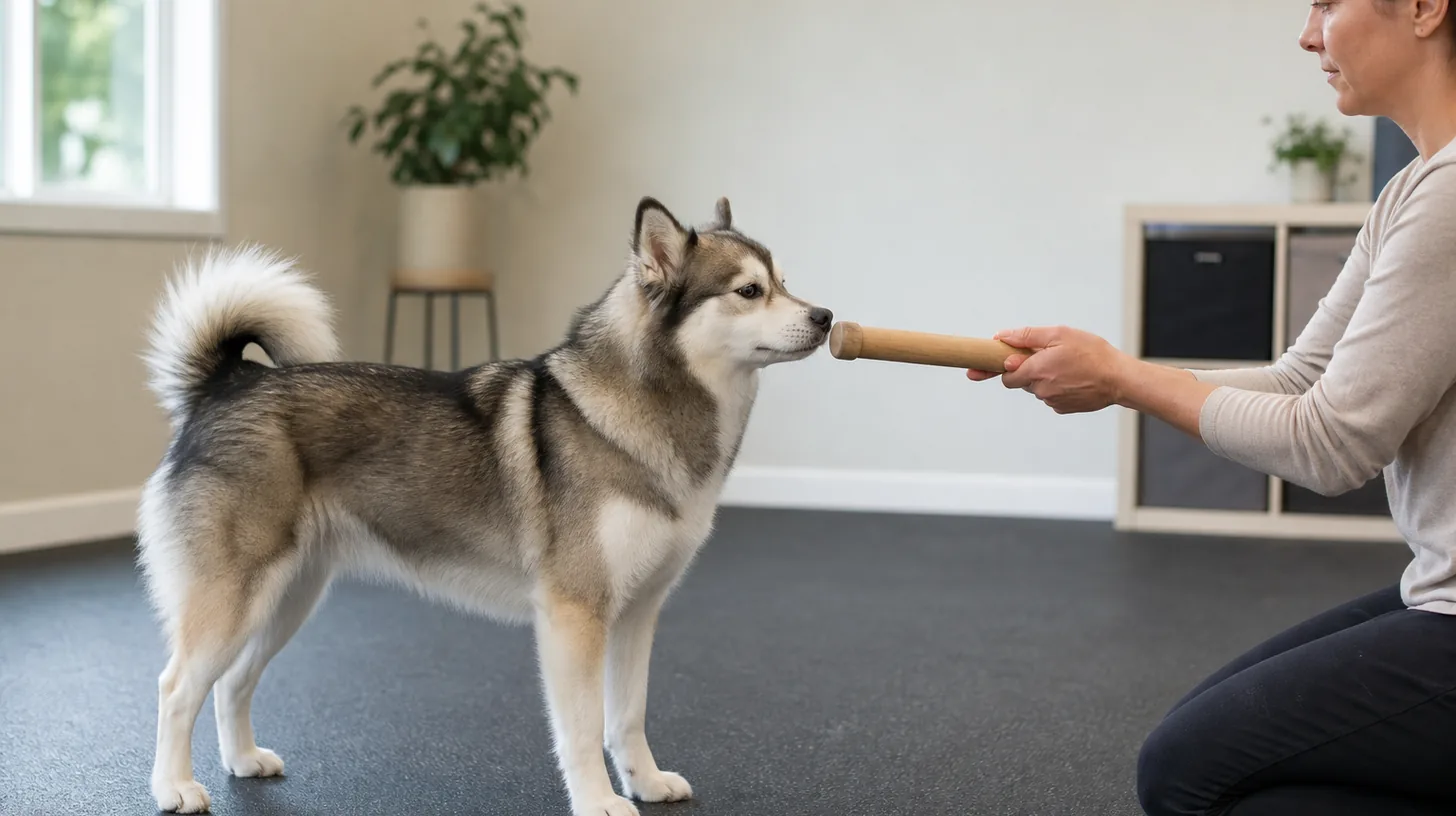
Direct answer: Use a short plain target stick with a broad blunt end. Hold it still several inches from the Pomsky's nose and mark any voluntary look or sniff. When the dog begins approaching, wait for a gentle nose touch, mark and deliver the reward away from the stick. Add the cue only after the touch is predictable. Move the target only a few inches at a time, keeping it below eye level and never poking the face or making the dog chase it. Build direction and distance separately, then fade the tool or transfer the touch to another safe target.
This page teaches nose contact with a movable neutral tool; hand targeting uses the caregiver's palm, button training adds mechanical travel, and go-around shapes a route around an object. Use a short plain target stick with a broad blunt end. Hold it still several inches from the Pomsky's nose and mark any voluntary look or sniff. When the dog begins approaching, wait for a gentle nose touch, mark and deliver the reward away from the stick. Add the cue only after the touch is predictable. Move the target only a few inches at a time, keeping it below eye level and never poking the face or making the dog chase it. Build direction and distance separately, then fade the tool or transfer the touch to another safe target. This guide is limited to reward-based skill building in a controlled setup. It does not make a medical, temperament or guaranteed-behavior claim.
Direct answer
Use a short plain target stick with a broad blunt end. Hold it still several inches from the Pomsky's nose and mark any voluntary look or sniff. When the dog begins approaching, wait for a gentle nose touch, mark and deliver the reward away from the stick. Add the cue only after the touch is predictable. Move the target only a few inches at a time, keeping it below eye level and never poking the face or making the dog chase it. Build direction and distance separately, then fade the tool or transfer the touch to another safe target.
The reader task is specific: Present a blunt stable target several inches from the nose, mark voluntary investigation and then a gentle nose touch, keep the stick still at first, add one small position change at a time, prevent chasing or poking, and fade the tool or transfer the behavior only after the touch is reliable. Keep the nearest owner pages separate when the real problem is prevention, release, equipment fit, confinement, travel management or professional care.
Select a Blunt Neutral Target
Use a clean broad-ended tool without sharp parts, strings, noise, lights, readable labels or food residue.
For pomsky target-stick training: step-by-step guide, this checkpoint passes only when the Pomsky can complete the described step voluntarily and recover without crowding, restraint or repeated prompting. End while the Pomsky can still choose the behavior. Repetition after fatigue, frustration or avoidance teaches a different pattern than the skill described here. Do not add the next select a blunt neutral target variable until that observable criterion is repeatable.
Hold the Tool Completely Still
Present it several inches away at nose height and allow the Pomsky to choose whether to investigate.
For pomsky target-stick training: step-by-step guide, this checkpoint passes only when the Pomsky can complete the described step voluntarily and recover without crowding, restraint or repeated prompting. Use management for real-life risk while training remains incomplete. A cue does not replace doors, barriers, fitted equipment, adult supervision or veterinary care. Do not add the next hold the tool completely still variable until that observable criterion is repeatable.
Mark Orientation Before Contact
Reward the first look or lean so early success does not depend on accidental face contact.
For pomsky target-stick training: step-by-step guide, this checkpoint passes only when the Pomsky can complete the described step voluntarily and recover without crowding, restraint or repeated prompting. Write direct observations rather than motive labels. Feet, head position, distance, latency, release and recovery are more useful than calling the dog stubborn or dominant. Do not add the next mark orientation before contact variable until that observable criterion is repeatable.
Shape a Gentle Nose Touch
Wait for the nose to meet the blunt end and mark instantly without pressing the target toward the dog.
For pomsky target-stick training: step-by-step guide, this checkpoint passes only when the Pomsky can complete the described step voluntarily and recover without crowding, restraint or repeated prompting. Generalization is a new lesson. Change location only after the starting setup remains predictable, and return to an easier criterion in every unfamiliar place. Do not add the next shape a gentle nose touch variable until that observable criterion is repeatable.
Reward Away From the Stick
Place the reward near your leg or on a safe floor point so the Pomsky resets for the next presentation.
For pomsky target-stick training: step-by-step guide, this checkpoint passes only when the Pomsky can complete the described step voluntarily and recover without crowding, restraint or repeated prompting. Stop rules protect the learner and the evidence. Pain, startle, guarding, panic, equipment failure or repeated avoidance requires a different plan, not a harder repetition. Do not add the next reward away from the stick variable until that observable criterion is repeatable.
Add a Cue Only After Reliability
Pair one spoken cue with a predictable touch while tool height and caregiver position remain unchanged.
For pomsky target-stick training: step-by-step guide, this checkpoint passes only when the Pomsky can complete the described step voluntarily and recover without crowding, restraint or repeated prompting. Set a pass condition before the repetition begins. Record the starting position, the exact cue or object movement and the first response that earned reinforcement. Do not add the next add a cue only after reliability variable until that observable criterion is repeatable.
Move the Target a Few Inches
Change left, right, up or down separately and avoid fast paths that trigger chasing or jumping.
For pomsky target-stick training: step-by-step guide, this checkpoint passes only when the Pomsky can complete the described step voluntarily and recover without crowding, restraint or repeated prompting. Keep the environment easier than the final use case. Stable footing, an open exit and one adult handler make errors observable without forcing another attempt. Do not add the next move the target a few inches variable until that observable criterion is repeatable.
Build Distance Without Reaching
Increase the Pomsky's travel by moving your whole setup rather than extending the stick toward the face.
For pomsky target-stick training: step-by-step guide, this checkpoint passes only when the Pomsky can complete the described step voluntarily and recover without crowding, restraint or repeated prompting. Change only one variable after three calm successes. Duration, distance, object position, caregiver posture and environmental distraction should not increase together. Do not add the next build distance without reaching variable until that observable criterion is repeatable.
Transfer or Fade the Tool
Shorten the visible target or move the behavior to a safe object only after accuracy remains high.
For pomsky target-stick training: step-by-step guide, this checkpoint passes only when the Pomsky can complete the described step voluntarily and recover without crowding, restraint or repeated prompting. A reset is information, not correction. Return equipment and bodies to the starting picture, wait for ordinary movement and make the next repetition easier. Do not add the next transfer or fade the tool variable until that observable criterion is repeatable.
Stop for Startle or Avoidance
End practice for flinching, backing away, pawing at the tool, frantic chasing or repeated inability to disengage.
For pomsky target-stick training: step-by-step guide, this checkpoint passes only when the Pomsky can complete the described step voluntarily and recover without crowding, restraint or repeated prompting. Place reinforcement where it supports the next safe setup. Poor placement can create crowding, turning, rushing or fixation even when the marker timing was accurate. Do not add the next stop for startle or avoidance variable until that observable criterion is repeatable.
Training record
Record the date, location, setup and reward used for pomsky target-stick training: step-by-step guide. Track the first three checkpoints (Select a Blunt Neutral Target, Hold the Tool Completely Still, Mark Orientation Before Contact), the middle progression (Shape a Gentle Nose Touch, Reward Away From the Stick, Add a Cue Only After Reliability, Move the Target a Few Inches) and the final safety checks (Build Distance Without Reaching, Transfer or Fade the Tool, Stop for Startle or Avoidance). Note latency, repetitions, release quality and recovery in direct language. A successful record also documents when the session ended early.
When to pause or get help
The risk boundary for this page is movable target face safety and tool fade. Stop for pain, lameness, breathing change, guarding, fear, a bite or snap, equipment failure, loss of physical control or a sudden change from the Pomsky's ordinary behavior. Use a veterinarian for health questions and a qualified reward-based professional when the setup cannot be completed without conflict or distress.
Keep the skill distinct
This page teaches nose contact with a movable neutral tool; hand targeting uses the caregiver's palm, button training adds mechanical travel, and go-around shapes a route around an object. Review that boundary before changing the page or combining exercises. The useful outcome is one clear voluntary behavior with a reliable release and safe management around it, not a staged demonstration or proof that the cue works in every setting.
Sources reviewed
Each source is used only for the claim scopes listed below. None establishes a guaranteed Pomsky outcome or replaces individual professional assessment.
- American Veterinary Society of Animal Behavior: Humane Dog Training Position Statement - Supports: reward-based training; aversive-method risk; behavior change principles. Limit: Does not guarantee outcomes for an individual dog.
- American Animal Hospital Association: Humane Restraint of Animals - Supports: least-stress handling; basket muzzle preparation; positive behavior modification. Limit: Does not authorize forceful restraint or replace veterinary handling decisions.