Written and reviewed by A Pomsky Editorial Team. Originally published 2026-07-26; substantively reviewed July 26, 2026.
Training boundary: Use humane, reward-based methods and protect safety with management. Pain, panic, aggression, a bite history, or serious handling risk requires a veterinarian or qualified behavior professional. Read the editorial policy.
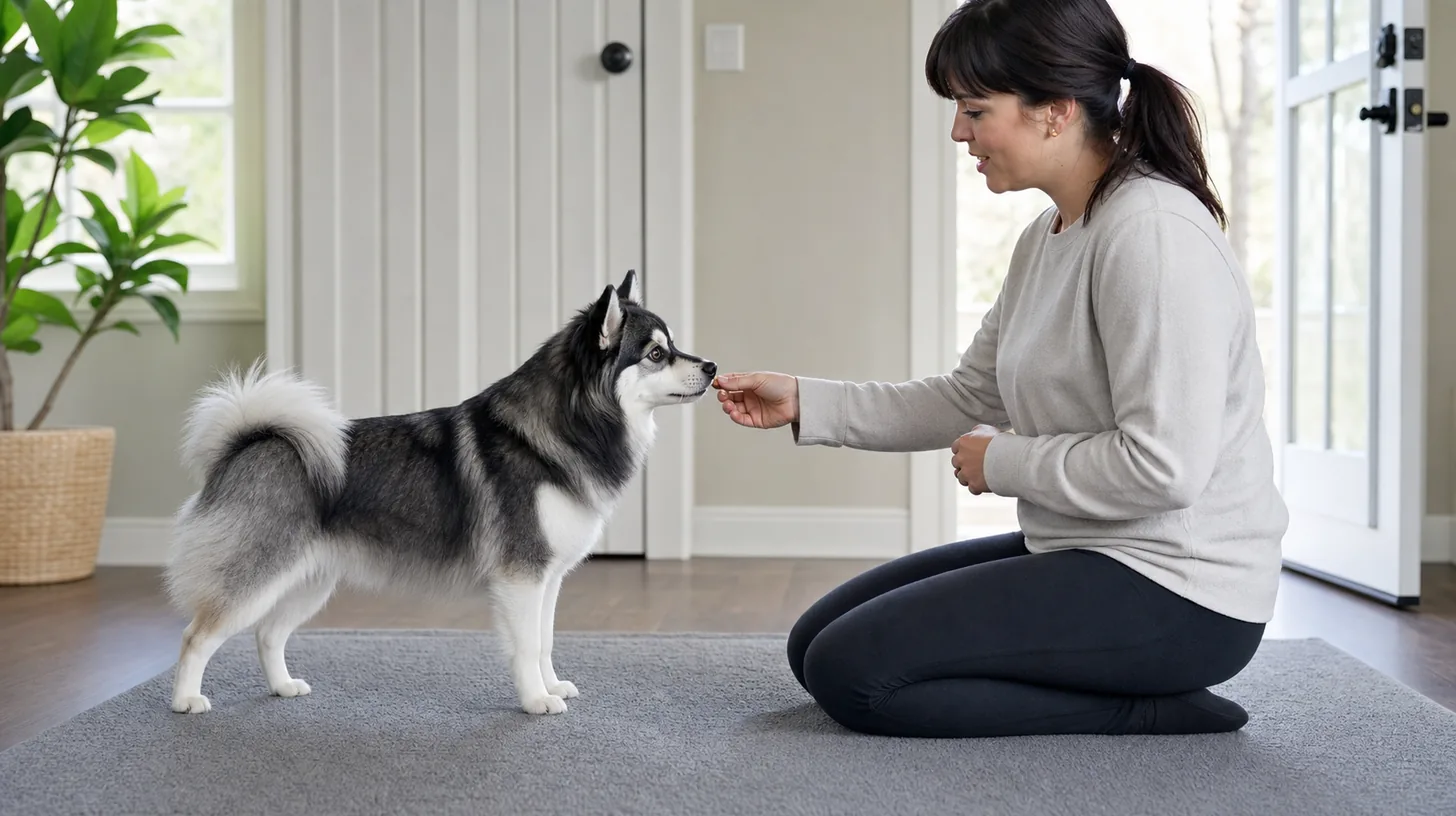
Direct answer: Choose one short neutral word that is not the Pomsky's name, a behavior cue or a release. In a quiet room, say it once and deliver a small suitable reward immediately afterward. Repeat only a few times, with the word always preceding hand movement toward the reward. Test the association by saying the word while your hands are still; a brief orientation predicts that the pairing is established. Begin using the marker for one simple known behavior, mark the exact completed moment and then reward. Do not repeat the marker, use it to call the dog, or say it when no reward can follow.
This page conditions one marker that identifies the exact rewarded moment; name response asks for orientation, a release ends a behavior, and the consistency plan coordinates caregiver vocabulary. Choose one short neutral word that is not the Pomsky's name, a behavior cue or a release. In a quiet room, say it once and deliver a small suitable reward immediately afterward. Repeat only a few times, with the word always preceding hand movement toward the reward. Test the association by saying the word while your hands are still; a brief orientation predicts that the pairing is established. Begin using the marker for one simple known behavior, mark the exact completed moment and then reward. Do not repeat the marker, use it to call the dog, or say it when no reward can follow. This guide is limited to reward-based skill building in a controlled setup. It does not make a medical, temperament or guaranteed-behavior claim.
Direct answer
Choose one short neutral word that is not the Pomsky's name, a behavior cue or a release. In a quiet room, say it once and deliver a small suitable reward immediately afterward. Repeat only a few times, with the word always preceding hand movement toward the reward. Test the association by saying the word while your hands are still; a brief orientation predicts that the pairing is established. Begin using the marker for one simple known behavior, mark the exact completed moment and then reward. Do not repeat the marker, use it to call the dog, or say it when no reward can follow.
The reader task is specific: Choose one short neutral marker word, pair it with a suitable reward in a quiet setting, keep the word before reward delivery, confirm that the Pomsky orients without repeating it, then use the marker only for precise moments while preserving separate cues and release words. Keep the nearest owner pages separate when the real problem is equipment selection, household management, a complete routine, medical care or another already-defined training behavior.
Choose One Neutral Marker
Select a brief distinct word that no caregiver already uses as the Pomsky's name, release or behavior cue.
For pomsky marker-word training: step-by-step guide, this checkpoint passes only when the Pomsky completes the described step voluntarily and returns to ordinary posture without crowding, restraint or repeated prompting. Define the pass condition before beginning and record the first observable response that earns reinforcement. Do not add the next choose one neutral marker variable until that observable criterion is repeatable.
Prepare Rewards Before Speaking
Place several small suitable rewards out of sight but within reach so hand movement does not precede the marker.
For pomsky marker-word training: step-by-step guide, this checkpoint passes only when the Pomsky completes the described step voluntarily and returns to ordinary posture without crowding, restraint or repeated prompting. Keep footing, equipment and the exit route easier than the final use case so one error does not create another forced attempt. Do not add the next prepare rewards before speaking variable until that observable criterion is repeatable.
Pair Sound Before Delivery
Say the marker once in a neutral tone, pause a fraction of a second and then deliver one reward.
For pomsky marker-word training: step-by-step guide, this checkpoint passes only when the Pomsky completes the described step voluntarily and returns to ordinary posture without crowding, restraint or repeated prompting. Change only one variable after three calm successes; duration, distance, body position and distraction should not rise together. Do not add the next pair sound before delivery variable until that observable criterion is repeatable.
Keep the First Session Short
End after five to eight clean pairings while the Pomsky remains relaxed rather than repeating until attention fades.
For pomsky marker-word training: step-by-step guide, this checkpoint passes only when the Pomsky completes the described step voluntarily and returns to ordinary posture without crowding, restraint or repeated prompting. Treat a reset as information by restoring the starting picture, waiting for ordinary movement and making the next repetition easier. Do not add the next keep the first session short variable until that observable criterion is repeatable.
Test With Still Hands
Say the marker once while your posture and hands remain neutral, then note whether the Pomsky briefly orients.
For pomsky marker-word training: step-by-step guide, this checkpoint passes only when the Pomsky completes the described step voluntarily and returns to ordinary posture without crowding, restraint or repeated prompting. Place reinforcement where it prepares the next safe setup instead of creating crowding, twisting, rushing or fixation. Do not add the next test with still hands variable until that observable criterion is repeatable.
Mark One Known Behavior
Use an easy sit, hand target or voluntary check-in and mark the exact completed moment before rewarding.
For pomsky marker-word training: step-by-step guide, this checkpoint passes only when the Pomsky completes the described step voluntarily and returns to ordinary posture without crowding, restraint or repeated prompting. End while the Pomsky can still choose and recover; repetition after fatigue or avoidance changes the behavior being taught. Do not add the next mark one known behavior variable until that observable criterion is repeatable.
Protect One Marker Per Event
Do not repeat the word while waiting, during reward delivery or when the Pomsky misses the criterion.
For pomsky marker-word training: step-by-step guide, this checkpoint passes only when the Pomsky completes the described step voluntarily and returns to ordinary posture without crowding, restraint or repeated prompting. Use physical management for real-world risk while the skill is incomplete because a cue never replaces barriers or fitted equipment. Do not add the next protect one marker per event variable until that observable criterion is repeatable.
Coordinate Every Caregiver
Write the exact marker and delivery sequence so household members do not create competing versions.
For pomsky marker-word training: step-by-step guide, this checkpoint passes only when the Pomsky completes the described step voluntarily and returns to ordinary posture without crowding, restraint or repeated prompting. Describe feet, head position, distance, latency and recovery rather than assigning motives such as stubbornness or dominance. Do not add the next coordinate every caregiver variable until that observable criterion is repeatable.
Refresh a Weakened Association
Return to a few clean sound-then-reward pairings if response latency grows or timing has become inconsistent.
For pomsky marker-word training: step-by-step guide, this checkpoint passes only when the Pomsky completes the described step voluntarily and returns to ordinary posture without crowding, restraint or repeated prompting. Generalize as a new lesson, returning to an easier criterion whenever the room, surface, caregiver or equipment changes. Do not add the next refresh a weakened association variable until that observable criterion is repeatable.
Stop for Conflict or Appetite Concerns
Pause when food creates guarding, stomach upset, refusal or frantic behavior and route health or behavior concerns appropriately.
For pomsky marker-word training: step-by-step guide, this checkpoint passes only when the Pomsky completes the described step voluntarily and returns to ordinary posture without crowding, restraint or repeated prompting. Protect the stop rule: pain, startle, guarding, panic, equipment failure or repeated avoidance requires a different plan. Do not add the next stop for conflict or appetite concerns variable until that observable criterion is repeatable.
Training record
Record the date, location, setup and reward used for pomsky marker-word training: step-by-step guide. Track the first three checkpoints (Choose One Neutral Marker, Prepare Rewards Before Speaking, Pair Sound Before Delivery), the middle progression (Keep the First Session Short, Test With Still Hands, Mark One Known Behavior, Protect One Marker Per Event) and the final safety checks (Coordinate Every Caregiver, Refresh a Weakened Association, Stop for Conflict or Appetite Concerns). Note latency, repetitions, release quality and recovery in direct language. A useful record also states why a session ended early.
When to pause or get help
The risk boundary for this page is marker timing reward delivery and household consistency. Stop for pain, lameness, breathing change, guarding, fear, a bite or snap, equipment failure, loss of physical control or a sudden change from the Pomsky's ordinary behavior. Use a veterinarian for health questions and a qualified reward-based professional when the setup cannot be completed without conflict or distress.
Keep the skill distinct
This page conditions one marker that identifies the exact rewarded moment; name response asks for orientation, a release ends a behavior, and the consistency plan coordinates caregiver vocabulary. Preserve that boundary when updating this page or linking related owners. The useful outcome is one observable voluntary behavior with a reliable transition and safe management, not a staged demonstration or proof that the cue works everywhere.
Sources reviewed
Each source is used only for the claim scopes listed below. None establishes a guaranteed Pomsky outcome or replaces individual professional assessment.
- American Veterinary Society of Animal Behavior: Humane Dog Training Position Statement - Supports: reward-based training; aversive-method risk; behavior change principles. Limit: Does not guarantee outcomes for an individual dog.
- American Veterinary Society of Animal Behavior: How to Select a Behavior Consultant - Supports: trainer credentials; behavior consultant selection; red flags. Limit: Avoid implying that a title alone proves competence.