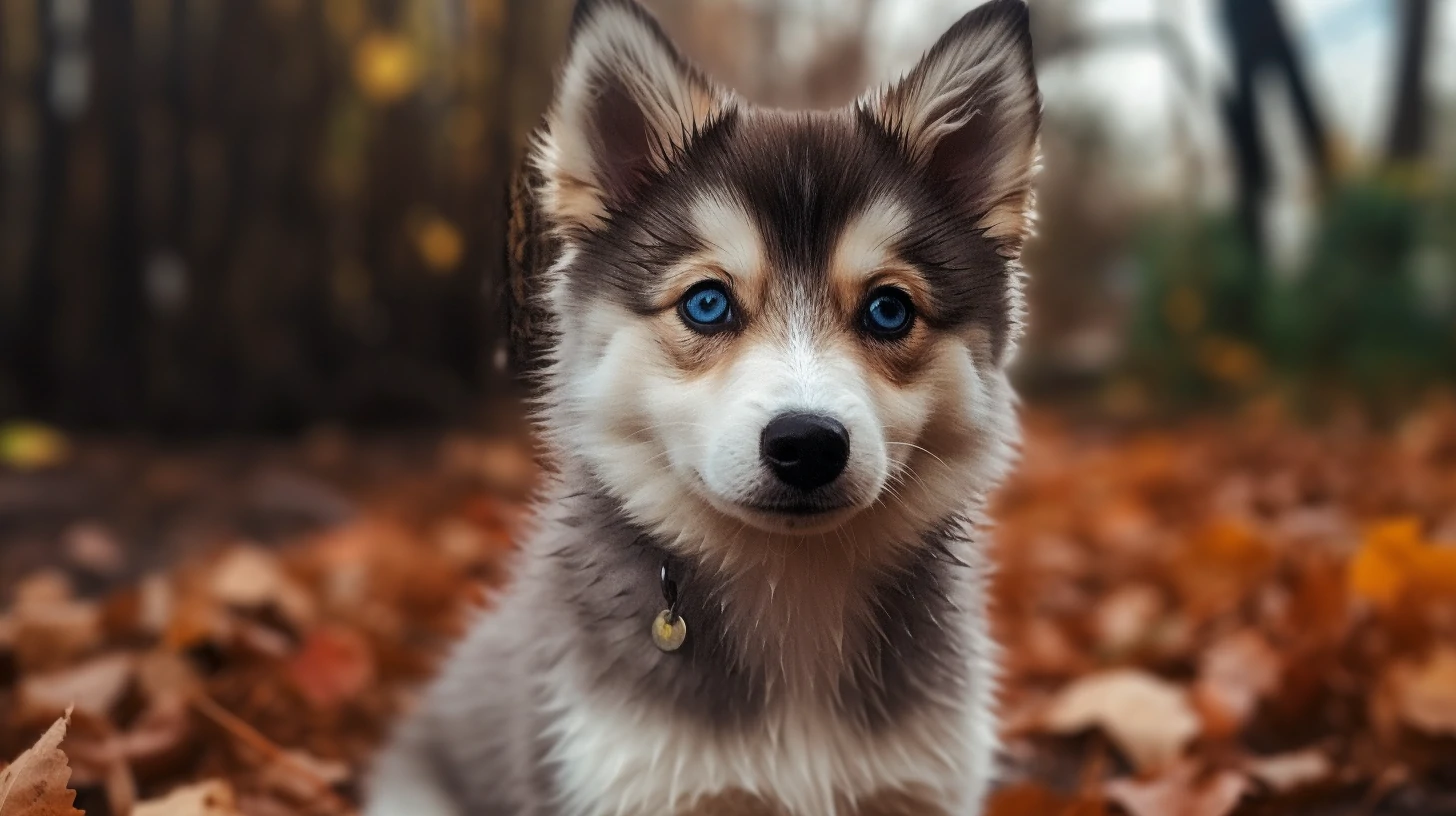
Written and reviewed by A Pomsky Editorial Team. Published 2023-07-23; last reviewed July 25, 2026.
This article provides general educational information. Individual dogs vary, and health or serious behavior concerns require an appropriate veterinary or qualified behavior professional. Read the editorial policy.
Quick answer: Pomsky coats can differ in length, density, texture, and undercoat because mixed inheritance varies. Labels such as plush or woolly are descriptive, not guarantees of shedding, allergy comfort, grooming workload, or adult appearance.
At-a-glance decisions
| Question | Evidence-led answer |
|---|---|
| What coat types can Pomskies have? | Pomsky coats can vary in length, density, texture, guard-hair character, and amount of undercoat. |
| How does puppy coat differ from adult coat? | A soft puppy coat can change in length, density, texture, and color as adult coat grows. |
| Does coat type predict shedding? | A denser or longer coat may hold more loose undercoat, tangle behind ears and legs, and require more section-by-section brushing and drying. |
| How does coat affect grooming? | Coat type does not reliably predict how much allergen a person will encounter. |
| Can coat labels predict allergies? | Planned brushing, bathing, drying, and professional support should be matched to the actual coat. |
| Which coat changes need veterinary attention? | Persistent itching, redness, sores, odor, dandruff, greasy coat, sudden texture change, heavy loss, or bald patches can indicate disease rather than a normal coat type. |
What coat types can Pomskies have?
Pomsky coats can vary in length, density, texture, guard-hair character, and amount of undercoat. Terms such as standard, plush, woolly, or fluffy are descriptive and may be used differently by different sources. They are not standardized Pomsky coat classes.
Assess the actual coat by touch and parting the hair to see density and skin, rather than relying on one label.
How does puppy coat differ from adult coat?
A soft puppy coat can change in length, density, texture, and color as adult coat grows. Awkward transitions and uneven-looking stages may be normal, but a seller cannot guarantee the final coat from an early photograph.
Keep dated photos and grooming notes. Seek veterinary advice when changes include skin inflammation, pain, odor, bald areas, or systemic signs.
Does coat type predict shedding?
A denser or longer coat may hold more loose undercoat, tangle behind ears and legs, and require more section-by-section brushing and drying. A shorter coat may still shed substantially. Grooming frequency should follow tangles, loose hair, skin condition, and handling tolerance.
No coat label removes the need for routine inspection, nail care, dental care, and appropriate bathing.
How does coat affect grooming?
Coat type does not reliably predict how much allergen a person will encounter. Allergens are not confined to hair, and individual human responses vary. A visually smooth or less fluffy puppy can still shed or trigger symptoms as an adult.
Households with significant allergies should test contact and consult a health professional rather than buying from a hypoallergenic claim.
Can coat labels predict allergies?
Planned brushing, bathing, drying, and professional support should be matched to the actual coat. Use tools gently and verify progress with a comb. Avoid routine shaving of a healthy double coat and do not cut mats close to skin without visibility and control.
Cooperative-care training makes regular handling safer and reduces the need to force completion.
Which coat changes need veterinary attention?
Persistent itching, redness, sores, odor, dandruff, greasy coat, sudden texture change, heavy loss, or bald patches can indicate disease rather than a normal coat type. Diet and supplements should not be changed randomly to treat these signs.
A veterinarian can assess skin, parasites, infection, allergy, endocrine causes, and other possibilities. Bring a timeline and product history.
Apply the guide in three common situations
Before you make a choice or change
Start with the first two questions on this page and write down the evidence you can actually verify. Pomsky coats can vary in length, density, texture, guard-hair character, and amount of undercoat. A soft puppy coat can change in length, density, texture, and color as adult coat grows. If the available record does not support those points, keep the uncertainty visible instead of replacing it with a Pomsky stereotype.
While you carry out the plan
Use the middle questions to define what you will observe and what you will change. A denser or longer coat may hold more loose undercoat, tangle behind ears and legs, and require more section-by-section brushing and drying. Coat type does not reliably predict how much allergen a person will encounter. Keep the setting easy enough for a safe, repeatable response, and change one important variable at a time so the result can be interpreted.
When you review, stop, or escalate
Use the final questions to decide whether the situation remains inside the article's boundary. Planned brushing, bathing, drying, and professional support should be matched to the actual coat. Persistent itching, redness, sores, odor, dandruff, greasy coat, sudden texture change, heavy loss, or bald patches can indicate disease rather than a normal coat type. Stop for deteriorating health, serious behavior risk, unsafe conditions, or transaction evidence that cannot be reconciled; route the issue to the appropriate professional or authority.
Use this guide as a practical decision loop
- Measure and photograph consistently rather than comparing with another dog.
- Use hands-on body condition checks beneath the coat.
- Treat color, coat, eye, generation, and size labels as descriptions, not promises.
- Preserve records that link claims to the actual dog and parents.
- Route sudden physical changes or discomfort to a veterinarian.
- Choose equipment and care for the dog's current measurements.
Record the starting conditions, make one controlled change, and observe the same outcome measures afterward. Keep what produces a safe, repeatable improvement and reduce difficulty when the dog cannot respond or recover. This approach is more reliable than a fixed rule based only on a Pomsky label.
Stop when the situation exceeds the article's safety boundary. Medical decisions belong to a veterinarian, serious behavior risk belongs to a qualified professional, and transaction claims require independent verification. A checklist supports judgment; it does not replace it.
Evidence boundaries for this page
- Do not promise adult size, coat, eye color, shedding level, or inherited traits from a label or photo.
- Use ranges and decision criteria; do not invent Pomsky-specific prevalence, survey, price, or outcome data.
- Attribute factual claims to a source whose declared claim scope supports them.
The sources below were selected for the claim scopes declared in the content brief. They do not create Pomsky-specific prevalence data, guarantee an individual result, or substitute for direct records and professional assessment. Where the evidence is parent-breed context, this page labels it as context rather than converting it into a prediction.
Common mistakes to avoid
- Using a photo, color, or generation label to promise an adult result.
- Confusing scale weight with healthy body condition.
- Changing diet to chase an internet growth target.
- Using appearance as proof of parentage, health, or quality.
- Ignoring sudden coat, eye, weight, or movement changes.
Related Pomsky guides
- Topics/Pomsky Appearance And Size
- Pomsky Adult Size What To Expect And How To Prepare
- Faqs About Pomsky Weight
- At What Age Is A Pomsky Full Grown Understanding The Size And Appearance Of Your Pomsky
- Pomsky Fat
Sources reviewed
These sources support only the claim scopes stated in this article. Parent-breed information is context, not proof of an individual Pomsky outcome.
- American Kennel Club: Pomeranian Dog Breed Information - Parent-breed context only; not direct Pomsky outcome evidence.
- American Kennel Club: Siberian Husky Dog Breed Information - Parent-breed context only; not direct Pomsky outcome evidence.
- World Small Animal Veterinary Association: Body Condition Score for Dogs - A visual or at-home check is not a diagnosis.