Written and reviewed by A Pomsky Editorial Team. Originally published 2026-07-26; substantively reviewed July 26, 2026.
Training boundary: Use humane, reward-based methods and protect safety with management. Pain, panic, aggression, a bite history, or serious handling risk requires a veterinarian or qualified behavior professional. Read the editorial policy.
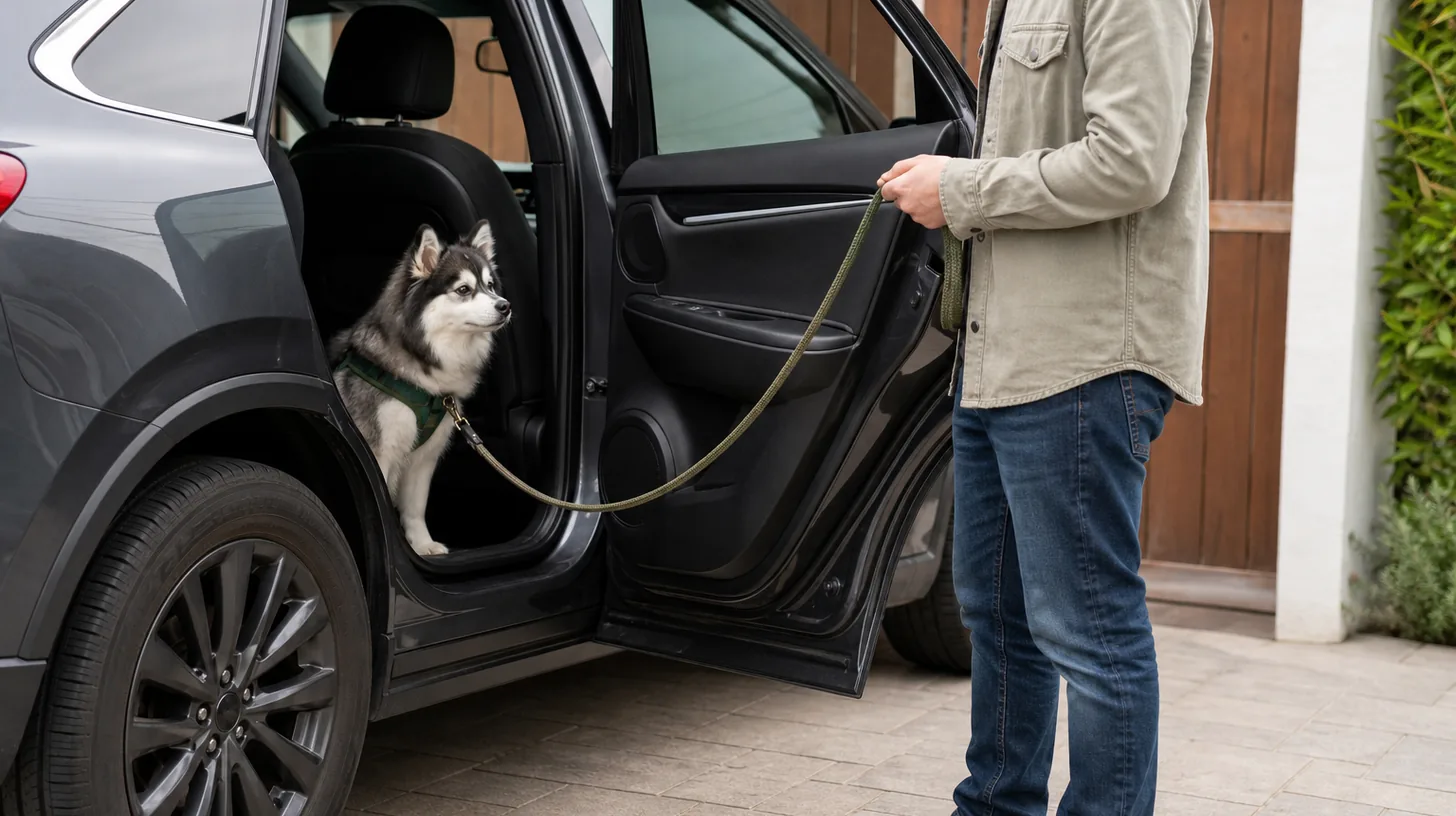
Direct answer: Park in a quiet enclosed driveway or other legal low-risk area, switch off the vehicle and secure the Pomsky before any door opens. Attach and verify the leash inside the car. Open the exit door only an inch or two while maintaining physical control; close it smoothly if the dog surges. Reward a brief pause inside, widen the opening gradually and give one release cue for a controlled step down on the safe side. Never practice beside moving traffic, and never rely on the wait instead of a harness, carrier, leash and adult door control.
This page teaches the precise pause-and-release skill at a parked vehicle exit; loading/unloading is the full operational checklist, exterior-door wait covers buildings, and curb pause applies during walks. Park in a quiet enclosed driveway or other legal low-risk area, switch off the vehicle and secure the Pomsky before any door opens. Attach and verify the leash inside the car. Open the exit door only an inch or two while maintaining physical control; close it smoothly if the dog surges. Reward a brief pause inside, widen the opening gradually and give one release cue for a controlled step down on the safe side. Never practice beside moving traffic, and never rely on the wait instead of a harness, carrier, leash and adult door control. This guide is limited to reward-based skill building in a controlled setup. It does not make a medical, temperament or guaranteed-behavior claim.
Direct answer
Park in a quiet enclosed driveway or other legal low-risk area, switch off the vehicle and secure the Pomsky before any door opens. Attach and verify the leash inside the car. Open the exit door only an inch or two while maintaining physical control; close it smoothly if the dog surges. Reward a brief pause inside, widen the opening gradually and give one release cue for a controlled step down on the safe side. Never practice beside moving traffic, and never rely on the wait instead of a harness, carrier, leash and adult door control.
The reader task is specific: Secure the Pomsky before opening a parked vehicle, attach and verify the leash inside, crack the door only while maintaining physical control, reward a brief pause, give one release cue for a controlled step down to a safe side, and close and reset without correction if the dog rushes. Keep the nearest owner pages separate when the real problem is prevention, release, equipment fit, confinement, travel management or professional care.
Choose a Stationary Low-Risk Location
Use an enclosed driveway or similarly controlled legal area, never a roadside, fueling lane or active parking aisle.
For pomsky car-exit wait and release training, this checkpoint passes only when the Pomsky can complete the described step voluntarily and recover without crowding, restraint or repeated prompting. Place reinforcement where it supports the next safe setup. Poor placement can create crowding, turning, rushing or fixation even when the marker timing was accurate. Do not add the next choose a stationary low-risk location variable until that observable criterion is repeatable.
Secure the Pomsky Before the Door
Confirm carrier or restraint status and attach the fitted leash while every vehicle door remains closed.
For pomsky car-exit wait and release training, this checkpoint passes only when the Pomsky can complete the described step voluntarily and recover without crowding, restraint or repeated prompting. End while the Pomsky can still choose the behavior. Repetition after fatigue, frustration or avoidance teaches a different pattern than the skill described here. Do not add the next secure the pomsky before the door variable until that observable criterion is repeatable.
Select the Safe Exit Side
Use the side away from traffic, heat, bicycles, loose dogs and other immediate hazards.
For pomsky car-exit wait and release training, this checkpoint passes only when the Pomsky can complete the described step voluntarily and recover without crowding, restraint or repeated prompting. Use management for real-life risk while training remains incomplete. A cue does not replace doors, barriers, fitted equipment, adult supervision or veterinary care. Do not add the next select the safe exit side variable until that observable criterion is repeatable.
Open the Door One Inch
Create a small visual gap while an adult controls the door and the leash remains short enough for safety but not tight.
For pomsky car-exit wait and release training, this checkpoint passes only when the Pomsky can complete the described step voluntarily and recover without crowding, restraint or repeated prompting. Write direct observations rather than motive labels. Feet, head position, distance, latency, release and recovery are more useful than calling the dog stubborn or dominant. Do not add the next open the door one inch variable until that observable criterion is repeatable.
Close Smoothly After a Surge
Return the door to closed without slamming, scolding or pulling the Pomsky backward.
For pomsky car-exit wait and release training, this checkpoint passes only when the Pomsky can complete the described step voluntarily and recover without crowding, restraint or repeated prompting. Generalization is a new lesson. Change location only after the starting setup remains predictable, and return to an easier criterion in every unfamiliar place. Do not add the next close smoothly after a surge variable until that observable criterion is repeatable.
Reward a Brief Interior Pause
Mark one second of staying inside before increasing the opening or adding duration.
For pomsky car-exit wait and release training, this checkpoint passes only when the Pomsky can complete the described step voluntarily and recover without crowding, restraint or repeated prompting. Stop rules protect the learner and the evidence. Pain, startle, guarding, panic, equipment failure or repeated avoidance requires a different plan, not a harder repetition. Do not add the next reward a brief interior pause variable until that observable criterion is repeatable.
Widen the Opening Gradually
Change door width while location, leash handler and exit side remain the same.
For pomsky car-exit wait and release training, this checkpoint passes only when the Pomsky can complete the described step voluntarily and recover without crowding, restraint or repeated prompting. Set a pass condition before the repetition begins. Record the starting position, the exact cue or object movement and the first response that earned reinforcement. Do not add the next widen the opening gradually variable until that observable criterion is repeatable.
Give One Release for Step-Down
Say the release once and guide a controlled exit to clear stable footing without jumping across people.
For pomsky car-exit wait and release training, this checkpoint passes only when the Pomsky can complete the described step voluntarily and recover without crowding, restraint or repeated prompting. Keep the environment easier than the final use case. Stable footing, an open exit and one adult handler make errors observable without forcing another attempt. Do not add the next give one release for step-down variable until that observable criterion is repeatable.
Reset Equipment Before Repetition
Close the door, check leash routing and allow recovery rather than cycling rapid exits.
For pomsky car-exit wait and release training, this checkpoint passes only when the Pomsky can complete the described step voluntarily and recover without crowding, restraint or repeated prompting. Change only one variable after three calm successes. Duration, distance, object position, caregiver posture and environmental distraction should not increase together. Do not add the next reset equipment before repetition variable until that observable criterion is repeatable.
Stop When the Environment Changes
End practice for traffic, heat, equipment failure, fear, repeated rushing or any loss of adult control.
For pomsky car-exit wait and release training, this checkpoint passes only when the Pomsky can complete the described step voluntarily and recover without crowding, restraint or repeated prompting. A reset is information, not correction. Return equipment and bodies to the starting picture, wait for ordinary movement and make the next repetition easier. Do not add the next stop when the environment changes variable until that observable criterion is repeatable.
Training record
Record the date, location, setup and reward used for pomsky car-exit wait and release training. Track the first three checkpoints (Choose a Stationary Low-Risk Location, Secure the Pomsky Before the Door, Select the Safe Exit Side), the middle progression (Open the Door One Inch, Close Smoothly After a Surge, Reward a Brief Interior Pause, Widen the Opening Gradually) and the final safety checks (Give One Release for Step-Down, Reset Equipment Before Repetition, Stop When the Environment Changes). Note latency, repetitions, release quality and recovery in direct language. A successful record also documents when the session ended early.
When to pause or get help
The risk boundary for this page is vehicle exit escape traffic and equipment safety. Stop for pain, lameness, breathing change, guarding, fear, a bite or snap, equipment failure, loss of physical control or a sudden change from the Pomsky's ordinary behavior. Use a veterinarian for health questions and a qualified reward-based professional when the setup cannot be completed without conflict or distress.
Keep the skill distinct
This page teaches the precise pause-and-release skill at a parked vehicle exit; loading/unloading is the full operational checklist, exterior-door wait covers buildings, and curb pause applies during walks. Review that boundary before changing the page or combining exercises. The useful outcome is one clear voluntary behavior with a reliable release and safe management around it, not a staged demonstration or proof that the cue works in every setting.
Sources reviewed
Each source is used only for the claim scopes listed below. None establishes a guaranteed Pomsky outcome or replaces individual professional assessment.
- American Veterinary Society of Animal Behavior: Humane Dog Training Position Statement - Supports: reward-based training; aversive-method risk; behavior change principles. Limit: Does not guarantee outcomes for an individual dog.
- American Animal Hospital Association: Lifestyle and Safety Assessment - Supports: appropriate confinement; leash, collar and harness planning; lifestyle-specific safety review. Limit: Equipment selection must account for the individual dog's anatomy, behavior, health, and environment.
- American Animal Hospital Association: How Can I Discourage My Dog From Running Away? - Supports: secure fencing; leash use; recall foundations; escape-route checks; appropriate activity. Limit: No recall cue or fence design guarantees that an individual dog cannot escape.